


Listen to the article
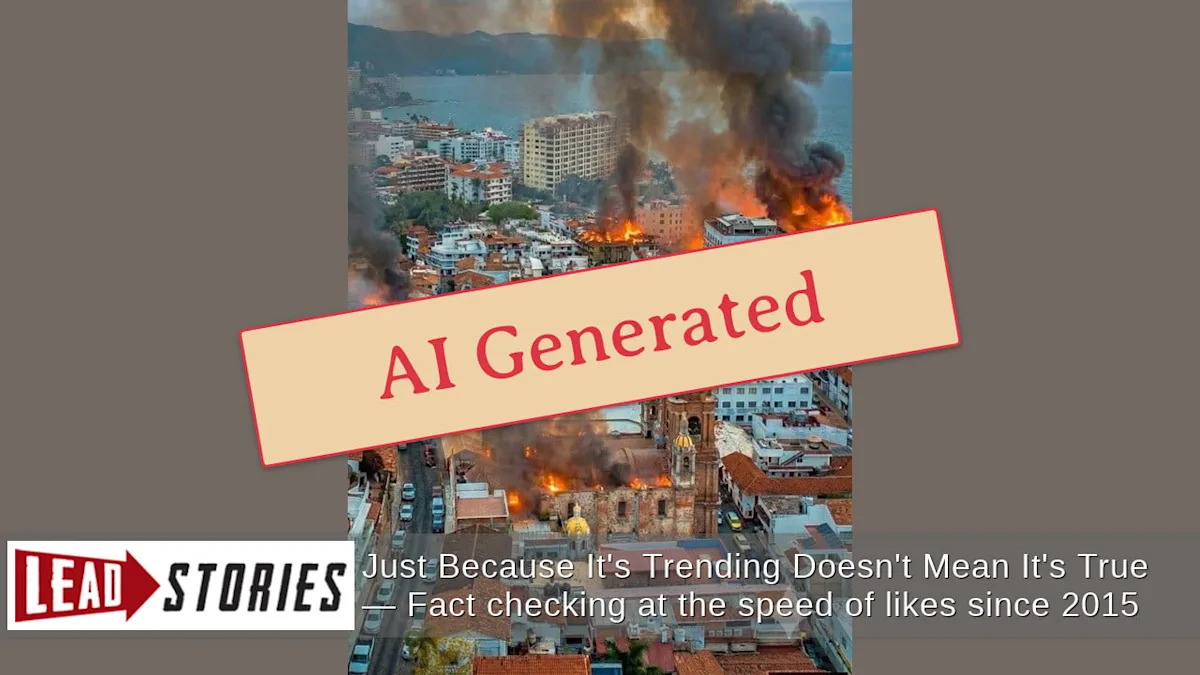
In the wake of drug lord Nemesio Oseguera’s death, a manipulated image circulating on social media falsely depicts Puerto Vallarta in flames, digital forensic experts confirm.
Multiple verification tools have identified the viral panoramic image, which purports to show widespread fires across the popular Mexican resort town, as an AI-generated fake. The manipulated image began spreading on February 22 following unrest that erupted after the killing of Oseguera, one of Mexico’s most powerful cartel leaders.
The Spanish-language post accompanying the doctored image claimed to show “a beautiful panorama of Puerto Vallarta, Jalisco” during what it described as “narco-blockades.” The caption continued with political commentary, blaming Mexico’s ruling Morena party, including former president Andrés Manuel López Obrador (often known as AMLO) and his successor Claudia Sheinbaum for allowing organized crime to flourish.
“There is the consequence of tolerating the expansion of organized crime’s power: They know they can sow terrorism with impunity,” the post alleged.
However, technical analysis reveals the image was created using artificial intelligence. When the image was processed through HiveModeration, a digital content verification platform, it was flagged as synthetic content. A second detection tool, AI or Not, assessed with 100% certainty that the image was AI-generated.
The original image appears to have been a Google Earth view of Puerto Vallarta that was digitally modified to add flames and smoke plumes to buildings throughout the cityscape. This manipulation created a dramatic but entirely fabricated scene of widespread destruction.
This misinformation emerges at a particularly sensitive time for Mexico’s tourism industry. Puerto Vallarta, located in Jalisco state on Mexico’s Pacific coast, is one of the country’s premier vacation destinations, welcoming millions of international tourists annually. False depictions of violence can have immediate economic impacts on communities dependent on tourism revenue.
The death of Oseguera, known as “El Mencho,” who led the powerful Jalisco New Generation Cartel (CJNG), has indeed triggered security concerns across several Mexican states where the organization maintains a strong presence. However, authorities have been quick to distinguish between actual security situations and misinformation designed to amplify fear.
This incident highlights a growing trend in crisis misinformation, where AI-generated imagery is deployed during real-world events to exaggerate conditions or influence public perception. Security analysts note that such digital manipulation is becoming increasingly sophisticated and difficult for average social media users to identify without specialized tools.
Mexican officials have urged citizens and tourists to rely on official sources for information about security situations rather than unverified social media posts. Tourism authorities in Puerto Vallarta have also issued statements confirming that the city continues to operate normally despite the circulation of false imagery.
Digital literacy experts point to several telltale signs that could help viewers identify the image as fake, including inconsistent lighting patterns across buildings, unnaturally uniform flame patterns, and perspective inconsistencies typical of AI-generated content.
The spread of this fabricated image underscores the challenges facing both authorities and social media platforms in combating misinformation during sensitive security situations. While platforms have implemented various measures to flag potentially misleading content, the rapid creation and distribution of convincing AI-generated imagery continues to outpace detection methods.
As Mexico navigates the aftermath of Oseguera’s death and the potential reorganization of cartel power structures, distinguishing between actual security threats and manufactured misinformation remains crucial for both citizens and visitors to affected regions.
Fact Checker
Verify the accuracy of this article using The Disinformation Commission analysis and real-time sources.

8 Comments
I’m glad the experts were able to confirm this as an AI-generated fake. It’s unsettling how convincing these types of manipulated images can be. Verifying the source and authenticity of visuals is crucial, especially on sensitive topics.
Cartel violence and its impact on communities in Mexico is a serious issue that deserves nuanced, fact-based reporting. I appreciate the diligent work done to debunk this misleading image and provide the correct context.
The political commentary accompanying the doctored image is concerning. It’s important to separate verified information from unsubstantiated claims, especially around sensitive topics like organized crime and government policies.
Agreed. Responsible reporting requires keeping personal biases and agendas out of the analysis. Sticking to the facts is the best way to inform the public accurately.
The use of AI-generated imagery to spread false narratives is worrying. I’m glad the experts were able to identify this as a fake. It’s important to be cautious about visuals shared online and verify their authenticity before drawing conclusions.
Absolutely. With the increasing sophistication of AI tools, we’ll likely see more of these types of manipulated images in the future. Vigilance and fact-checking will be key to staying informed.
Interesting fact-check on the doctored image of Puerto Vallarta. It’s concerning how disinformation can spread so quickly on social media, especially around sensitive issues like organized crime. Fact-checking is crucial to combat the spread of such manipulated content.
This is a good reminder of the need for digital literacy and critical thinking when consuming online content. Fact-checking initiatives play a vital role in identifying and correcting misinformation.