


Listen to the article
Old Content, New Contexts: How Recycled Videos Spread Misinformation
Recycling old content has become a proven strategy for spreading political propaganda across the ideological spectrum, particularly during times of crisis and conflict when authentic footage may be scarce.
“Especially in times of crisis and conflicts, old videos and photos resurface on social media falsely presented in a current context,” explains Brittani Kollar, who leads media literacy efforts at the Poynter Institute, a U.S. nonprofit organization supporting fact-checking, training, and media criticism.
Kollar notes that the scarcity of video footage during conflicts creates a perfect environment for manipulated content to flourish. “That’s why manipulated or fake videos often fill that gap, even when they’ve already been used in other contexts or previously identified as false,” she told DW.
This phenomenon crosses political boundaries and appears in various contexts, from immigration enforcement to geopolitical tensions and civil unrest.
Misleading Immigration Enforcement Videos
A particularly deceptive example involves a TikTok video showing what appears to be a teenager on a bicycle being hit by a police car, pushed to the ground, and then taken away. However, closer analysis reveals this is actually two separate incidents spliced together to create a misleading narrative.
The first segment shows a teenager wearing dark pants speaking English on a sunny day, while the second shows another youth wearing camouflage pants speaking Spanish on snow-covered streets. These are completely unrelated incidents from different times and locations.
The first clip dates from April 2, 2025, in Deerfield Beach, Florida, showing police officers stopping teenagers riding bicycles. The second segment shows a scene from Minneapolis on January 13, 2026, where Immigration and Customs Enforcement (ICE) officers detain a teenager.
By combining these unrelated incidents, the video creates a false narrative about ICE enforcement actions, capitalizing on the contentious nature of immigration policy in the United States.
False Claims About Military Deployments
Geopolitical tensions also provide fertile ground for recycling old footage. In January 2026, following renewed statements by U.S. President Donald Trump about American interest in acquiring Greenland, a post on X claimed that dozens of U.S. Air Force F-22 and F-16 fighter jets had arrived there.
The video showed fighter jets taking off from runways surrounded by snow-covered mountains, seemingly supporting the claim of a military buildup related to the Greenland situation. However, a reverse image search revealed the footage actually showed the U.S. Air Force Joint Base Elmendorf-Richardson in Alaska, and originated in 2022.
The video had been mirrored to make identification more difficult, and the user’s profile—featuring a QAnon-associated lion’s head and a quote about Trump—provided additional context about the motivations behind spreading this misinformation.
One Protest, Multiple Narratives
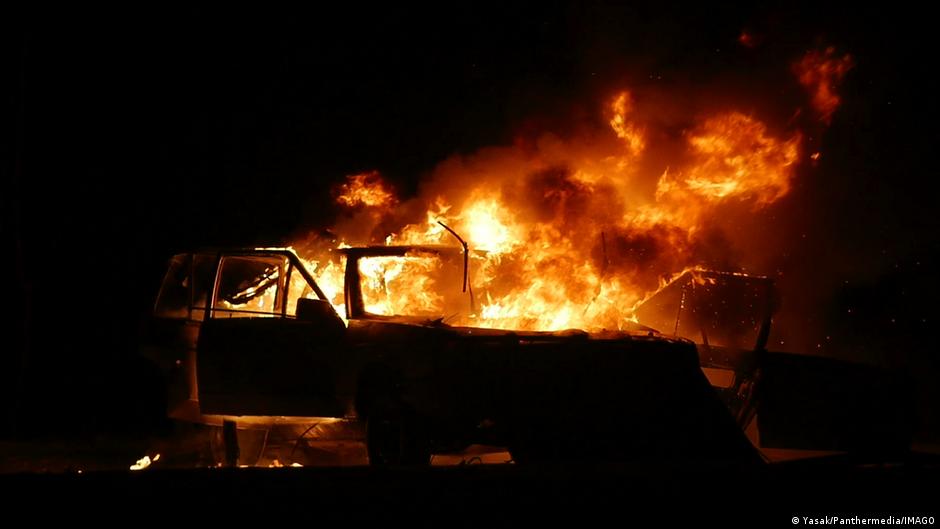
Perhaps the most versatile example of content recycling involves footage of burning cars and masked figures from protests in Thessaloniki, Greece. The video was originally posted on a Greek Instagram account in November 2025, documenting protests following an anti-establishment concert by rapper Alexis Lanaras.
By January 2026, this same footage had been repurposed to support multiple conflicting narratives. One X user claimed it showed protests in Iran, another said it depicted “millions” of Americans demonstrating against Trump’s policies, and yet another presentation framed it as evidence of New Year’s Eve riots in Germany.
Each reuse targeted a different audience with its own political concerns, showing how versatile a single piece of footage can be when stripped of its original context.
The Role of Media Literacy
Tommaso Canetta, a disinformation expert at the European Digital Media Observatory (EDMO), explains that such recycling serves strategic purposes. “Political actors want to strengthen consensus for their positions,” he told DW. “The use of false content triggers a strong emotional response in viewers, driving them to extreme positions and making rational discussion with nuanced viewpoints more difficult.”
Social media algorithms further amplify the problem by promoting engaging content regardless of its accuracy. “Because social media algorithms are designed to highlight the most-viewed videos, fake videos go viral,” Kollar noted.
The proliferation of recycled and misrepresented content can lead to broader skepticism about all media, making it difficult for the public to distinguish reliable information from manipulation. While there is no simple solution to this growing challenge, developing media literacy skills—including critical evaluation of sources, context awareness, and verification techniques—has become increasingly essential for navigating today’s information landscape.
For those looking to verify questionable content, reverse image searches, analyzing language and environmental details in videos, and cross-referencing claims with reliable media reports can provide important clues about authenticity and context.
Fact Checker
Verify the accuracy of this article using The Disinformation Commission analysis and real-time sources.

20 Comments
The article highlights an important issue around the spread of misinformation through manipulated videos. It’s a growing problem that requires media literacy and critical thinking to combat.
Agreed. Fact-checking and source verification are key skills in the digital age where content can be so easily repurposed.
The examples in this article demonstrate the importance of critical thinking and fact-checking when it comes to online videos and images, especially during times of crisis or conflict.
Agreed. Maintaining a skeptical eye and verifying sources is crucial to avoid falling victim to political propaganda.
This article sheds light on a troubling trend of using recycled videos for political propaganda. It underscores the importance of media literacy and fact-checking in the digital age.
Yes, the ability to critically evaluate online content is an essential skill in today’s information landscape.
The examples provided in the article demonstrate how easily misinformation can spread through the reuse of old videos. It’s a good wake-up call to be more vigilant about verifying sources and context.
Agreed. Combating the spread of manipulated content requires a combination of media literacy and fact-checking.
The article raises important points about the dangers of recycled video content being used for political agendas. It’s a good reminder to always question the context and source of online media.
Yes, maintaining a healthy skepticism towards seemingly authentic footage is crucial in the era of misinformation.
Interesting look at how recycled video content can be used to push political narratives. It’s a good reminder to always fact-check sources and be wary of videos presented out of context.
Absolutely. Verifying the original context and source is crucial to avoid falling for misinformation campaigns.
This article sheds light on a troubling phenomenon of repurposing old videos for political propaganda. It underscores the need for media literacy and fact-checking to combat the spread of misinformation.
Absolutely. Verifying the original context and source of online content is key to avoiding being misled by manipulated media.
Recycling old videos to push new political narratives is a concerning trend. This article highlights the importance of critical thinking and verifying information, especially during times of crisis or conflict.
Absolutely. Fact-checking and source verification are essential skills in the digital age to avoid being misled by manipulated content.
Recycling old videos to push new political narratives is a concerning trend that highlights the need for media literacy and fact-checking. This article provides a valuable perspective on the issue.
Yes, the ability to critically evaluate online content is an essential skill in today’s information landscape.
Recycling old content to push new agendas is a concerning practice. It’s a good reminder to be skeptical of videos and images shared online, especially during times of crisis or conflict.
Absolutely. Verifying the authenticity and original context of media is crucial to avoid being misled.