


Listen to the article
In a significant development on the international trade front, sources indicate that the United States and China are nearing a comprehensive trade agreement that could reshape economic relations between the world’s two largest economies. The potential deal comes amid years of tariffs, tensions, and economic competition that has disrupted global supply chains and impacted trillions of dollars in trade.
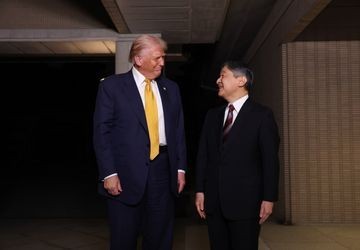
President Donald Trump, currently on a diplomatic tour through Asia, is reportedly prioritizing trade negotiations with Beijing as a central component of his administration’s foreign policy agenda. Fresh from appearances at the ASEAN summit in Malaysia, Trump is scheduled to continue discussions on trade matters during the upcoming APEC meetings in South Korea following his current visit to Japan.
Trade experts suggest that any new agreement could significantly alter the tariff structure implemented during previous years, which has affected hundreds of billions of dollars worth of goods flowing between the two economic superpowers. The existing tariffs have created price pressures for American consumers while simultaneously providing some protection for domestic manufacturers.
“This potential deal represents a critical juncture in U.S.-China economic relations,” said Scott Bessent, a prominent economist specializing in international trade. “We’re looking at negotiations that will impact everything from manufacturing jobs to consumer prices to global supply chain configurations.”
The stakes of these negotiations extend far beyond bilateral relations. A restructured trade agreement would reverberate throughout global markets, potentially alleviating some of the supply chain disruptions that have plagued industries worldwide. Many multinational corporations have spent the past several years reconfiguring their production networks to navigate around tariff barriers and geopolitical uncertainties.
The Chinese market represents an enormous opportunity for American businesses, with its expanding middle class and growing consumer economy. However, longstanding issues including intellectual property protection, forced technology transfers, and market access have complicated trade relations between Washington and Beijing.
Market analysts are closely watching these developments, with several major indices showing volatility as investors attempt to predict the economic impact of any potential agreement. Key industrial sectors including technology, agriculture, and manufacturing stand to be particularly affected by changes to the trading relationship.
“What we’re potentially seeing is a recalibration of economic relations rather than a complete reset,” noted Wei Lin, director of the Center for International Trade Studies. “Both sides recognize the mutual benefits of stable trade while maintaining their strategic positions on key issues.”
The negotiations come against a backdrop of broader geopolitical competition between the United States and China across multiple domains, including technology development, regional influence, and military capabilities. Economic relations remain one of the most tangible and immediately impactful dimensions of this complex relationship.
American manufacturing interests have expressed mixed reactions to the potential deal. While some industry groups welcome the prospect of greater market access in China, others fear that reducing tariff protections could reverse gains made in reshoring production to the United States.
The talks also reflect a gradual evolution in how both nations view their economic interdependence. Rather than pursuing complete decoupling, as some had advocated during periods of heightened tension, the current approach suggests a more nuanced strategy of managed competition in critical sectors while maintaining trade cooperation in others.
Congressional leaders from both parties are monitoring the negotiations closely, with several key lawmakers emphasizing the importance of enforcement mechanisms in any new agreement. Previous trade deals have faced criticism over implementation challenges and verification difficulties.
As President Trump continues his diplomatic engagements across Asia, the potential trade agreement remains a fluid situation, with final details still subject to negotiation and approval processes in both countries. Financial markets and global supply chains will likely experience continued uncertainty until the full parameters of any deal are officially announced and implemented.
Fact Checker
Verify the accuracy of this article using The Disinformation Commission analysis and real-time sources.

14 Comments
With tensions high, reaching a comprehensive trade agreement won’t be easy. But the potential upsides, like reduced economic uncertainty and restored supply chain reliability, make it a worthwhile goal. I’ll be interested to see the details as they emerge and how it affects industries like energy and mining.
Absolutely, reducing that economic uncertainty and restoring more predictable supply chains would be hugely beneficial, especially for capital-intensive industries like mining that rely on stable trade flows.
As a mining and commodities investor, I’ll be closely watching how this trade deal impacts the flow of key raw materials like copper, lithium, and rare earths between the two countries. Any changes to tariffs or supply chains could have major ripple effects on prices and availability of these critical resources.
Good point. The mining and materials sectors are so intertwined with US-China trade dynamics. Resolving some of the long-standing tensions could provide more stability and predictability for commodity markets.
This is certainly a high-stakes negotiation with major implications for the global economy. As an energy and mining analyst, I’ll be closely monitoring how the final trade deal, if reached, impacts commodity flows, prices, and investment decisions in my sectors. Reducing tariffs and easing trade tensions would be a positive step, but the details will be critical.
That’s a great point. The details of any agreement will be crucial, especially for industries like energy and mining that rely heavily on international trade and cross-border supply chains. Carefully watching how it all shakes out will be essential.
As an investor in mining and commodities equities, I’m very interested to see how this potential US-China trade deal might impact the outlook for those sectors. Reduced tariffs and more stable trade relations could boost demand and investment, but there are still a lot of moving parts. I’ll be closely monitoring any developments.
Absolutely, the implications for mining and commodities companies could be significant. Easing trade tensions and restoring more predictable supply chains would be a welcomed development for those industries and their investors.
Fascinating to see the US and China potentially reaching a major trade deal after years of tensions and tariffs. There’s certainly a lot at stake – trillions in trade flows and the overall global economic landscape could shift significantly. I’m curious to see how the details shake out and what the final agreement might entail.
Absolutely, the geopolitical and economic ramifications of this potential deal are huge. It will be interesting to see if they can overcome long-standing disputes and find common ground.
From a mining and commodities perspective, I’m curious to see how this potential trade agreement might impact things like access to critical minerals, pricing dynamics, and investment flows. There are a lot of complex issues at play, but restoring more stability in US-China trade relations would be a welcome development.
Absolutely. Stability and predictability in the flow of key raw materials is essential for mining and industrial companies to make long-term investment decisions. Anything that can reduce uncertainty would be beneficial.
This is certainly a high-stakes negotiation with far-reaching implications. I’m skeptical that the two sides will be able to fully resolve all their differences, but even a partial deal could provide some much-needed relief. As an observer, I’ll be watching closely to see how it plays out.
Good point. Even an incremental deal would be a positive step, as the current tariffs and tensions have created a lot of disruption and uncertainty. Gradual progress is likely better than no progress at all.