


Listen to the article
U.S. Extends $20 Billion Currency Swap to Argentina Amid Financial Turmoil
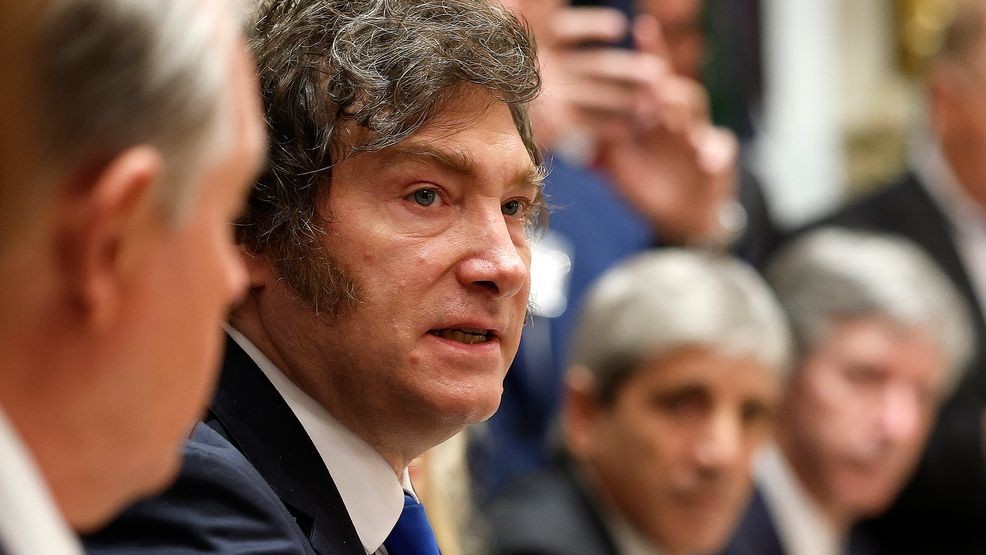
The United States has agreed to a $20 billion currency swap with Argentina’s central bank, marking a significant financial intervention as the South American nation struggles to avoid economic collapse. The announcement came during Argentine President Javier Milei’s first visit to the White House, signaling the Trump administration’s strategic interest in the region.
In an interview with Fox News, Treasury Secretary Scott Bessent emphasized that the move is designed to prevent China from gaining further economic influence in Argentina. “We wanted to make sure China doesn’t tighten its grip on Argentina’s economy,” Bessent stated, highlighting concerns about growing Chinese financial power throughout Latin America.
The Treasury Secretary warned that Argentina’s economic failure could have cascading effects on global markets and threaten stability throughout the Western Hemisphere—a concern that apparently justified the substantial financial commitment.
The currency swap represents one of the most significant U.S. financial interventions in Latin America in decades. It comes at a critical moment for Argentina, where Milei’s administration has been implementing aggressive economic reforms to combat hyperinflation and restore fiscal stability since taking office.
China’s expanding financial influence across Latin America has become a major concern for U.S. policymakers. The Asian superpower has strategically increased its presence in the region through loans, investments, and infrastructure projects as part of its global Belt and Road Initiative.
Venezuela stands as the most prominent example of Chinese financial entanglement in the region. According to data from the Council on Foreign Relations, Venezuela has received nearly $60 billion in Chinese state loans, primarily focused on energy and infrastructure development. These financial arrangements have helped sustain Venezuela’s authoritarian regime despite widespread economic collapse and international sanctions.
Bessent’s approach appears straightforward: provide financial support to Argentina before China can step in with its own offers. This preemptive strategy reflects growing concerns within the administration about Chinese influence in what the U.S. has traditionally considered its geopolitical backyard.
While international financial bailouts have been a tool of American foreign policy in the past, they have become less common in recent decades. The last comparable intervention occurred during the 1995 Mexican peso crisis, when the Clinton administration provided a $20 billion loan from the U.S. Treasury’s Exchange Stabilization Fund.
That crisis erupted shortly after President Ernesto Zedillo took office in Mexico, triggering rapid capital flight and fears of sovereign default. President Bill Clinton, facing a divided Congress, used executive authority to approve the emergency funding package.
The Mexican bailout ultimately proved financially successful for the United States. According to records from the Clinton Presidential Center, Mexico repaid the loan three years ahead of schedule, and the U.S. earned approximately $580 million in interest from the arrangement.
The Argentina currency swap demonstrates that the Trump administration is willing to deploy significant financial resources to counter Chinese influence in Latin America. It also reflects broader concerns about financial stability in emerging markets during a period of global economic uncertainty.
For Argentina, the financial lifeline provides breathing room as Milei’s government attempts to stabilize an economy suffering from decades of mismanagement, high inflation, and excessive debt. However, economic analysts note that currency swaps are temporary measures that don’t address Argentina’s fundamental structural economic challenges.
As President Milei continues his Washington visit, the currency swap agreement signals that despite the administration’s “America First” rhetoric, the United States remains willing to engage in significant financial diplomacy when strategic interests align with economic assistance.
Fact Checker
Verify the accuracy of this article using The Disinformation Commission analysis and real-time sources.

12 Comments
The US seems concerned about China’s growing influence in the region, which is understandable. However, this move could also be viewed as American meddling in Argentina’s affairs. I’m curious to see how the Argentinian public reacts to this intervention.
That’s a fair perspective. The US likely wants to maintain its economic dominance in Latin America and counter China’s rise, but there are always political sensitivities around such interventions. It will be interesting to see the local response in Argentina.
This currency swap highlights the complex geopolitical dynamics at play in the region. While the US may be motivated by concerns over China’s influence, it will be important to see if this intervention leads to tangible benefits for the Argentine people. Ultimately, the success of this move will depend on whether it catalyzes real economic progress.
Well said. Geopolitical maneuvering is often a factor in these types of financial interventions, but the true test will be whether it translates into meaningful, sustainable improvements for Argentina’s economy and citizens. The long-term impacts remain to be seen.
Interesting to see the US stepping in to prop up Argentina’s economy. While it may help in the short-term, I wonder if it’s really a sustainable solution or just kicking the can down the road. Argentina has struggled with financial stability for a long time.
You raise a good point. The US has a history of bailing out Latin American countries, but the underlying issues often remain unresolved. It will be crucial to see if this swap leads to meaningful structural reforms in Argentina’s economy.
The currency swap seems like a pragmatic move to stabilize Argentina’s economy and limit China’s influence in the region. However, I share the concern that it may not address the underlying structural issues that have plagued Argentina for years. Sustainable economic reform will likely require more than just short-term financial support.
Exactly. Temporary bailouts have historically done little to fix the deeper problems in Argentina’s economy. It will be critical for the US and Argentina to work together on meaningful policy changes and institutional reforms if they want to achieve lasting economic stability.
A $20 billion currency swap is a significant financial commitment. I wonder if this is part of a broader strategy to shore up US influence in the region or if it’s truly focused on Argentina’s economic stability. Geopolitics often plays a role in these types of decisions.
That’s a good point. The US likely has broader strategic interests at play beyond just Argentina’s economic troubles. Maintaining influence in Latin America is an ongoing priority, so this move could be viewed through that lens as well.
It’s interesting to see the Trump administration take such an active role in supporting Argentina’s economy. This seems like a departure from the more isolationist ‘America First’ rhetoric we’ve heard in the past. I wonder if it signals a shift in US foreign economic policy.
That’s a fair observation. The Trump administration has generally been more skeptical of international economic interventions, so this move does seem somewhat out of character. It will be worth watching to see if it represents a broader change in approach or is more narrowly focused on the Argentina situation.