


Listen to the article
In a significant development for higher education policy, seven out of nine major universities have formally rejected the Trump administration’s new campus initiative, known as the “Compact for Academic Excellence.” The widespread resistance comes as the Department of Education attempts to implement sweeping changes to university governance and curriculum standards.
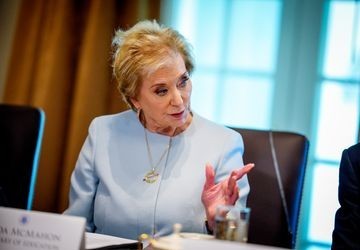
Education Secretary Linda McMahon, who unveiled the policy earlier this month during a Cabinet meeting at the White House, has faced immediate pushback from some of the nation’s most prestigious institutions. Harvard, Columbia, Yale, Stanford, Princeton, MIT, and the University of California system have all issued statements opposing the administration’s requirements.
“Academic freedom is not negotiable,” said Harvard University President in a statement released yesterday. “While we welcome constructive dialogue with the federal government, we cannot accept conditions that would fundamentally alter our institutional independence.”
The controversial policy would require participating universities to implement a standardized core curriculum, accept greater federal oversight of campus activities, and adopt specified speech codes. In exchange, institutions would receive priority consideration for federal research grants and protection from certain regulatory requirements.
Only two major universities—Liberty University and Hillsdale College—have signaled willingness to adopt the framework. Both institutions have historically maintained close ties to conservative policy initiatives.
The rejection comes amid growing tension between the administration and higher education institutions. Secretary McMahon has criticized what she calls “ideological monocultures” on American campuses, arguing that the new policy would restore intellectual diversity and prepare students for “real-world challenges.”
“We’re simply asking universities to honor their commitment to genuine intellectual diversity,” McMahon said during a press conference defending the initiative. “Institutions receiving billions in taxpayer dollars should be accountable to the American public.”
Critics of the policy, however, see it as governmental overreach. The American Association of University Professors called it “an unprecedented intrusion into academic self-governance” in a strongly-worded statement. Constitutional law experts have raised questions about potential First Amendment implications.
California Governor Gavin Newsom announced that his state would provide additional funding to University of California campuses to offset any potential federal funding reductions resulting from non-compliance. “We will not allow political pressure to compromise the educational mission of our world-class institutions,” Newsom stated.
The standoff highlights deeper divisions over the purpose and direction of American higher education. Conservative advocates have long argued that universities have drifted too far left politically, while academic leaders maintain that institutional autonomy is essential for research innovation and educational excellence.
Market analysts note that universities with large endowments like Harvard and Stanford are better positioned to weather potential funding challenges compared to smaller, more financially vulnerable institutions that may feel greater pressure to comply.
For students and families, the conflict creates uncertainty about future tuition costs and financial aid. Two universities—Harvard and Columbia—announced tuition freezes for the coming academic year, though their announcements did not explicitly connect these decisions to the policy dispute.
Department of Education officials indicated they would proceed with implementation despite the resistance, suggesting that non-participating universities might face increased scrutiny of their federal funding arrangements. Legal challenges to the policy are widely expected.
The confrontation represents one of the most significant clashes between the federal government and higher education institutions in decades, raising fundamental questions about academic independence and the proper relationship between universities and government.
Education policy experts suggest the dispute may ultimately be resolved through compromise provisions or legislative intervention, though the deeply entrenched positions on both sides make immediate resolution unlikely.
Fact Checker
Verify the accuracy of this article using The Disinformation Commission analysis and real-time sources.

7 Comments
I’m curious to learn more about the specific requirements of this policy and the rationale behind them. What problem is the administration trying to solve, and how would their proposed changes actually improve higher ed outcomes?
Those are good questions. The administration will need to provide a very compelling justification if they hope to overcome the strong opposition from leading universities on this matter.
This is an important issue that touches on the fundamental role and autonomy of universities in a free society. I’m glad to see these institutions standing up for their principles and academic freedom.
This policy seems like a clear overreach by the federal government. Universities must maintain their academic independence and resist these types of heavy-handed interventions that threaten core principles like free speech and curriculum autonomy.
I’m glad to see so many top universities pushing back against this misguided initiative. Preserving the integrity and independence of higher education institutions should be a top priority, not subjecting them to increased federal control.
Absolutely. Allowing the government to dictate campus policies and curriculum is a slippery slope that goes against the very purpose of universities as bastions of free and open inquiry.
While the administration may have good intentions, this policy appears to be an overreach that could undermine academic freedom. Universities must retain the ability to set their own standards and chart their own course.