


Listen to the article
UK Police Investigation of Offensive Username Claim Found to be False
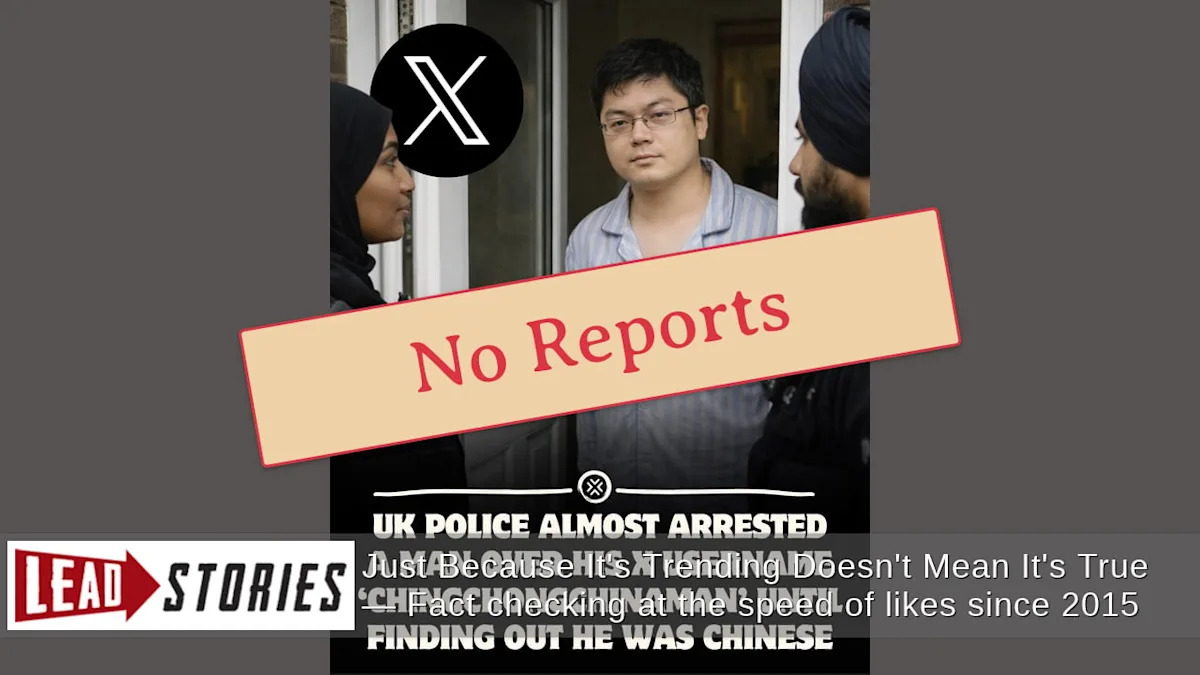
Claims that UK police investigated or attempted to arrest a man over a racially offensive X (formerly Twitter) username have been debunked, with no evidence supporting the viral social media narrative that spread across multiple platforms in March.
The allegation, which gained traction after appearing in a post on Meta’s Threads platform, suggested that British authorities had visited a man’s home to arrest him over a username containing the phrase “ChingChongChinaman,” only to abandon the case upon discovering the account owner was himself Chinese.
Digital forensics reveal the claim originated from a now-banned Reddit account using the handle “Subject-Mistake-5315.” The account posted what appeared to be a firsthand account of police visiting a residence over an offensive username complaint, but investigators found no corroborating evidence from any legitimate news sources or police reports.
The viral post attempted to frame the alleged incident as part of a wider “crackdown” by UK authorities on Elon Musk’s X platform, playing into ongoing tensions between British law enforcement and social media companies over content moderation and online speech regulations.
“The UK continues their crackdown on Elon Musk’s X, this time they arrived at a man’s house to arrest him for his ‘offensive’ username after receiving a complaint,” read the Threads post, which included screenshots purportedly showing the original Reddit post about the incident.
The UK’s approach to policing online content has indeed become more stringent in recent years. The National Online Hate Crime Hub, established to coordinate responses to digital hate speech across various police forces, has been tasked with investigating reports of online abuse that cross legal thresholds.
However, comprehensive searches of reputable news databases, including Google News and Yahoo News archives, yielded no legitimate reporting about this specific incident. The only mentions were from gaming websites that simply repeated the claims from social media without independent verification.
The fabricated story appears designed to ignite debate around free speech limitations and law enforcement priorities in the United Kingdom. It comes amid legitimate discussions about the balance between combating harmful online content and protecting freedom of expression.
In recent years, UK authorities have faced both criticism and support for their handling of online hate speech cases. Critics argue some investigations constitute overreach into protected speech, while supporters maintain that targeted harassment and hate speech require appropriate law enforcement responses.
The National Online Hate Crime Hub, contacted for comment on the viral claim, did not provide an immediate response. The unit typically does not comment on specific cases unless formal charges are filed.
This incident highlights the growing challenge of misinformation spreading through social media platforms. Screenshots of purported firsthand accounts can quickly gain traction and be shared across multiple platforms before fact-checkers can verify their authenticity.
Digital literacy experts emphasize the importance of seeking verification from multiple credible sources before accepting sensational claims, particularly those involving law enforcement actions that would normally generate official records or legitimate news coverage.
As online speech regulations continue to evolve in the UK and globally, the tension between content moderation and free expression remains a contentious issue. However, this particular claim appears to be fabricated, with no evidence supporting the narrative that police investigated anyone over the offensive username in question.
Fact Checker
Verify the accuracy of this article using The Disinformation Commission analysis and real-time sources.

10 Comments
If this story proves to be unfounded, it’s another example of the dangers of misinformation going viral. I hope thorough investigations can uncover the truth and stem the spread of false narratives.
Absolutely. Misinformation can have serious consequences, so it’s critical that we strive to verify claims, especially those that seem sensational or politically charged, before amplifying them.
This seems like another case of misinformation spreading quickly on social media. I’ll be interested to see if any legitimate news reports emerge to corroborate or refute the claims. Fact-checking is crucial these days.
Agreed. With the prevalence of misinformation online, it’s important to verify claims before accepting them as true. Careful scrutiny of the evidence is warranted in this case.
Interesting to see UK authorities investigate potentially offensive usernames, though the lack of evidence raises questions about the veracity of this claim. I wonder if there are clearer guidelines around acceptable usernames on social platforms to avoid such disputes.
You make a good point. Without concrete evidence, it’s difficult to determine the accuracy of this story. Clear policies on usernames could help avoid these kinds of controversies in the future.
The alleged police investigation into an offensive username raises concerns about free speech and content moderation on social platforms. It will be important to find the right balance between preventing harm and preserving individual expression.
That’s a complex issue with valid arguments on both sides. Reasonable people can disagree on where to draw the line, but transparency and due process are crucial when it comes to potentially restricting online speech.
While the lack of evidence is concerning, I’m glad the authorities are taking potentially offensive usernames seriously. Social media platforms need to have clear rules and enforcement to maintain inclusive and respectful communities.
That’s a fair perspective. Striking the right balance between free expression and moderation is an ongoing challenge, but upholding community standards is important, even if the details of this particular case remain unclear.