


Listen to the article
False Image of UAE President in Epstein Files Debunked
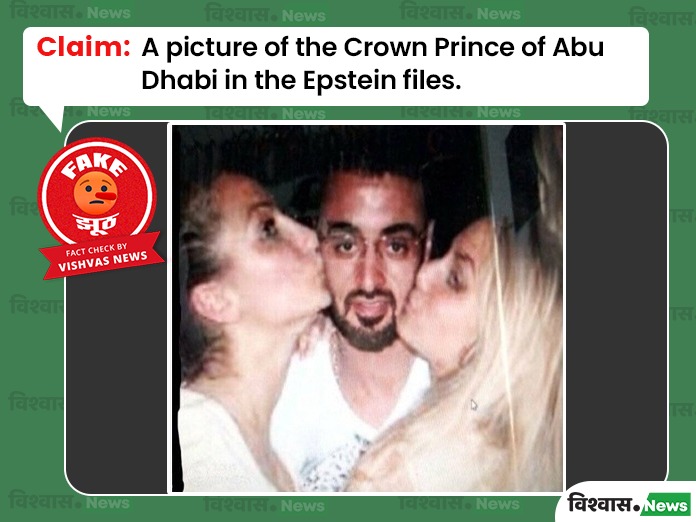
A digitally manipulated image falsely claiming to show UAE President Mohammed bin Zayed Al Nahyan with two women in connection with the Jeffrey Epstein case has been exposed as a sophisticated fake. Fact-checking organization Vishvas News conducted a comprehensive investigation that conclusively determined the viral image circulating on social media has no connection to the recently released Epstein files.
The investigation revealed that the original photograph, which dates back to 2012, actually shows an entirely different individual identified as Chamakh. The image first appeared on a Facebook page called “Save Morocco” on January 25, 2012, and was later featured in Moroccan sports news publications in 2013 and 2014 in connection with the Moroccan Football Federation.
Vishvas News employed digital forensic techniques, including reverse image searches through Google Lens and careful comparison of the original and manipulated photos. The side-by-side analysis clearly showed how the original subject’s face had been replaced with that of the UAE President.
The false claim gained traction when Facebook user Gaurav Pandey, who has approximately 13,000 followers, shared the doctored image on February 1, 2026, with the caption: “Abu Dhabi Crown Prince Mohammed bin Zayed Al Nahyan has also been caught in the Epstein files… He used to visit the private island on Epstein’s invitation for enjoyment. #EpsteinFiles.”
Senior international affairs correspondent Jai Prakash Ranjan, from Vishvas News’s associate organization Dainik Jagran, also confirmed the fraudulent nature of the image during the investigation.
The fabricated post exploits significant public interest in the Epstein case files. In recent months, the U.S. Department of Justice has released nearly three million pages of documents related to the investigation of Jeffrey Epstein, who was convicted of sexual offenses before his death in 2019. These files include texts, videos, and photographs that detail connections between Epstein, his associate Ghislaine Maxwell, and numerous high-profile individuals.
According to the BBC, “Even six years after his death, the Epstein files continue to cause trouble for governments, leaders, businessmen, and prominent personalities worldwide.” The release of these documents has fueled intense speculation and, unfortunately, created a climate ripe for misinformation.
This incident highlights the increasing sophistication of digital manipulation tools and the challenges in combating false information in the digital age. Images can be seamlessly altered to create convincing but entirely fictitious scenarios that exploit current news topics and public figures.
The case also demonstrates the crucial role of fact-checking organizations in verifying viral content, particularly when it involves high-profile individuals and sensitive international relationships. Without proper verification, such manipulated images can damage reputations, inflame diplomatic tensions, and mislead public discourse.
Social media users are encouraged to approach sensational claims with caution, especially those related to prominent figures in connection with controversial cases. Verifying information through reliable sources before sharing is essential to prevent the further spread of misinformation.
Fact Checker
Verify the accuracy of this article using The Disinformation Commission analysis and real-time sources.

13 Comments
The in-depth investigation into the origins and manipulation of this photo is really commendable. It’s a great example of the importance of skilled fact-checking, especially when dealing with high-profile and sensitive topics. Kudos to the team for their thorough work.
This is a sobering reminder of the need to approach viral content, even when it seems to confirm our biases, with a critical eye. The level of digital manipulation shown here is quite impressive. Rigorous fact-checking is essential to maintaining trust in media and combating the spread of misinformation.
Absolutely. In the age of social media, we have to be vigilant about verifying the authenticity of information, no matter how convincing it may seem. Kudos to the investigators for their detailed work in exposing this sophisticated fake.
The detailed investigation into the origins and manipulation of this photo is really impressive. It’s crucial that journalists and fact-checkers have the skills to uncover these kinds of sophisticated fakes. Maintaining trust in media is vital, especially on sensitive topics.
This is a good example of how misleading images can be used to spread false narratives. I’m glad the investigators were able to trace the origins of this particular photo and conclusively prove it was digitally edited. Fact-checking is so important in the age of social media.
Agreed. It’s worrying how easily false information can spread online. Rigorous fact-checking is essential to combat the proliferation of misinformation, especially around high-profile cases.
This is a good illustration of why we need to be so careful about verifying the authenticity of viral content, even when it seems to align with our preconceptions. The level of digital manipulation shown here is quite sophisticated. Fact-checking is essential to maintaining trust in media.
Absolutely. It’s worrying how easily false information can gain traction online. Rigorous investigation and debunking, like what’s shown here, are crucial to combating the spread of misinformation.
Interesting to see this debunking of the fake image. It’s important to be vigilant about verifying the authenticity of viral content, especially when it involves sensitive topics like Epstein. Fact-checking is crucial to preventing the spread of misinformation.
Absolutely. Digital forensic analysis seems to have played a key role in exposing this sophisticated manipulation. It’s a good reminder that images can be easily altered these days.
This is a timely reminder of the importance of scrutinizing viral content, even when it seems to confirm pre-existing beliefs or narratives. The level of digital manipulation shown here is quite sophisticated. Kudos to the fact-checkers for their thorough work.
Yes, it’s a sobering example of how easy it is to create misleading images these days. Maintaining a critical eye and relying on authoritative sources is key to avoiding falling for misinformation.
The detailed forensic analysis that exposed this edited image is really impressive. It’s crucial that we have rigorous fact-checking capabilities to combat the spread of misinformation, especially around high-profile figures and cases. Kudos to the investigators.