


Listen to the article
In a swift response to misinformation spreading across social media platforms, Senator Raffy Tulfo has categorically denied making statements attributing the Philippines’ “rotten system” to former President Rodrigo Duterte, labeling such claims as fabricated.
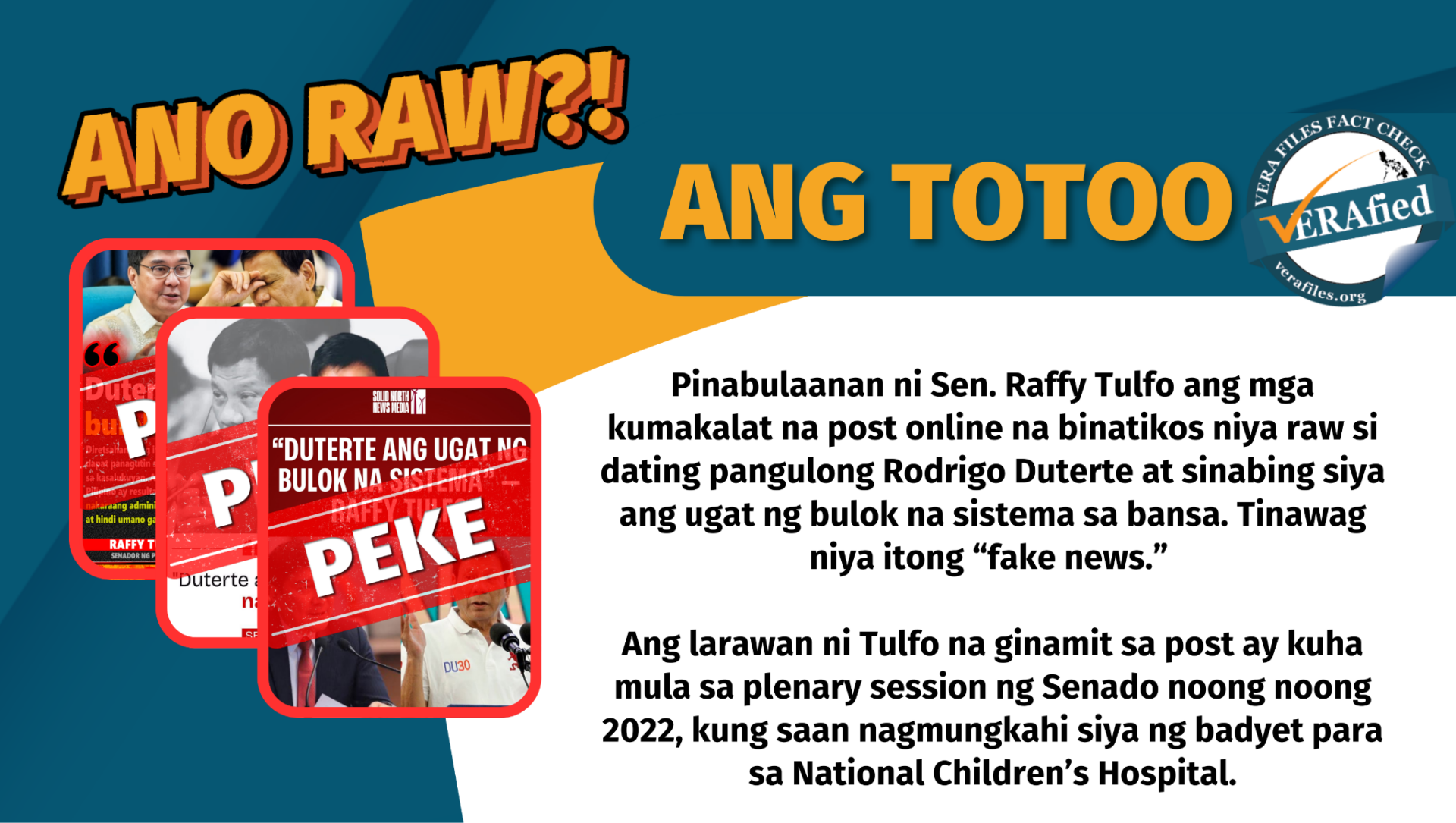
The false quote cards, which began circulating online on February 2, feature side-by-side images of Tulfo and Duterte with the caption: “Duterte ang ugat ng bulok na sistema – Raffy Tulfo” (Duterte is the root of a rotten system – Raffy Tulfo). Similar quote cards with the same alleged statement continued to appear in subsequent days.
On February 7, Tulfo took to his official Facebook page to debunk the viral posts. “Fake news,” the senator declared, while urging the public to exercise caution when consuming information online. He emphasized the importance of fact-checking content before sharing it, recommending that people verify information through official websites and legitimate social media accounts.
A thorough investigation of the images used in these fabricated quote cards revealed that Tulfo’s photo was taken from a 2022 plenary session of the 19th Congress during budget discussions for the National Children’s Hospital. The image of Duterte, meanwhile, dates back to July 2016 when the then-president joined Davao City’s Muslim community for Mindanao Hariraya Eid’l Fit’r observances.
The timing of these falsified quotes coincides with heightened scrutiny of government corruption, particularly amid investigations into a multi-billion peso “ghost” flood control scandal. Tulfo, a vocal member of the Senate Blue Ribbon Committee examining these allegations, has been actively participating in these inquiries, making him a notable figure in current political discourse.
No reputable news organization has reported Tulfo making such statements against the former president, confirming the fabricated nature of the claims.
Digital forensics shows the fake quote cards have been disseminated by numerous Facebook pages including “Solid North News Media,” “Politiko Tasyo,” “Online Trending News,” “South Manila News,” “Voice of Reality PH,” “Pinas News TV,” and “Bayaning Filipino Migrant Workers.” Individual Facebook users such as “Engr. Jaydee,” “Anthony Comedia,” and “Marcus Peligrino, Bisayang Dako” also shared the misinformation, alongside accounts on Thread and Instagram.
The false posts have generated substantial engagement, accumulating more than 222,600 reactions, 72,000 comments, and nearly 9,900 shares across platforms, highlighting the rapid spread of misinformation in the Philippine social media landscape.
This incident illustrates the ongoing challenge of combating digital misinformation in the Philippines, where political discourse is increasingly vulnerable to manipulation through falsified statements and doctored images. Media literacy advocates point to such cases as evidence of the need for greater public vigilance when consuming political content online.
Political analysts note that the fabrication of such inflammatory statements between high-profile figures like Tulfo and Duterte could be aimed at creating artificial divisions or exacerbating existing tensions within Philippine politics, particularly as the country faces significant governance challenges.
Fact Checker
Verify the accuracy of this article using The Disinformation Commission analysis and real-time sources.

17 Comments
This is a timely reminder of the importance of critical thinking and due diligence when it comes to online content. Tulfo’s actions set a good example for public figures.
Absolutely. Proactively addressing misinformation and encouraging the public to verify sources is a responsible approach.
Kudos to Tulfo for swiftly debunking these fabricated quotes. Maintaining transparency and accountability in the face of misinformation is crucial for upholding public trust.
This incident underscores the challenges we face in the digital age when it comes to the spread of misinformation. Tulfo’s response is a good model for how leaders should handle these situations.
Agreed. Calling out fabricated content and urging the public to verify information is a critical part of combating the disinformation problem.
It’s good to see Senator Tulfo swiftly address this misinformation. Fact-checking and verifying information before sharing is so important, especially on social media these days.
Agreed. Spreading false quotes can be damaging, so I’m glad Tulfo took the time to debunk this claim publicly.
I’m glad to see Tulfo taking such a firm stance against these false claims. Fact-checking and media literacy are essential skills for navigating the modern information landscape.
This highlights the need for increased digital literacy and critical thinking skills when it comes to consuming online information. Good on Tulfo for taking a stand against misinformation.
Totally. Fact-checking should be a reflex, not an afterthought, especially for high-profile figures and sensitive political issues.
This seems like a clear case of fabricated content. I appreciate Tulfo’s transparent response and call for the public to be more cautious about unverified information online.
Absolutely. The ability to quickly create and spread misinformation is a major challenge, but vigilance from public figures like Tulfo can help address it.
It’s refreshing to see a public official like Tulfo proactively addressing and debunking false claims. This level of transparency and accountability is important for building public trust.
Tulfo’s handling of this situation is commendable. Calling out fake news and urging people to verify information is an important civic duty.
Agreed. In an era of information overload, we all need to be more discerning consumers of news and content.
This incident highlights the need for greater media literacy education to help people distinguish fact from fiction online. Tulfo’s response is a step in the right direction.
Agreed. We all have a role to play in combating the spread of misinformation, and public figures setting a good example is an important part of that.