


Listen to the article
Trump’s White House Ballroom Project Raises Funding and Ethics Questions
A controversial ballroom project at the White House, announced on July 31, has come under scrutiny as President Donald Trump claims he will personally fund the massive structure alongside other private donors. The 90,000-square-foot event space, intended for state dinners and special occasions, carries an estimated price tag of $250 million according to the president’s latest statements.
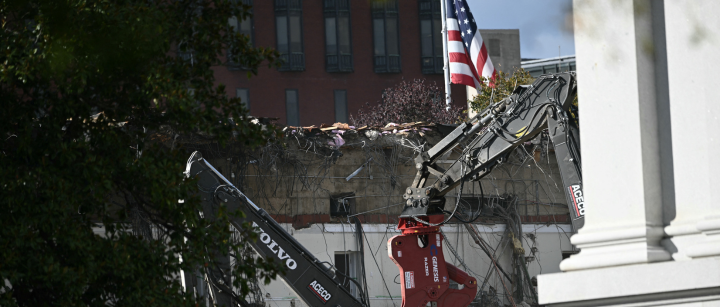
The White House revealed that nearly $200 million has already been pledged toward the project, though officials have not disclosed how much the president himself will contribute despite his repeated assurances that he would pay for it. Construction has already begun, with demolition underway on the East Wing where the ballroom will be located.
Several major corporations have reportedly made significant contributions. Defense contractor Lockheed Martin has pledged $10 million, while Google is expected to donate at least $5 million. A legal settlement between Trump and YouTube will direct $22 million toward the ballroom. Other corporate giants reportedly involved include Amazon, Apple, Caterpillar, Coinbase Global, Comcast, Meta Platforms, Microsoft, Palantir Technologies, and T-Mobile.
On October 15, the president hosted a fundraising dinner at the White House attended by representatives from these corporations and wealthy supporters of his presidential campaign. The White House has not released a comprehensive list of donors or their contribution amounts.
The project has drawn sharp criticism from Democratic lawmakers and ethics experts. Senator Richard Blumenthal of Connecticut called it “a gigantic boondoggle,” questioning what influence contributors might gain over Trump. Representative Darren Soto of Florida was more blunt, writing on social media that “Trump is building a fancy White House Ballroom for his rich buddies.”
Noah Bookbinder, president of Citizens for Responsibility and Ethics in Washington, expressed concern about the fundraising process, telling Axios that “all of this money that they’re giving for something that’s important to the president could influence his decision making, and he could be thinking about that instead of thinking about what’s best for the American people.”
Ethics experts identified several potential legal problems with the arrangement. Richard W. Painter, who served as chief ethics lawyer in the White House Counsel’s Office under President George W. Bush, told FactCheck.org that the fundraising violates federal ethics rules prohibiting government employees from using their positions to induce benefits.
Painter also raised concerns about the Antideficiency Act, which prohibits federal agencies from receiving voluntary services or gifts from outside sources to supplement congressionally appropriated funds. Although the White House might argue it’s not technically an “agency” subject to this law, Painter noted that previous administrations have abided by these restrictions.
Claire Finkelstein, director of the University of Pennsylvania’s Center for Ethics and the Rule of Law, questioned how a private ballroom on White House grounds serves the public interest, especially since the donations are being coordinated through the Trust for the National Mall, a nonprofit charitable organization. “I don’t see how adding a ballroom to the White House grounds benefits the public,” Finkelstein said.
She also raised potential Emoluments Clause concerns, questioning whether the space would truly be used for official duties or to entertain individuals seeking favor with the administration or Trump personally.
While private funding for monuments and memorials in Washington is not unprecedented—the Vietnam Veterans Memorial and Martin Luther King Memorial both relied heavily on private donations—those projects were clearly public-oriented. Finkelstein emphasized that “a White House ballroom is not open to the public, so it’s not of any obvious public benefit.”
As construction continues and more corporate pledges roll in, the ballroom project remains a contentious symbol of the blurring lines between government functions and private interests in the current administration.
Fact Checker
Verify the accuracy of this article using The Disinformation Commission analysis and real-time sources.

10 Comments
The involvement of companies like Lockheed Martin and Google in funding this White House project raises some red flags for me around potential conflicts of interest. Transparency on the donation process and decision-making will be crucial.
Agreed, the corporate sponsorship angle definitely needs to be scrutinized closely to ensure there are no undue influences or improper dealings.
While I appreciate the president’s desire to upgrade White House facilities, a $250 million ballroom seems like an excessive luxury, even with private funding. I hope there is a strong public interest justification provided for a project of this scale and cost.
A $250 million ballroom is certainly an ambitious undertaking. I’m curious to learn more about the project’s specific goals and how it will benefit the public, beyond just hosting state events.
Good point. The costs and scale of this project raise valid questions about its necessity and whether it’s the best use of resources compared to other potential White House upgrades or priorities.
It’s interesting to see major corporations getting involved in funding this ballroom project. I wonder if there are any concerns around undue influence or conflicts of interest, given the high-profile political nature of the White House.
Yes, the corporate donations definitely add an extra layer of complexity and potential ethics issues that will need to be carefully navigated.
Interesting to see how private funding is being leveraged for this major White House renovation project. I wonder how the ethics around corporate donations will be handled, given the potential for conflicts of interest.
Agreed, transparency on the funding sources and decision-making process will be crucial here to maintain public trust.
A $250 million price tag for a White House ballroom seems quite extravagant, even if funded by private donors. I hope there is thorough public oversight and justification provided for this significant expenditure.