


Listen to the article
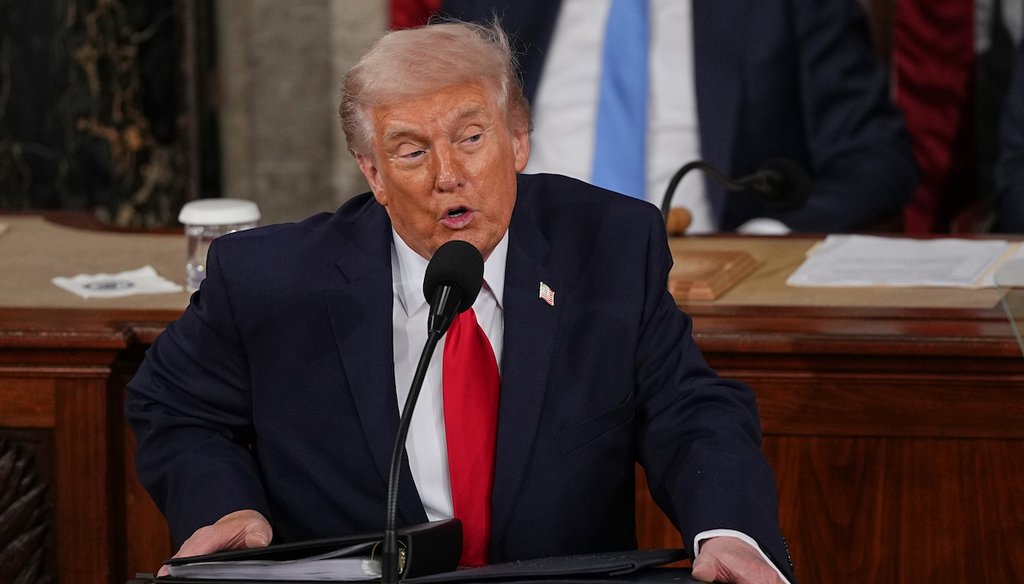
In a heated State of the Union address that reflected the nation’s political divisions, President Donald Trump vigorously defended his administration’s economic policies and immigration stance, drawing sharp contrasts with Democratic opponents as midterm elections approach.
The president’s speech, marked by combative rhetoric and partisan responses, highlighted what he described as economic achievements during his second term. “Inflation is plummeting,” Trump claimed, though economic data suggests a more modest improvement. While inflation has eased to about 2.4% year-over-year in January 2026, down from roughly 2.9% when he took office in January 2025, experts note this continues a trend that began during the Biden administration, when inflation had already fallen significantly from its peak of approximately 9% in mid-2022.
The economic picture Trump painted showed mixed results. Some sectors have seen price decreases during his second term—gasoline dropped about 6%, while new and used cars fell slightly under 1%. However, several essential categories continue to see price increases: groceries are up 2%, electricity costs have risen 6.3%, housing 3.4%, medical care 3.2%, and apparel 1.8%. A positive economic indicator is that wage growth has outpaced inflation during Trump’s current term.
The president’s claim about gasoline prices being “below $2.30 a gallon in most states” contradicted current data. According to the American Automobile Association, not a single state has an average below $2.30 per gallon. Oklahoma currently has the nation’s lowest statewide average at $2.37, with only three other states—Arkansas, Kansas, and Mississippi—showing averages at or below $2.50 per gallon. While individual stations in a handful of states might offer gas at $1.99, these represent exceptional cases rather than the norm.
Immigration policy dominated significant portions of the address, with Trump defending controversial measures that have created tension in Democratic-led cities. In a moment that crystallized the partisan divide, Trump called on legislators to stand if they agreed that “the first duty of the American government is to protect American citizens, not illegal aliens.” The request prompted extended applause from Republicans while Democrats remained seated, leading Trump to remark that they should be “ashamed of themselves.”
The president also claimed success in drug interdiction, stating that his administration had “virtually stopped completely” drugs entering the United States by water or sea through a “new military campaign.” However, evidence supporting this assertion remains elusive. Since September 2025, the administration has conducted strikes against at least 41 vessels in the Caribbean Sea and Eastern Pacific Ocean, resulting in approximately 152 casualties, but has not provided evidence these vessels were carrying narcotics.
Drug interdiction statistics tell a complex story. While Customs and Border Protection drug seizures have decreased since the military operations began, the Coast Guard—which handles most water-based drug interdictions—has reported increased seizures during the same period. Drug policy experts point out that neither rising nor falling interdiction numbers can accurately measure the total volume of drugs entering the country, as they only reflect what authorities manage to intercept.
The divisive atmosphere surrounding the address was further highlighted by dozens of Democratic lawmakers who boycotted the speech entirely, opting instead to attend alternative events, including a rally on the National Mall. In a dramatic moment, Representative Al Green (D-Texas) was escorted from the chamber after displaying a sign apparently referencing a controversial video Trump had recently posted on social media.
As the midterm elections approach, the president’s address reflected his strategy of emphasizing economic improvements and a tough stance on immigration, themes likely to feature prominently in upcoming campaigns across the country.
Fact Checker
Verify the accuracy of this article using The Disinformation Commission analysis and real-time sources.

7 Comments
Appreciate the fact-checking on Trump’s State of the Union speech. It’s important to look at the full economic picture, not just cherry-picked data points. Curious to see how his policies impacted different industries and consumers over time.
The continued rise in essential costs like groceries, electricity, and housing is concerning, even if some sectors saw price drops. I wonder how that affected lower-income families and the overall standard of living during Trump’s second term.
Interesting to see the contrast between Trump’s rhetoric and the actual economic data. Strikes me as an example of how politicians can sometimes cherry-pick information to fit their narrative. Looking forward to more in-depth analysis on this.
Interesting to see the data on inflation and prices under Trump’s second term. Seems the economic picture is more nuanced than the black-and-white claims made. I’d like to dig into the specifics on sector performance and the broader trends.
Fact-checking is crucial, especially for high-profile political speeches. Looking forward to seeing more analysis on the full scope of Trump’s economic record and how it impacted different segments of society.
Appreciate the nuanced look at the data rather than just taking Trump’s claims at face value. Curious to see how this plays out as the 2028 election cycle approaches and the economic record becomes a key campaign issue.
This fact-check provides a good starting point for further examination of Trump’s economic record. I’m curious to see how it stacks up against the claims made by his supporters and detractors as the next election cycle heats up.