


Listen to the article
In an era of rapid information spread, a fake excerpt from Michael Wolff’s book about former President Donald Trump continues to circulate online years after its original debunking. The fabricated passage, which claims Trump demanded a “gorilla channel” in the White House, recently resurfaced on social media platform X on March 25, 2026, despite being thoroughly disproven.
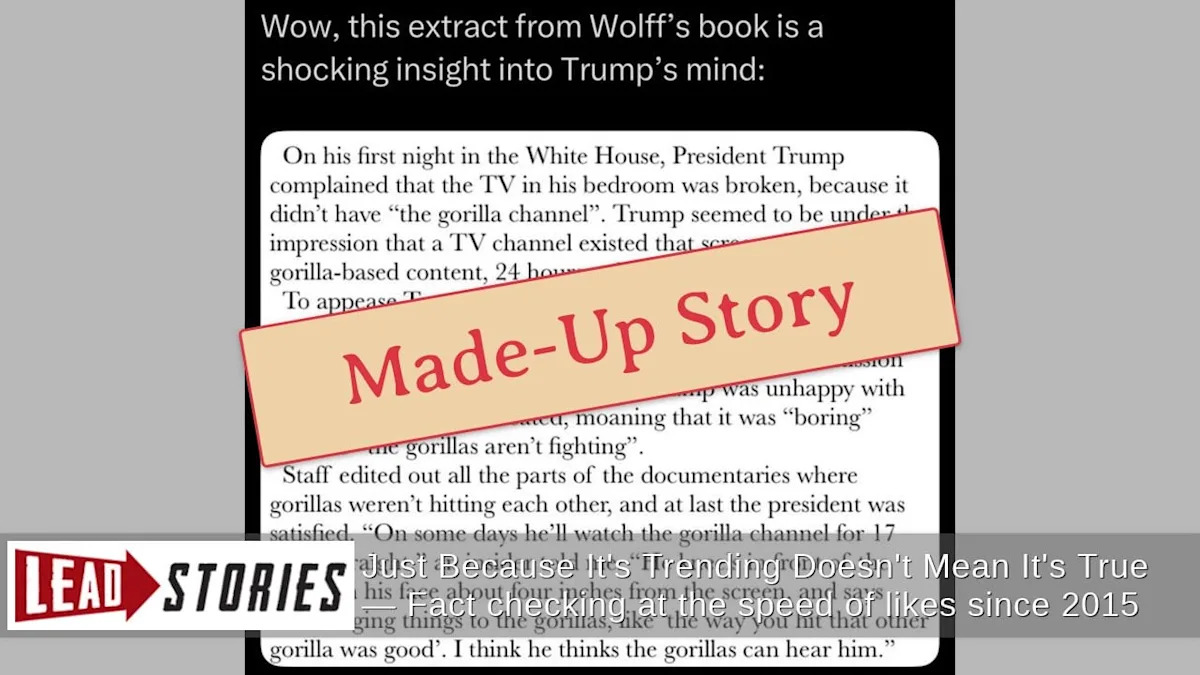
The viral screenshot presents what appears to be an extract from Wolff’s controversial 2018 book “Fire and Fury: Inside the Trump White House.” According to the fabricated passage, Trump allegedly complained on his first night in the White House that his bedroom television was broken because it lacked “the gorilla channel” – a fictional TV channel supposedly dedicated to gorilla-based content.
The fake excerpt goes on to claim that White House staff created a makeshift gorilla channel by compiling documentaries and constructing a transmission tower on the South Lawn. It further alleges that Trump was initially dissatisfied because “the gorillas aren’t fighting,” prompting staff to edit the footage to show only gorillas in combat. The fabrication reaches its climax with an unnamed “insider” claiming Trump would watch this channel for up to 17 hours straight while kneeling close to the screen and speaking encouragingly to the animals.
This false narrative first emerged on January 4, 2018, coinciding with the release of Wolff’s actual book. According to PolitiFact, the claim originated from a prankster social media account that later acknowledged the post was intended as satire. Despite this admission, the fabricated story gained significant traction online.
Politico reported at the time that the “Internet falls for Trump-‘Gorilla Channel’ parody,” highlighting how quickly misinformation can spread even when the content seems implausible. The story’s absurdity didn’t prevent it from being shared widely, demonstrating the challenges of information verification in the social media age.
Lead Stories conducted a thorough search of the electronic version of “Fire and Fury” and confirmed that the book contains no mention of gorillas whatsoever. This verification underscores the complete fabrication of the viral excerpt.
The persistence of this debunked claim nearly eight years after its original circulation illustrates a troubling pattern in digital information consumption. False narratives, particularly those that align with existing perceptions about public figures, can remain dormant before resurfacing during relevant news cycles.
Media literacy experts point to the “gorilla channel” hoax as a classic example of satire being mistaken for fact. The story’s continued circulation demonstrates how the boundaries between news, entertainment, and misinformation have blurred in the digital landscape.
This phenomenon has broader implications for political discourse and public trust in media. When satirical content is presented as factual reporting, it can reinforce existing biases and contribute to an environment where even legitimate journalism faces skepticism.
The “gorilla channel” fabrication represents a particular category of misinformation that exploits the public’s fascination with behind-the-scenes details about powerful figures. While Wolff’s actual book did contain controversial claims about the Trump White House, the gorilla channel narrative was purely fictional.
As social media platforms continue to grapple with the spread of misinformation, this case highlights the importance of verification before sharing content, especially when claims seem extraordinary or designed to provoke strong emotional responses.
Fact Checker
Verify the accuracy of this article using The Disinformation Commission analysis and real-time sources.

7 Comments
Haha, the ‘gorilla channel’ story is just too ridiculous to be true. Glad the article confirms it was just a silly internet joke, not an actual excerpt from Wolff’s book. Gotta love how fake news can spread like wildfire these days.
I’m curious what other ‘excerpts’ from this book have been faked over the years. Seems like a prime target for disinformation campaigns, given the controversial subject matter. Kudos to the author for setting the record straight on this particular hoax.
Haha, the ‘gorilla channel’ story is just too absurd to be true. Love how the article traces it back to an original 2018 joke, not an actual excerpt. Really puts the power of social media to spread misinformation into perspective.
It’s wild how quickly misinformation can spread these days. Glad the article was able to confirm the ‘gorilla channel’ as a fabrication, not something actually in the Wolff book. Fact-checking is so crucial, especially for politically-charged stories.
This kind of fabricated ‘insider’ story is exactly why I try to verify information before believing it, especially when it comes to political figures. Good to see this myth debunked so clearly. Fact-checking is so important in the age of social media.
Fascinating to see how a silly internet joke can morph into ‘confirmed’ fake news over time. Kudos to the author for taking the time to thoroughly debunk this ‘gorilla channel’ myth. Fact-checking is so important in the digital age.
Wow, I can’t believe people are still sharing that ‘gorilla channel’ story in 2026! Impressive how a silly joke can take on a life of its own online. Good to know the facts behind it, though – thanks for the thorough debunking.