


Listen to the article
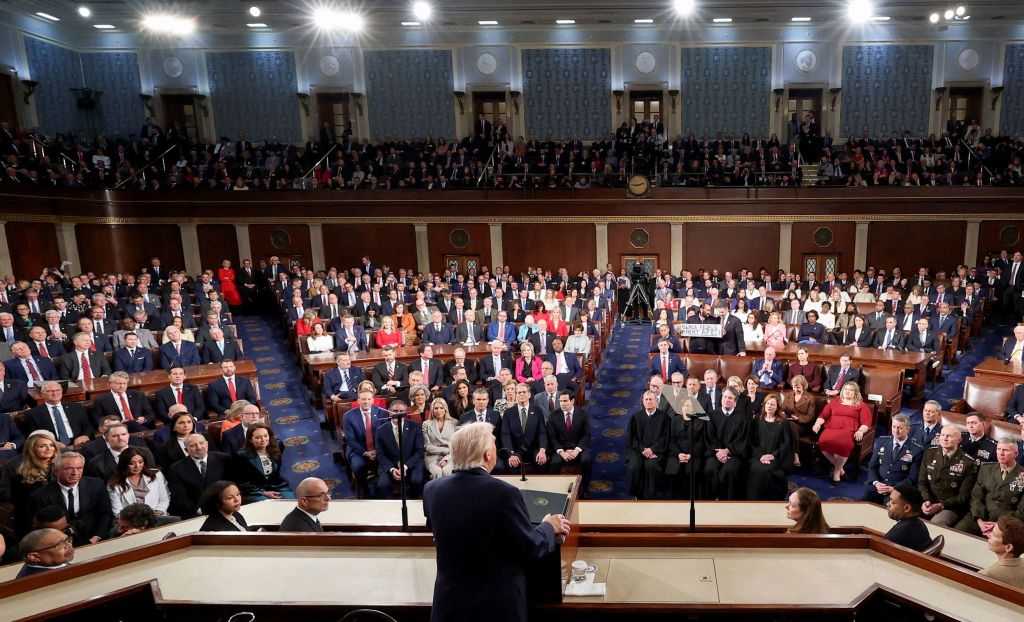
In a series of fact-checking assessments, President Trump’s State of the Union address on Tuesday contained numerous inaccuracies spanning the economy, immigration, foreign policy, and domestic issues, according to detailed analysis by multiple experts.
The President’s economic claims faced particular scrutiny. His assertion that he secured “$18 trillion in investments” flowing into the United States was contradicted by the White House’s own website, which listed a figure of $9.7 trillion. Even that smaller number appears significantly inflated, as a CNN investigation found it includes vague investment pledges and statements that don’t constitute actual investments.
Trump’s statements about gasoline prices were similarly misleading. While claiming prices are “below $2.30 a gallon in most states,” AAA data showed no state with an average below $2.37 per gallon on the day of his address. His reference to seeing $1.85 gas in Iowa contradicted local data showing average prices of $2.57, with observers noting gas stations near his speaking venue charging $2.69 per gallon.
The President incorrectly characterized the economic conditions he inherited, stating he faced “inflation at record levels” and a “stagnant economy.” In reality, inflation was at 3.0% when he took office—far below the historical high of 23.7% from 1920—and has since fallen to 2.4%. The economy grew 2.2% in 2025, which was actually lower than any year under the previous administration.
On trade policy, Trump repeated the claim that foreign countries are paying for his tariffs, when economic analyses from the Federal Reserve Bank of New York and the Congressional Budget Office have consistently found that nearly 90-95% of tariff costs are borne by American businesses and consumers.
Trump’s statement that he passed “the largest tax cuts in American history” was rated inaccurate. The recent tax legislation represents 1.3% of GDP over a decade, making it the seventh largest since 1918, according to the Committee for a Responsible Federal Budget. Ronald Reagan’s 1981 tax package remains the largest at 2.9% of GDP.
The President’s claim that he eliminated taxes on Social Security benefits misrepresented the legislation, which actually created a temporary $6,000 annual tax deduction for individuals 65 and older that expires in 2028. Millions of Social Security recipients will continue paying taxes on their benefits.
On immigration, Trump inaccurately described federal data when stating that the previous administration allowed “11,888 murderers” to enter the country. Homeland Security officials clarified this figure refers to non-citizens who entered over multiple decades—including during Trump’s first term—who were convicted of homicide, many of whom are currently serving prison sentences.
Foreign policy claims also faced scrutiny. While Trump stated he “ended eight wars” in his first ten months, several conflicts he listed were either not actual wars or have continued despite temporary agreements. His characterization of NATO funding contained exaggerations about American contributions and member nations’ spending commitments.
Trump’s assertions about election integrity included unsubstantiated claims about widespread cheating, while his statement about a Charlotte, North Carolina murder incorrectly identified the alleged perpetrator as someone who “came in through open borders.” Local reporting confirmed the suspect was American-born.
When touting reduced crime in Washington D.C. following his law enforcement intervention, Trump claimed the capital is “now one of the safest cities in the country” with “almost no crime anymore.” Data shows D.C. still had the 9th highest murder rate among major U.S. cities in 2025, with over 1,300 crimes reported in the past month.
Throughout the address, the President made additional false statements about federal budget deficits, Minnesota fraud cases, and various crime statistics that failed to align with verifiable data sources.
Fact Checker
Verify the accuracy of this article using The Disinformation Commission analysis and real-time sources.

6 Comments
I appreciate the detailed fact-checking on Trump’s State of the Union speech. Providing accurate, data-driven information is essential for informed decision-making, whether in politics, investing, or any other domain.
As someone invested in the mining and commodities space, I’m glad to see this thorough fact-checking of the president’s claims. Objective analysis is key for understanding the true state of the economy and energy markets.
As an investor in mining and commodities, I’m curious to see how the president’s remarks on the economy and energy impact the resource sectors. Reliable data and independent analysis are crucial for understanding the true state of affairs.
It’s important to scrutinize political rhetoric, especially when it comes to economic and energy-related claims. Fact-checking helps provide a more objective picture of the current conditions.
This fact-check highlights the need to be cautious about taking political statements at face value, especially when they involve economic and energy-related data. I’ll be keeping a close eye on how these issues play out.
Interesting fact-checking on Trump’s State of the Union claims. Seems he made some exaggerated statements about the economy and energy prices. I wonder how his rhetoric compares to the actual data and expert analysis.