


Listen to the article
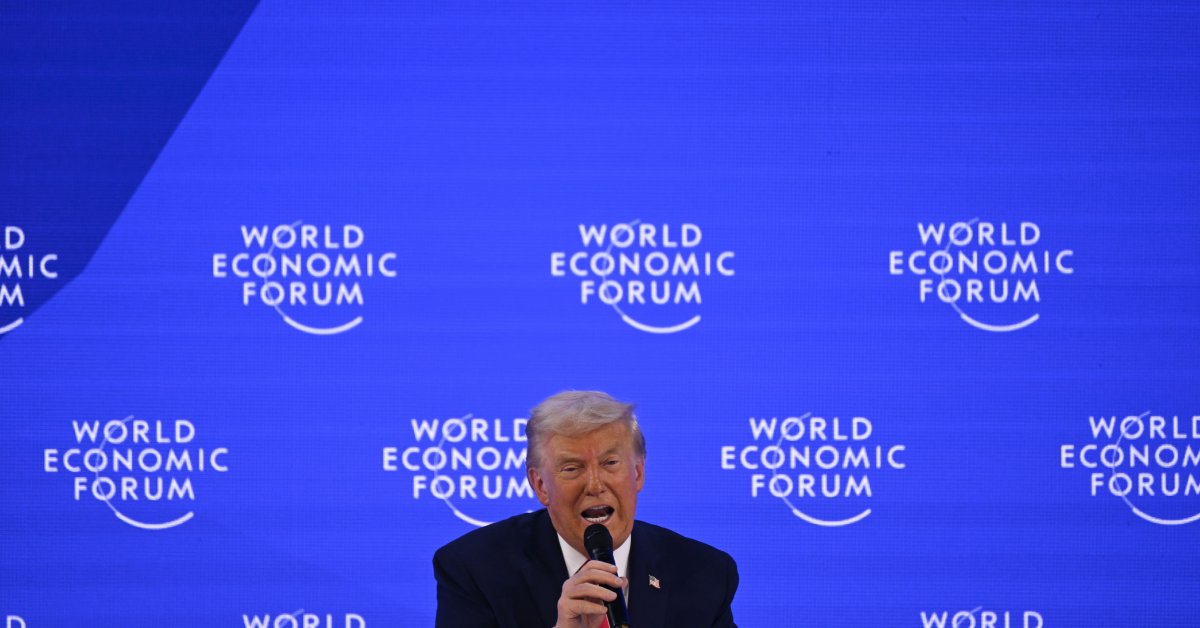
In a wide-ranging and controversial speech at the World Economic Forum in Davos on Wednesday, former President Donald Trump made numerous claims touching on geopolitics, energy policy, and domestic politics, while revisiting familiar grievances about the 2020 election and international relations.
Trump’s address, eagerly anticipated by attendees of the elite global gathering, covered topics from his desire to acquire Greenland to criticisms of renewable energy, while also targeting political opponents and allies alike, including Federal Reserve Chair Jerome Powell, Democratic Rep. Ilhan Omar, and former President Joe Biden.
Among Trump’s more eyebrow-raising assertions was a claim about Greenland, which he attempted to purchase during his first term. “After the war, which we won, without us, you’d all be speaking German and a little Japanese. After the war, we gave Greenland back to Denmark. How stupid were we to do that?” Trump said, adding, “So we want a piece of ice for world protection. And they won’t give it.”
The statement represents a significant historical inaccuracy. The United States never owned Greenland. In 1941, during World War II, the U.S. and Denmark signed an agreement allowing America to establish military bases on the island as a defense against Nazi Germany, while explicitly recognizing Danish sovereignty over the territory.
On NATO financing, Trump revived a familiar but misleading claim, stating, “We pay for NATO. We paid for many years, until I came along, in my opinion, 100% of NATO, because they weren’t paying their bills.” Official NATO figures contradict this assertion, showing the United States contributed approximately 16% of NATO’s budget in 2025, while 31 of the 32 member nations are estimated to have met the alliance’s 2% of GDP defense spending target that year.
Trump’s comments on renewable energy and China were equally problematic. He claimed China manufactures wind turbines but doesn’t use them domestically: “China makes almost all of the wind mills, and yet I haven’t been able to find any wind farms in China… They make them. They sell them for a fortune…But they don’t use them themselves.”
In reality, China’s wind energy sector is the largest in the world. According to the Global Wind Energy Council, China’s wind installations in 2024 represented 70% of global additions, with cumulative capacity exceeding 520 gigawatts—nearly half the world’s total installed wind power capacity.
Trump also made specific claims about European energy production, stating that “Germany now generates 22% less electricity than it did in 2017… and the electricity prices are ‘64% higher,'” and that “The United Kingdom produces just 1/3 of the total energy from all sources that it did in 1999.”
While Germany’s electricity generation has indeed decreased—by about 25% from 2017 to 2025, according to the Fraunhofer Institute—electricity prices rose by approximately 35%, not 64% as claimed. Similarly, UK electricity generation in 2024 was about 25% lower than in 2000, not the two-thirds reduction Trump suggested.
Perhaps most controversially, Trump repeated his baseless claim that the 2020 presidential election was fraudulent, suggesting that the Russia-Ukraine war wouldn’t have happened “if the 2020 US presidential election weren’t rigged,” adding that “people will soon be prosecuted for what they did.”
This assertion has been repeatedly debunked. Multiple investigations by Republican officials at federal and state levels found no evidence of widespread voter fraud. Trump’s former lawyer, Rudy Giuliani, who promoted similar claims, was ultimately disbarred in New York and Washington, D.C., and reached a confidential settlement with Dominion Voting Systems in a defamation lawsuit related to his false election claims.
Trump’s Davos appearance highlights the former president’s continued embrace of controversial and often factually challenged positions on the international stage, even as he continues to command significant attention at major global forums.
Fact Checker
Verify the accuracy of this article using The Disinformation Commission analysis and real-time sources.

8 Comments
Fact-checking is essential to hold leaders accountable and separate truth from fiction, especially on complex geopolitical and policy issues. Curious to see how this analysis unpacks the various claims made in Trump’s Davos speech.
The claim about the US ‘giving back’ Greenland after WWII is quite puzzling. I look forward to seeing the historical context and facts presented in this analysis.
Interesting fact-check on Trump’s speech at Davos. While he made some bold claims, it’s important to verify the historical accuracy. Looking forward to seeing a balanced analysis of the key points.
Renewable energy seems to be a frequent target of criticism from Trump. I’m curious to understand his specific objections and how they align with the broader energy landscape and policy debates.
Trump’s speech touched on a wide range of topics, from geopolitics to domestic politics. It will be interesting to see how this fact-check analyzes the accuracy and context around each of his key claims.
Acquiring Greenland seems like an unusual priority for a US president. The historical context around that is worth digging into further. Curious to learn more about the motivations and feasibility of such a move.
You’re right, the Greenland claim appears to be inaccurate. The US never owned that territory, despite Trump’s assertions. Fact-checking is crucial to separate fact from fiction, especially on high-profile political speeches.
It’s important to maintain a critical eye when evaluating high-profile political speeches, even from former presidents. This fact-check should provide valuable insights and clarity on the accuracy of Trump’s claims.