


Listen to the article
Trump’s Cognitive Test Claims Draw Scrutiny from Social Media Fact-Checkers
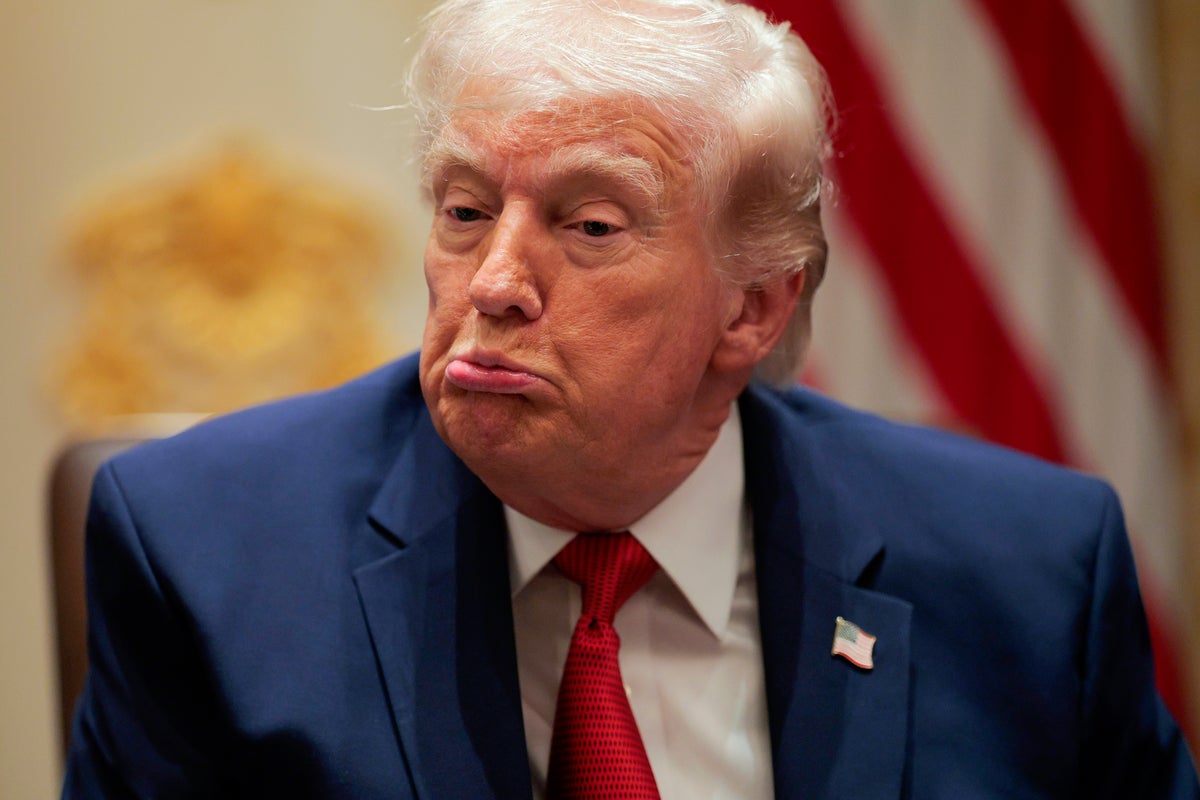
Former President Donald Trump has once again found himself at odds with fact-checkers after repeating claims about his performance on a cognitive assessment during a cabinet meeting Thursday.
During a meandering critique of California Governor Gavin Newsom’s dyslexia, Trump veered into familiar territory, boasting about his past cognitive evaluations.
“I’m the only president that ever took a cognitive test. I took it three times. It’s actually a very hard test for a lot of people. It wasn’t hard for me. But it’s a cognitive test,” Trump told those assembled.
He went on to characterize the assessment as increasingly difficult, claiming it concludes with “very tough mathematical equations and things” that “very few people can answer.”
Trump was referring to the Montreal Cognitive Assessment (MoCA), which was administered during a medical examination six years ago in 2020 amid the COVID-19 pandemic. The former president has frequently cited his performance on this test as evidence of his mental acuity.
“I aced it three times in front of numerous doctors,” Trump declared Thursday, adding that his physician at the time, Dr. Ronnie Jackson, had warned him that poor results would have leaked to the media.
This narrative has become a recurring theme in Trump’s public statements about his fitness for office. In a July 2020 interview with Fox News medical contributor Dr. Marc Siegel, Trump memorably recounted being asked to remember five words: “Person. Woman. Man. Camera. TV.” The segment drew widespread ridicule from commentators who noted that remembering five simple words is a basic screening task, not a demonstration of exceptional mental capacity.
Trump’s latest assertions quickly attracted a community note on X (formerly Twitter), where users pointed out factual inaccuracies in his characterization. The note clarified that the MoCA is “a 10-minute screening tool for mild cognitive impairment that people with normal cognition easily pass” rather than an intelligence test or measure of advanced cognitive ability.
The assessment includes basic tasks such as drawing a clock, identifying animals in pictures, stating the current date and location, and performing simple arithmetic like serial subtraction – not the “complex mathematical equations” Trump described.
When X users consulted the platform’s Grok AI chatbot about Trump’s claims, it responded that the assessment is “a quick 10-15 min clinical screening tool for mild cognitive impairment in older adults” that “begins with easy tasks (naming animals, drawing a clock) then adds attention/memory items like serial 7s subtraction from 100—not complex equations.”
Medical experts have previously explained that the MoCA is designed specifically to detect early signs of dementia or mild cognitive impairment in older adults. A perfect score of 30 is considered normal for most adults without cognitive issues. The test is not meant to measure intelligence or to be particularly challenging for individuals with typical cognitive function.
Trump’s tendency to exaggerate the difficulty of the assessment has become a pattern. During his 2020 Fox News interview, he claimed the test was “not that easy” for most people while simultaneously boasting that it was basic for him.
The former president’s cognitive abilities have been a subject of political debate as both he and President Biden, who are 78 and 81 respectively, face questions about age-related mental fitness in the context of the 2024 presidential race.
This latest episode highlights the ongoing tension between Trump’s characterizations of events and the factual record, a dynamic that has defined much of his political career and continues to play out on social media platforms equipped with community fact-checking features.
Fact Checker
Verify the accuracy of this article using The Disinformation Commission analysis and real-time sources.

9 Comments
Trump’s boasts about acing the cognitive test multiple times raise some interesting questions. I wonder if there are any independent experts who could provide more insight into the test and its potential uses.
That’s a good point. Hearing from medical professionals or psychologists who specialize in cognitive assessments could help shed light on the significance and interpretation of the test results.
The fact-checkers seem to be pushing back on the specifics of Trump’s claims about the cognitive test. It would be helpful to have a more detailed and objective analysis of the test and his performance.
The scrutiny around Trump’s cognitive test claims is understandable, given the political nature of the topic. It would be good to see an objective, non-partisan analysis of the test and his performance.
Absolutely, an impartial assessment of the facts surrounding these tests would go a long way in informing the public discourse. Relying on credible sources is key when evaluating such claims.
Trump seems quite proud of his cognitive test results, but the fact-checkers raise some valid points about the lack of detailed information. I’d be curious to learn more about the assessment and how it’s typically administered.
Agreed, more context on the test and its scoring would provide helpful perspective on Trump’s claims. Fact-checking is important, but the public would benefit from a deeper dive into the specifics.
Interesting to see the claims around Trump’s cognitive test performance being scrutinized. I wonder what the specifics of the test were and how his results compare to other presidents or the general population.
Yes, it would be helpful to have more transparency around the details of these tests and how they are scored. Factual information is important for evaluating such claims.