


Listen to the article
President Trump’s White House Address Contained Numerous False Claims, Fact-Check Reveals
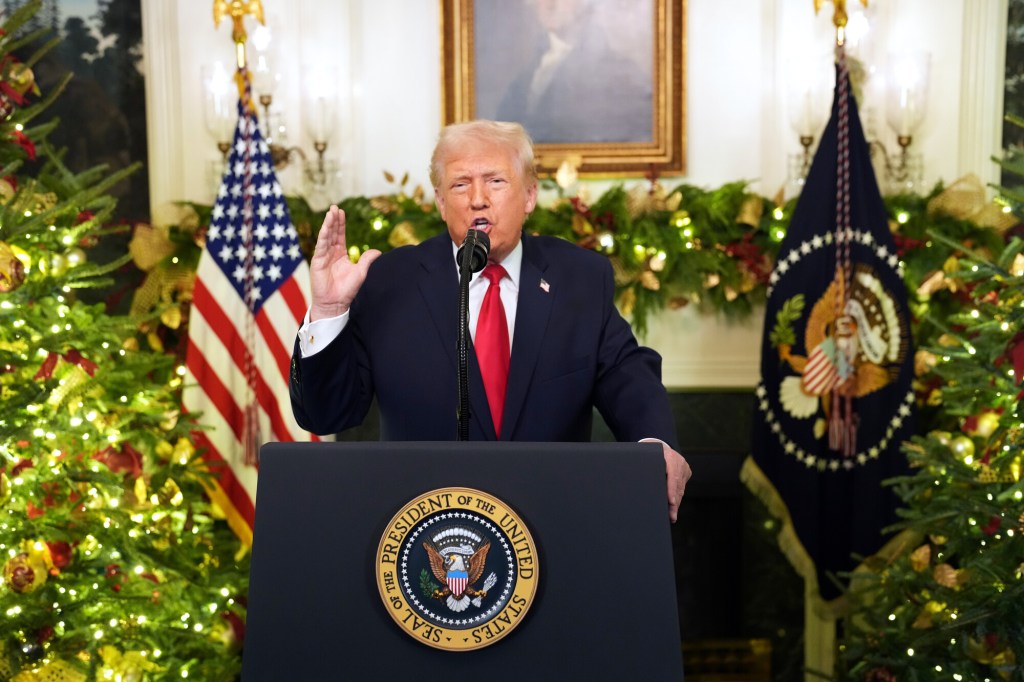
President Donald Trump’s recent prime-time address from the White House contained a series of false or misleading claims on topics ranging from inflation and the economy to immigration and foreign policy, according to a detailed fact-check analysis.
In his Wednesday night speech, Trump erroneously declared that “inflation is stopped” – a statement contradicted by official data. The year-over-year inflation rate in September stood at 3.0%, unchanged from January when Trump took office. In fact, September marked the fifth consecutive month of increases in the year-over-year rate.
Trump also mischaracterized the economic situation he inherited, claiming inflation was “the worst in 48 years, and some would say in the history of our country” when he took office. The year-over-year inflation rate in December 2024, the last full month of the Biden administration, was 2.9%, rising slightly to 3.0% in January 2025 when Trump returned to office – nowhere near historic highs.
While inflation did reach approximately 9.1% during the Biden administration in June 2022, this peak occurred more than two years before Trump’s return to office and was far below the all-time U.S. record of 23.7% set in 1920. By the time Trump began his second term, inflation had already declined substantially.
The president’s claims about falling grocery prices also failed to match reality. Consumer Price Index data reveals that most grocery items have actually increased in price since Trump took office in January. As of September, average grocery prices were up about 2.7% year-over-year and approximately 1.4% since January.
Another mathematical impossibility appeared in Trump’s assertions about prescription drug prices, where he claimed his executive order would cut prices by “as much as 400, 500, and even 600%.” Such reductions are mathematically impossible – even reducing prices to zero would constitute only a 100% cut.
On gasoline prices, Trump’s statement that fuel costs “under $2.50 a gallon in much of the country” lacked proper context. AAA data showed only four states with average prices below $2.50 per gallon as of Wednesday, with the national average at $2.905. His claim about prices hitting $1.99 in some states was technically true but highly selective, with industry analyst Patrick De Haan estimating only 75-100 stations nationwide offering such prices.
Perhaps most striking was Trump’s assertion that he had “secured a record-breaking $18 trillion of investment into the United States” during his second presidency. The White House’s own website contradicted this figure, listing $9.6 trillion – and even that number represents a significant exaggeration according to detailed analysis, which found the administration counting vague pledges and statements that didn’t qualify as actual investments.
On foreign policy, Trump’s claim of having “settled eight wars in 10 months” included conflicts that weren’t actually wars, such as the diplomatic dispute between Egypt and Ethiopia over a dam project. Other conflicts he claimed to have resolved, including fighting in the Democratic Republic of Congo and between Thailand and Cambodia, have continued despite U.S.-brokered agreements.
Regarding immigration, Trump drastically inflated migrant numbers, claiming “25 million” people entered the country under Biden. Federal data shows fewer than 11 million migrant “encounters” through December 2024, with many of those individuals being promptly expelled. Even accounting for those who evaded detection, estimates fall far short of Trump’s figures.
The president also repeated unsubstantiated claims about foreign countries emptying prisons and mental institutions to send people to the U.S. – assertions for which he has never provided evidence and which have been refuted by experts and the governments of countries he has specifically named.
Trump’s claims about his domestic policy achievements similarly diverged from reality. He stated that his recent bill includes “no tax on Social Security,” but the White House itself has acknowledged that millions of Social Security recipients will continue paying taxes on their benefits despite a new temporary deduction.
Finally, Trump falsely suggested that under Biden, crime reached “record levels” and phrases like “law enforcement” were “forbidden.” Crime statistics show that both violent crime and property crime declined nationally in 2023 and 2024, while the Biden administration regularly used law enforcement terminology in its communications.
The accumulation of these inaccuracies raises questions about the reliability of information presented during the president’s prime-time address, at a time when factual clarity remains essential for public understanding of government policy and national conditions.
Fact Checker
Verify the accuracy of this article using The Disinformation Commission analysis and real-time sources.

12 Comments
The details provided here highlight the importance of verifying claims, especially on high-profile economic issues. It will be interesting to see how this develops and how it impacts public discourse.
You’re right, fact-checking is essential to maintain trust in our institutions and leaders. Looking forward to seeing how this story progresses.
Rigorous fact-checking is essential for maintaining accountability and transparency in our political discourse. While I may not agree with all the conclusions here, I appreciate the effort to scrutinize high-profile claims on economic issues.
That’s a fair perspective. Fact-checking should strive for objectivity, even on politically charged topics. Healthy debate and discussion can lead to better understanding and more informed decision-making.
This report underscores the need for rigorous, impartial fact-checking on statements from all political figures. It’s crucial to separate rhetoric from verifiable data, especially on critical economic matters.
Absolutely. Objective analysis is key to ensuring the public receives accurate information and can make informed decisions. Fact-checking holds leaders accountable.
Interesting fact-check on Trump’s claims. It’s important to carefully examine statements from all political leaders and hold them accountable for accuracy. I’m curious to see how this ongoing economic situation evolves.
Agreed, transparency and factual scrutiny are crucial, regardless of political affiliation. Economic complexities require nuanced analysis from reliable sources.
While I appreciate the desire to hold leaders accountable, I’d caution against overly partisan approaches to fact-checking. A balanced, non-partisan perspective is ideal for evaluating claims on complex economic issues.
That’s a fair point. Fact-checking should be conducted objectively, without political bias, to provide the public with the most accurate and unbiased information possible.
This report highlights the importance of verifying claims, especially on high-stakes economic issues. It will be interesting to see how this story develops and if it leads to any policy changes or shifts in public discourse.
Agreed. Fact-based analysis is crucial for informed decision-making. I’m curious to see how this evolves and what the broader implications might be for economic policy and public trust.