


Listen to the article
The claim that former President Donald Trump threatened to invade Greenland if European allies refused to help with the Strait of Hormuz has been debunked as false.
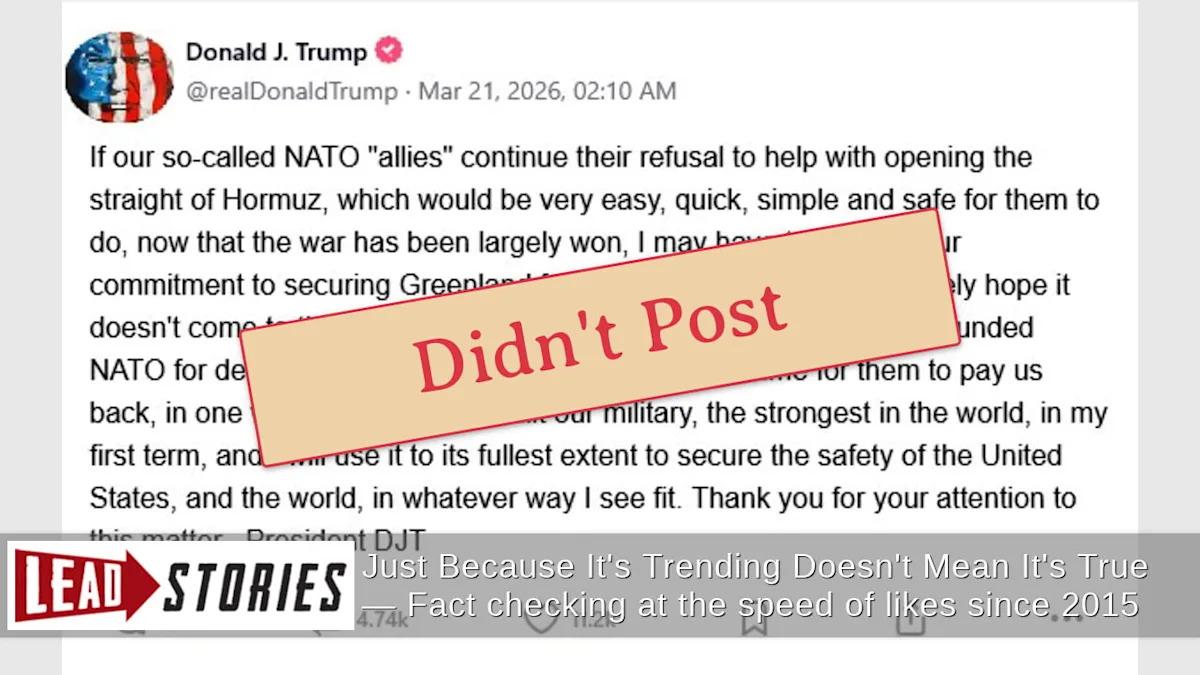
A viral image circulating on social media platforms since March 21 appeared to show Trump posting on Truth Social about NATO allies’ “refusal to help with opening the straight of Hormuz” and suggesting he might “reaffirm our commitment to securing Greenland for our national security” in response.
However, a thorough investigation reveals no evidence that Trump ever made such statements on his Truth Social account or any other platform.
The fabricated post gained traction after being shared on X (formerly Twitter) with the caption: “BREAKING 🚨 Trump threatens to invade Greenland again if Europe doesn’t help him against Iran.” From there, it spread rapidly across multiple social media channels, generating significant engagement and concern among users.
In the purported Truth Social message, Trump supposedly wrote that NATO allies’ reluctance to assist with the Strait of Hormuz situation might force him to take action regarding Greenland. The fabricated post included phrases like “I rebuilt our military, the strongest in the world, in my first term, and I will use it to its fullest extent to secure the safety of the United States.”
Digital forensics experts note several red flags indicating the post’s inauthenticity. Most tellingly, advanced Google searches targeting Trump’s Truth Social account (@realDonaldTrump) yielded no results containing the text from the alleged post. Had the statement been genuine, it would have been indexed by search engines.
Additionally, all circulating screenshots displayed identical comment counts, likes, shares, and background formatting. Authentic viral posts typically generate multiple screenshots with varying engagement metrics and display formats depending on when they were captured and which devices were used.
The false claim references two actual geopolitical situations. The Strait of Hormuz—often misspelled as “straight” in the fake post—is a critical maritime chokepoint between the Persian Gulf and the Gulf of Oman, through which approximately 20% of the world’s oil supply passes. Tensions in this region have historically affected global oil markets and international relations.
The Greenland reference recalls a 2019 incident when then-President Trump expressed interest in purchasing Greenland from Denmark, causing diplomatic friction. Danish Prime Minister Mette Frederiksen called the idea “absurd,” leading Trump to cancel a planned state visit to Denmark.
This fabricated post appears to be part of a growing trend of manipulated content involving political figures ahead of the 2024 presidential election. Social media platforms continue to struggle with the rapid spread of such misinformation despite increased content moderation efforts.
Media literacy experts recommend that users verify political claims through multiple credible sources before sharing content, particularly when posts contain provocative statements that would likely generate significant news coverage if authentic.
Neither Trump’s campaign team nor Truth Social has officially commented on this specific fabricated post, though both have previously warned supporters about false information circulating under the former president’s name.
Fact Checker
Verify the accuracy of this article using The Disinformation Commission analysis and real-time sources.

10 Comments
Interesting to see this debunked claim about Trump’s alleged threats regarding Greenland and the Strait of Hormuz. It’s important to rely on verified information from reputable sources, rather than unsubstantiated social media posts.
Good to see this claim being thoroughly debunked. It’s important we maintain a clear distinction between real and fabricated news, especially when it involves sensitive geopolitical issues.
This seems like another case of misinformation spreading quickly online. I’m glad the article could provide a thorough investigation and clarification on the facts. Fact-checking is so crucial these days.
Absolutely. It’s easy for false claims to gain traction, so it’s important to scrutinize information and look for reliable sources before believing or sharing it.
This is a valuable lesson in the importance of critical thinking and fact-checking, even when it comes to high-profile political figures. Relying on verified information is key to staying informed.
I appreciate the diligence in investigating this claim and setting the record straight. Fact-checking is essential, especially when it comes to politically charged topics and statements from public figures.
This is a helpful reminder to be cautious about unverified information, even if it seems plausible or comes from seemingly authoritative sources. Fact-checking is crucial in today’s media landscape.
Agreed. It’s all too easy for misinformation to spread quickly online, so we must take the time to verify claims before accepting or sharing them as truth.
Appreciate the detailed investigation and clarification provided in this article. Fact-checking is essential to counter the spread of misinformation, especially on topics related to national security and foreign policy.
Thanks for the update on this issue. It’s good to see the media taking the time to debunk these kinds of fabricated stories. Maintaining accuracy and trust in reporting is vital.