


Listen to the article
Fact Check: Trump Did Not Post Threat to “Vaporize” Iran on Truth Social
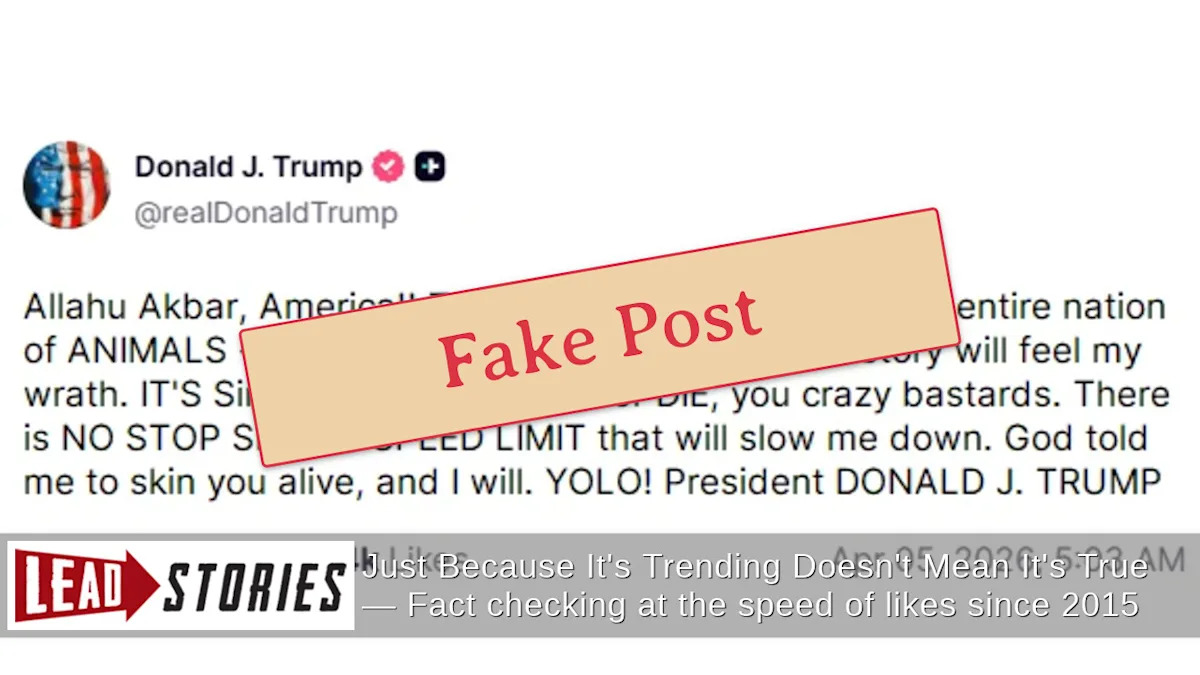
A fabricated social media post falsely attributed to former President Donald Trump claiming he would be “vaporizing an entire nation of ANIMALS” has been debunked as a hoax. The inflammatory post, which began circulating widely on social media platforms over the weekend, appears to be the work of a satirical account rather than an authentic communication from the former president.
The fake screenshot, which mimics the appearance of Trump’s Truth Social platform, contained incendiary language allegedly threatening Iran with military action. “Allahu Akbar, America!! Tuesday I will be vaporizing an entire nation of ANIMALS – Persians Who have NO SENSE of history will feel my wrath,” read part of the fabricated message.
Investigators conducting a thorough search of Trump’s verified Truth Social account found no evidence that the former president ever used the term “vaporizing” in any posts. Additionally, a broader internet search for the specific phrase “vaporizing an entire nation of ANIMALS” returned no legitimate results connected to Trump.
The fake post appeared to capitalize on genuine tensions between the United States and Iran. While Trump did post authentic messages regarding Iran on Easter Sunday, the inflammatory language in the viral screenshot was entirely fabricated.
The source of the misinformation appears to be an account on X (formerly Twitter) with the handle @RudyHavenstein, whose profile explicitly states that its posts are intended for entertainment purposes. This disclaimer clearly signals the satirical nature of the content, though many social media users sharing the image failed to recognize or acknowledge this context.
The spread of this fabricated post comes amid heightened tensions in the Middle East, particularly concerning Iran’s nuclear program and regional activities. Misinformation of this nature can potentially escalate diplomatic tensions and contribute to public confusion about U.S. foreign policy positions.
Social media platforms have struggled to contain the spread of fabricated content, especially when it involves high-profile political figures. These digitally altered or completely fabricated posts can spread rapidly before fact-checkers can intervene, often reaching millions of viewers within hours.
Media literacy experts recommend that social media users verify information through multiple reliable sources before sharing potentially inflammatory content. Telltale signs of fabricated posts often include unusually extreme language, a lack of corroborating sources, and content that appears exclusively on unofficial channels rather than verified accounts.
The incident underscores the ongoing challenge of distinguishing between authentic communications from public figures and satirical or deliberately misleading content. As political tensions remain high in an election year, the volume of misinformation circulating on social media platforms is likely to increase.
While Trump has been known for his unfiltered communication style, particularly on social media, fact-checkers emphasize the importance of verifying purported statements from political figures through official channels before accepting their authenticity.
Platforms like Truth Social and X continue to implement policies aimed at reducing the spread of misinformation, though critics argue these measures remain insufficient to address the scale of the problem.
Fact Checker
Verify the accuracy of this article using The Disinformation Commission analysis and real-time sources.

7 Comments
While tensions between the US and Iran are real, fabricating threats and attributing them to political figures is counterproductive and erodes public trust. Diligent fact-checking is the responsible path forward.
This seems like a clear hoax designed to stoke tensions and outrage. I’m glad the investigators found no evidence to support the inflammatory claims attributed to Trump.
Agreed. Spreading unverified and inflammatory content, even in a supposedly satirical context, is irresponsible and can have real-world consequences.
This incident highlights the need for increased media literacy and critical thinking skills, especially when it comes to evaluating content on social media platforms. Fact-checking should be a standard practice.
In today’s divisive political climate, it’s crucial that we approach potentially controversial statements with nuance and caution. Fact-checking is essential to prevent the spread of misinformation.
Well said. Maintaining objectivity and relying on credible sources is the best way to have a constructive dialogue around sensitive topics.
Good to see fact-checking efforts debunking this fabricated social media post. It’s important to verify claims, especially those involving threats of violence, before spreading misinformation.