


Listen to the article
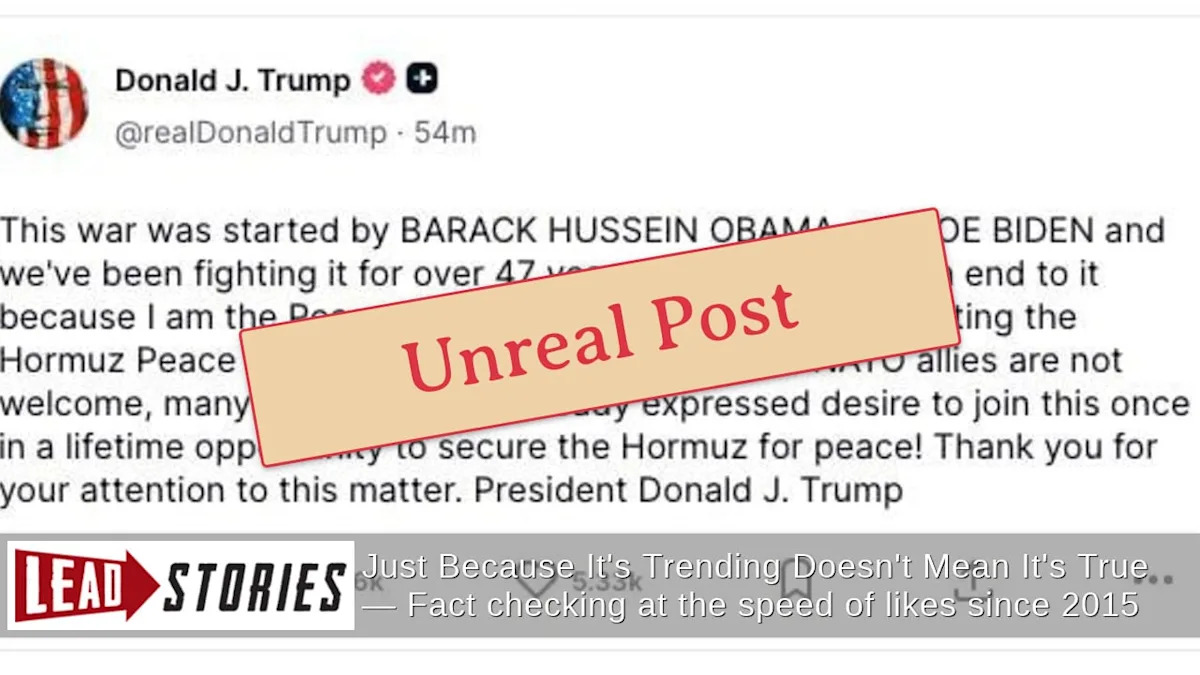
In a case of digital misinformation, claims that former President Donald Trump announced the creation of a “Hormuz Peace Board” on his Truth Social platform have been debunked as fabricated.
The alleged post, which circulated on X (formerly Twitter) on March 16, contained inflammatory statements claiming that former Presidents Barack Obama and Joe Biden had started a war with Iran that the United States has “been fighting for over 47 years.” The fabricated message went on to declare Trump as “the Peace President” who would establish a “Hormuz Peace Board” that would exclude NATO allies.
Comprehensive fact-checking revealed no evidence of such a post on Trump’s Truth Social account. Searches for the specific phrase “Hormuz Peace Board” within Trump’s social media presence yielded no results, confirming the post as inauthentic.
The false post appeared on the X platform from an account using the handle @Ahab4Eva, accompanied by the caption “He’s flopping around like a chicken with its head cut off,” seemingly designed to mock the former president’s communication style.
This instance highlights the ongoing challenge of misinformation on social media platforms, particularly involving high-profile political figures. The Strait of Hormuz, a strategic waterway between Iran and the Arabian Peninsula through which approximately one-fifth of the world’s oil supply passes, has been a geopolitical flashpoint for decades, making it a plausible but false backdrop for the fabricated announcement.
The reference to a 47-year conflict with Iran contains a glaring historical inaccuracy. While U.S.-Iran relations have been strained since the 1979 Islamic Revolution and subsequent hostage crisis, characterizing it as a continuous war spanning nearly five decades is factually incorrect. This obvious error should serve as a red flag for readers encountering such content.
Digital literacy experts consistently advise social media users to verify political statements by checking official accounts and reliable news sources before sharing or reacting to provocative content. The spread of such fabricated political statements can contribute to polarization and undermine public trust in genuine political discourse.
The incident also underscores the importance of platform-specific verification. Truth Social, launched by Trump after his suspension from mainstream social platforms, has become a primary communication channel for the former president, making it the authoritative source for verifying statements attributed to him.
Google searches incorporating site-specific parameters failed to return any results linking the phrase to Trump’s Truth Social account, providing further evidence of the post’s inauthenticity.
This type of misinformation, which mimics a political figure’s communication style and platform, represents a sophisticated form of digital deception that can quickly spread across social networks before fact-checking efforts can intervene.
As election cycles intensify, both platforms and users face increased responsibility to combat the spread of fabricated political content that can mislead voters and inflame tensions. Social media companies continue to refine policies and tools to identify and limit the spread of false information, though the challenge remains substantial given the volume and velocity of content across digital spaces.
Fact Checker
Verify the accuracy of this article using The Disinformation Commission analysis and real-time sources.

14 Comments
This serves as a reminder of the importance of verifying information, especially in the age of social media where misinformation can spread rapidly. The fact-checking process here is commendable and helps uphold the credibility of online content.
You’re right, the ability to quickly identify and debunk fabricated social media posts is crucial. Fact-checking efforts like this help maintain trust in the information we consume online.
This highlights the ongoing challenge of combating misinformation on social media. While it’s disappointing to see fabricated posts circulating, I’m encouraged by the fact-checking efforts that were able to swiftly identify and debunk this claim. Maintaining the truth is crucial.
Absolutely. The ability to quickly verify the authenticity of online content is essential in the digital age. Fact-checking plays a vital role in upholding the integrity of information shared on social media.
It’s concerning to see false claims circulating on social media, even about high-profile figures. I’m glad the fact-checkers were able to thoroughly investigate and confirm this post as fabricated. Upholding the truth is essential in the digital age.
I agree, the proliferation of misinformation online is a serious issue. Rigorous fact-checking is vital to ensure the integrity of information shared on social media platforms.
It’s disappointing to see false information being spread, even about high-profile political figures. However, I’m glad the fact-checkers were able to thoroughly investigate and confirm the post as fabricated. Upholding the truth is crucial.
Absolutely. Fact-checking is a critical process in the digital age to ensure the information we consume is accurate and reliable. This helps prevent the spread of harmful misinformation.
This highlights the challenges of monitoring social media platforms for accurate information. While it’s concerning to see fabricated posts circulating, I’m glad the fact-checkers were able to quickly identify and debunk this particular claim.
You’re right, the proliferation of misinformation on social media is a growing issue. Rigorous fact-checking is essential to maintain the integrity of online discourse.
Interesting to see fact-checking in action. It’s important to distinguish real social media posts from fabricated ones, especially when they involve inflammatory political claims. This helps maintain trust in the information we consume online.
Absolutely. Verifying the authenticity of online content is crucial in today’s digital landscape. Fact-checking efforts play a vital role in combating the spread of misinformation.
The prevalence of misinformation on social media platforms is a concerning trend. I’m glad to see this particular claim was swiftly debunked through comprehensive fact-checking. Maintaining the integrity of online discourse is essential.
I agree, fact-checking is crucial in today’s digital landscape. It’s important to distinguish real information from fabricated content, especially when it involves political figures and sensitive topics.