


Listen to the article
Evidence Points to U.S. Involvement in Iranian School Bombing Despite Trump Denial
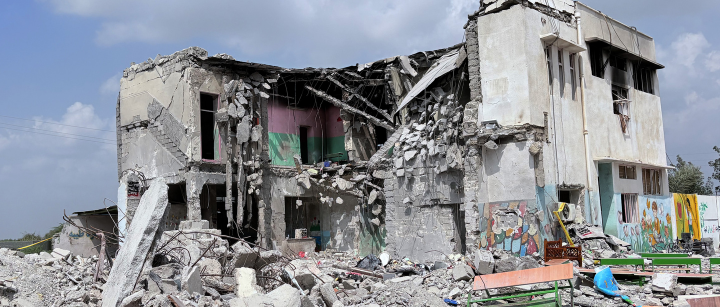
Multiple independent investigations, including video footage, satellite imagery, and expert analysis, suggest the United States likely bears responsibility for the February 28 bombing of an Iranian elementary school that reportedly killed numerous young girls—contradicting former President Donald Trump’s claims that “Iran did it.”
When questioned about the bombing of Shajareh Tayyebeh elementary school while aboard Air Force One on March 7, Trump firmly rejected U.S. involvement, stating, “No, in my opinion, based on what I’ve seen, that was done by Iran.” He added: “We think it was done by Iran – because they are very inaccurate, as you know, with their munitions. They have no accuracy whatsoever.”
Defense Secretary Pete Hegseth, standing nearby, was notably more cautious in his response, saying only that “we’re certainly investigating” before adding that “the only side that targets civilians is Iran.”
The bombing occurred during the first day of “Operation Epic Fury,” a joint U.S.-Israeli military campaign targeting Iran. The school was located in close proximity to an Iranian naval base operated by the Islamic Revolutionary Guard Corps (IRGC) that was also struck in the attacks. Iranian officials have claimed more than 160 people, primarily students, were killed, though this figure has not been independently verified.
A key piece of evidence emerged on March 8 when Mehr News Agency, a semi-official Iranian news outlet, released video showing a missile striking the area where both the naval base and school were located in southern Iran. Multiple news organizations, including The New York Times and The Washington Post, verified the video’s authenticity using geolocation tools.
Satellite imagery obtained by The New York Times “shows that multiple precision strikes hit at least six Revolutionary Guards buildings along with the school,” with four buildings completely destroyed. The timing suggests the school may have already been struck when another missile, captured in the video, impacted nearby structures.
Eight munitions experts interviewed by The Washington Post identified the missile in the footage as a Tomahawk Land Attack Missile—a weapon developed and used by the U.S. military during the operation. The U.S. has released several videos showing these long-range missiles being launched from Navy warships during the conflict.
Trevor Ball, a former U.S. Army explosive ordnance disposal technician now working with investigative journalism group Bellingcat, wrote on social media that the footage “shows a US Tomahawk missile hitting an IRGC facility in Minab, Iran, on Feb 28, showing for the first time that the US struck the area.” He concluded that “the footage appears to contradict President Donald Trump’s claim it was an Iranian missile that hit the school.”
At a March 9 press conference in Miami, Trump maintained his position, suggesting Iran “also has some Tomahawks” and that “a Tomahawk is very generic.” However, military experts promptly disputed this claim. Mark Cancian, senior adviser at the Center for Strategic & International Studies, confirmed that “Iran has none, though it has lots of missiles of different kinds.” Ball added that the U.S. “is the only participant in the war that is known to have Tomahawk missiles.”
General Dan Caine, chairman of the Joint Chiefs of Staff, stated at a March 4 news conference that initial U.S. airstrikes were concentrated in southern Iran, precisely where the school bombing occurred, while Israel “predominantly” targeted air defense systems in Iran’s “northern flank.”
Several news outlets, including Reuters, the Associated Press, CBS News, and The Wall Street Journal, cited unnamed U.S. officials stating that military investigators believe U.S. forces were “likely” responsible for the strike. CBS News reported that the preliminary assessment suggests the United States “did not intentionally target the school and may have hit it in error, possibly due to the use of dated intelligence which wrongly identified the area as still part of an Iranian military installation.”
The White House has pushed back on these reports, with spokeswoman Anna Kelly stating that the “investigation is ongoing” and has reached “no conclusions at this time.” She called it “both irresponsible and false for anyone to claim otherwise.”
A definitive determination of responsibility remains challenging, as arms expert N.R. Jenzen-Jones noted that remnants of the missile would need examination, and no independent agency has been able to access the site during the ongoing conflict.
When pressed on why he remains the only U.S. government figure claiming Iranian responsibility, Trump acknowledged, “I just don’t know enough about it” and said “whatever the report shows, I’m willing to live with that report.”
Fact Checker
Verify the accuracy of this article using The Disinformation Commission analysis and real-time sources.
