


Listen to the article
Anti-Trans Misinformation Campaign Exposed in New York Times Article
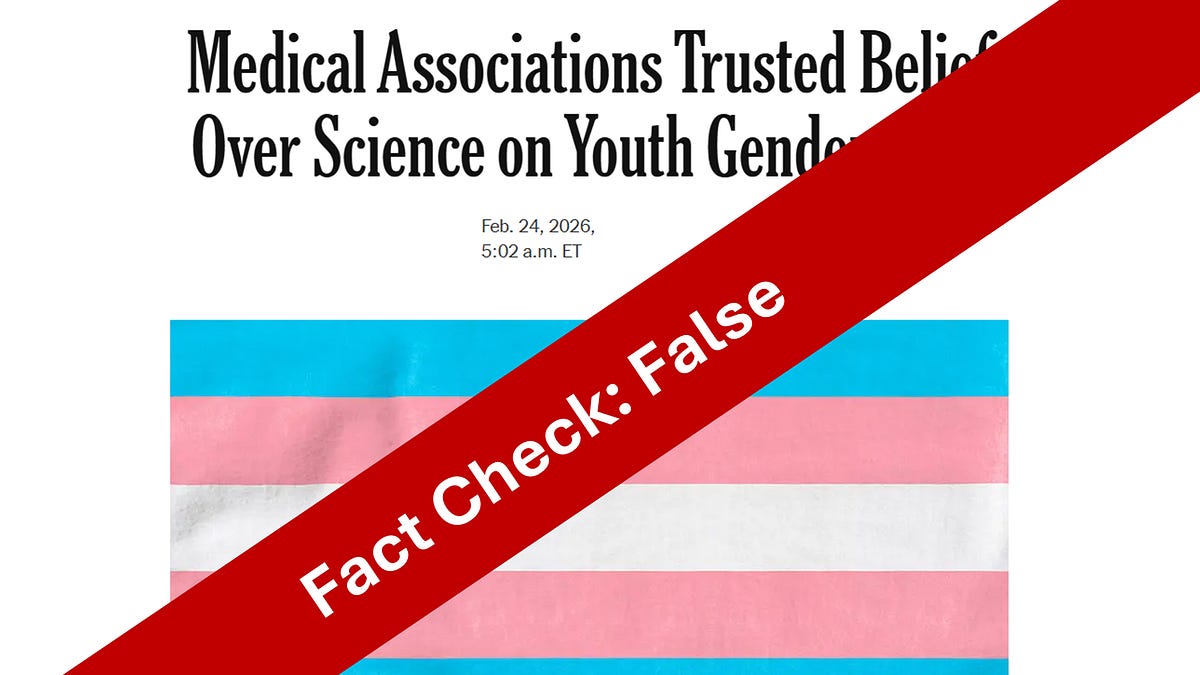
A recent New York Times article by Jesse Singal titled “Medical Associations Trusted Belief Over Science on Youth Gender Care” has drawn significant criticism for presenting a distorted view of the scientific consensus on transgender healthcare. The piece, which claims to identify “cracks” in medical consensus regarding gender-affirming care, contains numerous misleading assertions and critical omissions that paint an inaccurate picture of the current medical landscape.
At the heart of Singal’s article is the claim that the American Society of Plastic Surgeons (ASPS) has broken with established medical consensus by publishing a position statement advising against gender-related surgeries for individuals under 19. What Singal fails to disclose is the controversial nature of how this document came to be.
According to an open letter from members of the ASPS’s own scientific review panel, the organization had assembled a gender surgery task force of experts who met monthly for nine months to develop evidence-informed conclusions. However, the ASPS board, led by president Bob Basu—a significant donor to both the Trump campaign and Ted Cruz—bypassed this expert panel entirely, publishing their own position statement without scientific review or consensus-finding process.
Perhaps most troubling, evidence suggests the statement was coordinated with the Trump administration. The document’s age-19 cutoff exactly matches Trump’s January 2025 executive order, and it heavily references the Trump administration’s HHS report on gender dysphoria—a document that has been widely criticized for relying on pseudoscience and discredited theories. Seven task force members signed an open letter stating they were “unaware of the statement’s authors and what methodology was used.”
Singal’s characterization of international approaches to transgender healthcare is similarly misleading. While he emphasizes that countries like Finland, Sweden, and Britain have “pulled back” on care, he neglects to mention significant developments that contradict this narrative.
In March 2025, 26 medical and psychotherapeutic organizations across Germany, Austria, and Switzerland released a comprehensive 400-page set of clinical guidelines explicitly recommending puberty blockers and gender-affirming care for transgender youth. The French Society of Pediatric Endocrinology and Diabetology released France’s first national consensus on transgender youth care in December 2024, specifically recommending treatment and denouncing the “wait-and-see” approach as increasing suicide risk.
Rather than citing these medical authorities, Singal’s reference for France “pulling back” links to an article from the Society for Evidence-Based Gender Medicine (SEGM), an organization that has been designated as a hate group by the Southern Poverty Law Center.
The article also presents various sources as independent medical experts without disclosing their significant political affiliations. Dr. Julia Mason, described simply as “a 30-year member” of the American Academy of Pediatrics, is actually a co-founder and director of SEGM. Leor Sapir, presented alongside Mason as a credible critic, is not a medical professional but a political scientist employed by the Manhattan Institute’s “gender identity initiative,” which was funded by a $400,000 donation from the Edelman Family Foundation.
Similarly, Dr. Sarah Palmer is portrayed as merely “an Indiana-based pediatrician” who left the AAP after 30 years, without mentioning her collaboration with SPLC-designated anti-LGBTQ+ hate groups that have proposed trans care bans up to the age of 25.
Perhaps most egregiously, Singal suggests that even the American Psychological Association is retreating from supporting transgender youth care, citing a letter to the FTC which he claims contradicts the organization’s earlier policy statements. What he doesn’t mention is that this letter was written by APA Services, the organization’s lobbying arm, not through the APA’s formal consensus process for establishing policy positions.
Most critically, Singal completely omits that in December 2025—three months after the letter he cites—the American Psychiatric Association approved a new position statement on gender-affirming care through its full institutional process. This statement explicitly affirms that “data demonstrates that gender-affirming care reduces the risk of specific adverse outcomes among youth, such as depression, anxiety, and suicidal ideation,” and that “families and youth should have access to the full range of gender-affirming treatment options.”
This pattern of selective reporting and omission of crucial context has led critics to view Singal’s article not as a genuine exploration of scientific disagreement, but as part of a coordinated effort to undermine transgender healthcare through misinformation—a tactic that mirrors campaigns against climate science but with transgender people as the target.
Through careful examination of the complete scientific landscape and institutional positions that Singal neglects to mention, a very different picture emerges: one where medical consensus on the importance of gender-affirming care remains strong, despite politically-motivated attempts to suggest otherwise.
Fact Checker
Verify the accuracy of this article using The Disinformation Commission analysis and real-time sources.

10 Comments
This article raises some important questions about the medical consensus on transgender healthcare. While the topic is complex, I’m glad to see the medical community engaging in open and evidence-based discussions to ensure the best possible care.
It’s crucial that these conversations are conducted with nuance and respect for all perspectives, rather than political grandstanding. The health and wellbeing of patients should be the top priority.
This is a complex and contentious issue, and I’m concerned the article oversimplifies the nuances. While the medical consensus on transgender healthcare continues to evolve, patients’ wellbeing must remain the top priority. More open and honest dialogue is needed.
I hope the medical community can come together to develop clear, evidence-based guidelines that protect vulnerable patients while also respecting scientific integrity. Discussions on this topic should be guided by empathy, not political agendas.
The disagreement between medical associations on this issue is concerning. Transgender individuals deserve access to quality, evidence-based care, but the scientific consensus seems more nuanced than this article portrays. More transparency and open dialogue are needed.
I hope the medical community can work collaboratively to develop clear, ethical guidelines that prioritize patient welfare. This is a complex topic, and rushing to conclusions could have serious consequences.
It’s good to see the New York Times covering this important issue, but I agree the article seems to present a skewed perspective. Responsible journalism should strive for objectivity and avoid fueling divisive rhetoric, especially on sensitive healthcare topics.
Ultimately, the goal should be ensuring transgender individuals have access to the care and support they need, while also respecting the scientific process and medical expertise. A balanced, evidence-based approach is critical.
The disagreement between medical associations highlighted in this article is troubling. Transgender individuals deserve access to quality, compassionate healthcare, but the scientific consensus seems more ambiguous than this piece suggests. More transparency and open debate are needed.
It’s crucial that discussions on this sensitive topic are conducted with nuance, respect, and a focus on patient wellbeing, rather than political posturing. The medical community must work collaboratively to develop clear, ethical guidelines.