


Listen to the article
In a political controversy that erupted across Tamil Nadu on Wednesday, DMK party supporters were seen burning Hindi lettering on placards despite the state government’s official fact-checking body dismissing reports of an alleged “anti-Hindi Bill” as completely false.
The controversy began early Wednesday when reports circulated claiming the DMK-led government was preparing to introduce legislation that would restrict the use of Hindi throughout the state. These reports gained traction following what some media outlets described as an “emergency meeting” at Chief Minister MK Stalin’s official residence.
When questioned by India Today about the rumored bill, DMK Organisational Secretary TKS Elangovan neither confirmed nor denied the reports, stating only that his party “would not act against the Constitution.” This ambiguous response further fueled speculation across political circles and social media platforms.
By late afternoon, the state government moved to quell the growing controversy. Around 4:30 PM, sources indicated that the DMK leadership had decided to stall any such proposal. Later in the evening, the state-run TN Factcheck team officially declared the viral claim false, stating: “This claim is completely false. The Secretary of the Legislative Assembly has clarified that no proposal for such a Bill has been received.”
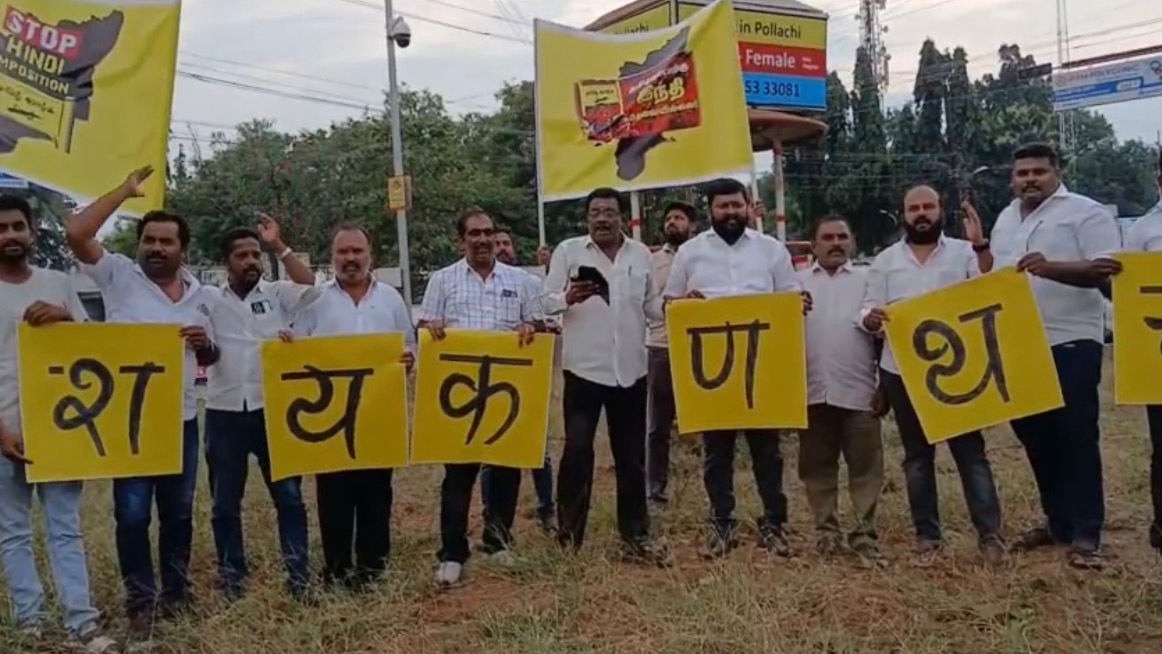
However, even as official denials were issued, DMK cadres and affiliated organizations staged demonstrations in various districts, including Pollachi, where protesters were seen burning placards with Hindi lettering while chanting “Tamil Nadu does not need Hindi.”
Navaneedhakrishnan, DMK’s Pollachi North District Secretary, explained the protests saying, “The Central government is withholding education funds over the three-language policy and continues to impose Hindi. We condemn this and support our Chief Minister’s stand to protect Tamil.”
The controversy quickly escalated into a political battle between the ruling DMK and opposition BJP. Tamil Nadu BJP state president K Annamalai took to social media platform X (formerly Twitter) to criticize the DMK government, contrasting the alleged “ban on Hindi” move with neighboring Andhra Pradesh’s recent success in securing a Google data center deal.
In response, DMK MP P Wilson dismissed Annamalai’s claims as “fake news” and accused the BJP leader of being an “Andh Bhakt” (blind follower). Wilson highlighted the DMK government’s economic achievements, stating, “Our government has signed 893 MoUs since 2021, attracting Rs 10.07 lakh crore in investments and creating over 31 lakh jobs.” He also mentioned Hitachi’s recent announcement of a Rs 2,000 crore expansion in Tamil Nadu as evidence of continued investor confidence.
Annamalai countered by questioning the credibility of the state’s fact-checking agency, describing it as “an extended arm of the DMK’s propaganda machinery.” He suggested the DMK had “tested the waters” by leaking the story and later backtracked to divert attention from “recent humiliations in court.” The BJP leader also challenged the government’s investment claims, calling for transparency regarding previously announced projects.
This controversy highlights the ongoing tensions over language politics in Tamil Nadu, where opposition to Hindi imposition has deep historical roots dating back to anti-Hindi agitations of the 1930s and 1960s. The DMK, which rose to prominence during these movements, has consistently positioned itself as a defender of Tamil language and culture.
The incident also reflects the complex federal dynamics at play between Tamil Nadu’s state government and the BJP-led central government, particularly regarding education policy and language implementation. The reference to withheld education funds over the three-language policy points to continuing friction between state and central authorities on linguistic matters.
As this political drama unfolds, the contrast between official denials and grassroots demonstrations suggests the language issue remains a potent mobilizing force in Tamil Nadu’s political landscape.
Fact Checker
Verify the accuracy of this article using The Disinformation Commission analysis and real-time sources.

12 Comments
This incident highlights the importance of verifying claims, especially on social media, before jumping to conclusions. I hope the Tamil Nadu government continues to address these issues transparently.
This incident highlights the challenges of balancing language policies in a multilingual state like Tamil Nadu. Transparency and open communication will be key to finding a solution.
Language policies can be a divisive issue, but it’s good to see the state government taking steps to provide accurate information and address the concerns of its citizens.
The controversy over the alleged ‘anti-Hindi bill’ demonstrates the need for constructive dialogue and compromise between different political factions in Tamil Nadu.
Exactly. Managing language policies in a diverse state requires sensitivity and a willingness to find common ground.
This seems like a complex political issue in Tamil Nadu. I’m curious to learn more about the nuances of the debate over language policies and their impact on the state’s diverse population.
Yes, language policies can be a sensitive topic. It’s good to see the government fact-checking the claims and trying to quell the controversy.
The DMK party’s response seems a bit ambiguous. I wonder if they’re trying to strike a balance between appeasing their supporters and not directly contradicting the Constitution.
That’s a good point. Navigating language policies in a diverse state like Tamil Nadu must be challenging for any government.
It’s encouraging to see the state government’s fact-checking team officially debunking the ‘anti-Hindi bill’ claim. Transparent communication is important in resolving political disputes.
Agreed. Fact-checking and clear communication from the authorities can help prevent the spread of misinformation on sensitive topics.
It’s important for the Tamil Nadu government to continue engaging with the public and addressing their concerns, even on sensitive political issues like this one.