


Listen to the article
In a dramatic reversal of widely shared claims, data scientists have debunked a recent analysis suggesting transgender identification is declining in America, revealing instead that the numbers continue to rise across demographic groups.
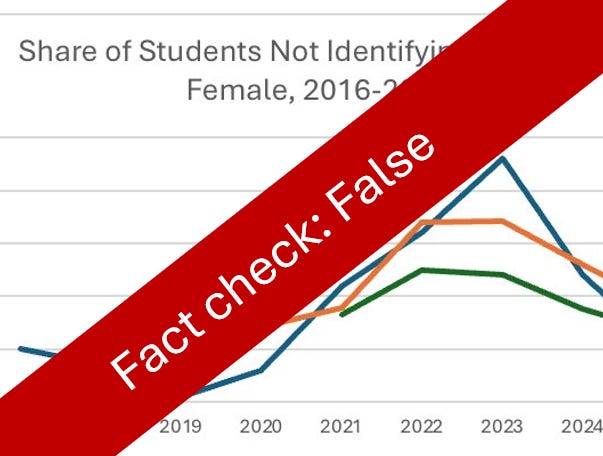
The controversy began Tuesday when Eric Kaufmann, a right-wing academic, published what he described as groundbreaking research through his Centre for Heterodox Social Science and the publication UnHerd. His analysis claimed to show transgender identification in America was in “free fall” among young people – a conclusion that quickly gained traction among conservative voices.
Within hours, prominent figures seized on the findings. Tech billionaire Elon Musk shared the graph with his hundreds of millions of followers, while conservative commentator Matt Walsh boasted, “Transgenderism is effectively over. We destroyed it.” Walsh received personal thanks from Musk for “playing a major role” in what they celebrated as a victory.
However, independent researchers soon discovered Kaufmann’s analysis contained a fundamental statistical error that completely invalidated his conclusions. Data scientist Jacob Eliason first identified that Kaufmann had failed to apply standard survey weights to the raw data from the Foundation for Individual Rights and Expression (FIRE), the organization behind the original survey.
“Deriving causal claims about temporal effects from cross-sectional data is always challenging, but a good faith answer to the question of how the prevalence of gender non-conforming identification has changed over time is dead on arrival without survey weights,” Eliason explained.
The error wasn’t minor. When properly weighted to make the results nationally representative – a standard practice in survey research – the trend line flipped entirely. The corrected analysis showed the share of students identifying outside traditional gender categories had actually increased to approximately 10% and remained stable since early 2024.
Dr. Robert Bohan, who holds an advanced diploma in statistics from Trinity College Dublin, explained the significance of the error: “Without weighting, a survey is unrepresentative. Every single political poll uses weighting. No one would pay for an unweighted one.”
To illustrate the problem, consider two annual campus surveys on gender identity. If one year samples predominantly from liberal arts colleges and the next from rural campuses, any apparent drop in LGBTQ+ identification could simply reflect sampling differences rather than actual population changes. This is precisely why reputable survey organizations require weights before drawing conclusions.
When questioned about his methodology, Kaufmann offered a brief response: “Yes no weights. I don’t believe weighting is appropriate for this kind of over time analysis.” This justification left data scientists baffled, as longitudinal comparisons actually make weighting more crucial, not less.
To verify the proper approach, FIRE itself was contacted about whether the data should be used with or without survey weights. Karl de Vries, speaking for the organization, was unequivocal: “FIRE strongly recommends applying the weights to all analyses, as this is a standard practice in survey research.”
Beyond correcting Kaufmann’s analysis, more reputable data sources confirm transgender identification continues to rise nationwide. Gallup, considered an industry standard in polling, reports that 1.3 percent of Americans now identify as transgender, up from 0.9 percent in 2023 and significantly higher than the approximately 0.5 percent reported in earlier surveys.
Generation Z accounts for much of this increase, with LGBTQ+ identification broadly climbing across all categories. These findings suggest that as stigma decreases and visibility improves, more individuals feel safe enough to express their authentic identities.
The incident highlights the importance of scrutinizing research, particularly when it comes from ideologically driven sources bypassing peer review. Kaufmann, who has previously advocated for “white self-interest” and publishes through vaguely named institutions, appears to be conducting politically motivated research rather than neutral scholarship.
The rapid spread of the faulty analysis demonstrates how misinformation can shape public perception and policy discussions long before corrections can catch up – a reminder that data interpretation requires both technical competence and intellectual honesty to be meaningful.
Fact Checker
Verify the accuracy of this article using The Disinformation Commission analysis and real-time sources.

9 Comments
The statistical error that invalidated the initial claims highlights the importance of rigorous methodology and peer review, especially on sensitive topics that can be susceptible to ideological biases. I’m curious to see how this story develops.
Absolutely. The debunking serves as a valuable lesson in the need for transparency and accountability in academic research, particularly when the findings have the potential to influence public discourse.
This is a complex and sensitive topic. I appreciate the fact-checking efforts to verify the claims. It’s important to rely on credible, data-driven sources when discussing trends in identity and demographics.
This case underscores the importance of fact-checking and verifying claims, even from seemingly authoritative sources. I hope the scrutiny applied to this research will encourage more careful, objective analysis on complex social issues.
The findings seem to highlight the need for careful statistical analysis and peer review, especially on issues that can be politicized. I look forward to seeing further research that provides a more nuanced and reliable picture.
Agreed. It’s crucial that discussions around gender identity are grounded in rigorous, impartial analysis rather than ideological agendas.
The reversal of the initial findings is a good reminder that claims, even from ostensibly reputable sources, should be viewed with a critical eye and subjected to independent verification. This helps maintain trust in the scientific process.
Discussions around gender identity and demographics can be highly polarized. I appreciate the efforts to provide a more balanced, fact-based perspective on this issue. Nuance and objectivity are essential when addressing complex social trends.
While the initial claims gained traction, the subsequent debunking underscores the importance of scrutinizing research methodology and conclusions, especially on socially charged topics. I hope this serves as a lesson in the value of critical thinking.