


Listen to the article
A Supreme Court ruling on human rights petitions incorrectly linked to Duterte’s ICC case
The Philippine Supreme Court’s 2024 dismissal of protective writs filed by local human rights organizations has been misrepresented in a viral video claiming former president Rodrigo Duterte is set to be released from International Criminal Court detention.
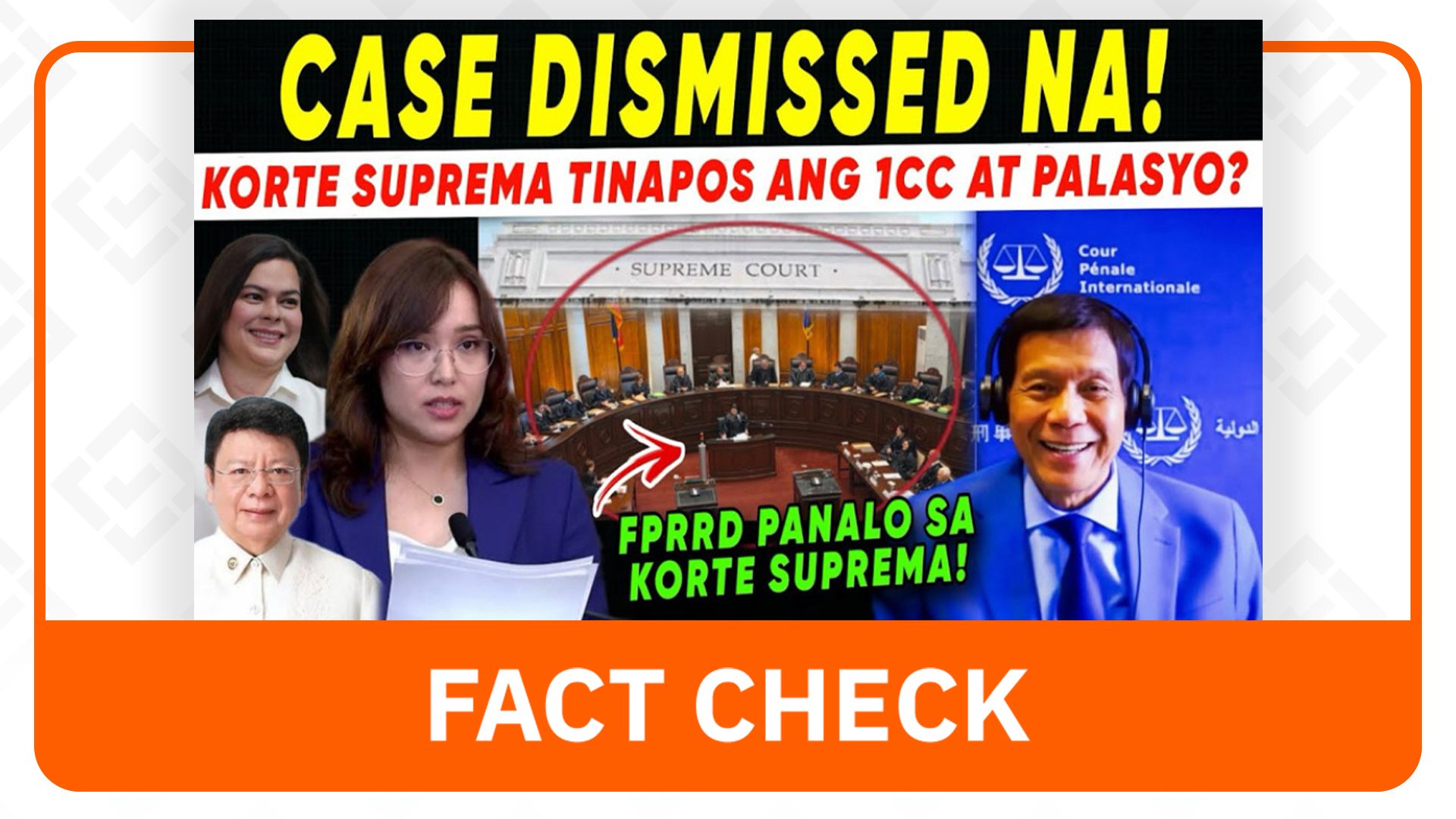
The YouTube video, which has garnered over 103,000 views since its October 7 posting, falsely connects two separate legal matters. Titled “Shocking good news! Uuwi na [at] panalo si FPRRD, nagdesisyon na ang Korte Suprema! Palasyo [at] Kamara, tiklop!” (Shocking good news! Former President Rodrigo Roa Duterte is coming home victorious, the Supreme Court has decided! The Palace and Congress are cornered!), the video misleadingly suggests that a Philippine Supreme Court decision has implications for Duterte’s ICC case.
The video’s thumbnail reinforces this erroneous connection with phrases like “Case dismissed!” and “FPRRD panalo sa Korte Suprema!” (FPRRD wins in the Supreme Court) alongside ICC references.
In reality, the Supreme Court ruling mentioned in the video relates to a completely different legal matter. In May 2019, three human rights organizations—Karapatan, Rural Missionaries of the Philippines, and Gabriela—filed petitions seeking writs of amparo and habeas data. These protective legal remedies were sought for their members who allegedly faced threats and extrajudicial killings during Duterte’s presidency.
The Court of Appeals dismissed these petitions in June 2019, citing insufficient evidence. The petitioners subsequently appealed to the Supreme Court, which affirmed the dismissal with finality in 2024. This decision has no bearing whatsoever on the ICC’s proceedings against Duterte.
Contrary to the video’s claims, Duterte remains in detention at the ICC facility in The Hague, Netherlands, following his arrest in March. The former president faces three counts of widespread murder related to his controversial war on drugs campaign, which allegedly resulted in thousands of extrajudicial killings during his administration.
Most recently, on October 10, the ICC Pre-Trial Chamber I rejected Duterte’s request for interim release. The court determined that he continues to pose a flight risk and that concerns about witness intimidation and potential re-commission of crimes remain valid. The court also denied his appeal for humanitarian release, though it stated that his right to family life remains guaranteed under the court’s detention conditions.
This is not the first instance of misinformation regarding Duterte’s ICC case. Multiple false claims about his supposed release from ICC custody have previously circulated on social media platforms and been debunked by fact-checkers.
The spread of such misinformation comes amid continuing public interest in the former president’s case, which represents one of the most significant international legal proceedings involving a Philippine leader. The ICC investigation has been controversial in the Philippines, with some supporting accountability for alleged human rights violations and others viewing it as an infringement on national sovereignty.
For accurate information about legal proceedings, especially those of international significance, the public is advised to rely on official court documents and credible news sources rather than unverified social media content.
Fact Checker
Verify the accuracy of this article using The Disinformation Commission analysis and real-time sources.

8 Comments
While the details of Duterte’s ICC case remain unresolved, it’s concerning to see it being misrepresented in this manner. Maintaining a clear distinction between separate legal proceedings is crucial for accurate reporting and public understanding.
This seems like an unfortunate case of misinformation. The Supreme Court ruling was unrelated to Duterte’s ICC case, which remains ongoing. It’s important to carefully distinguish between separate legal proceedings and avoid conflating them, even inadvertently.
You’re right, it’s critical to report accurately on complex legal matters and not jump to conclusions. Mixing up different cases can lead to real confusion.
While the ICC case against Duterte is very serious, it’s concerning to see it being misrepresented in this way. Accurate reporting on the status and details of these proceedings is essential, even if the outcomes may be politically charged.
Agreed. Responsible journalism is key when covering high-profile legal battles with global implications. Maintaining objectivity and distinguishing facts from speculation is crucial.
This situation highlights the importance of verifying information, especially around sensitive political and legal issues. Rushing to conclusions or conflating unrelated court decisions can spread misinformation and undermine public trust.
It’s disappointing to see the Supreme Court ruling being mischaracterized in this way. Fact-checking and careful reporting are vital to prevent the spread of misinformation, even if it means debunking appealing narratives.
You make a good point. Responsible journalism requires resisting the temptation to sensationalize or oversimplify complex stories, no matter how enticing the headlines may be.