


Listen to the article
Recent Supreme Court Ruling Clarifies Religious Conversion Impact on SC Status, Not ST Reservations
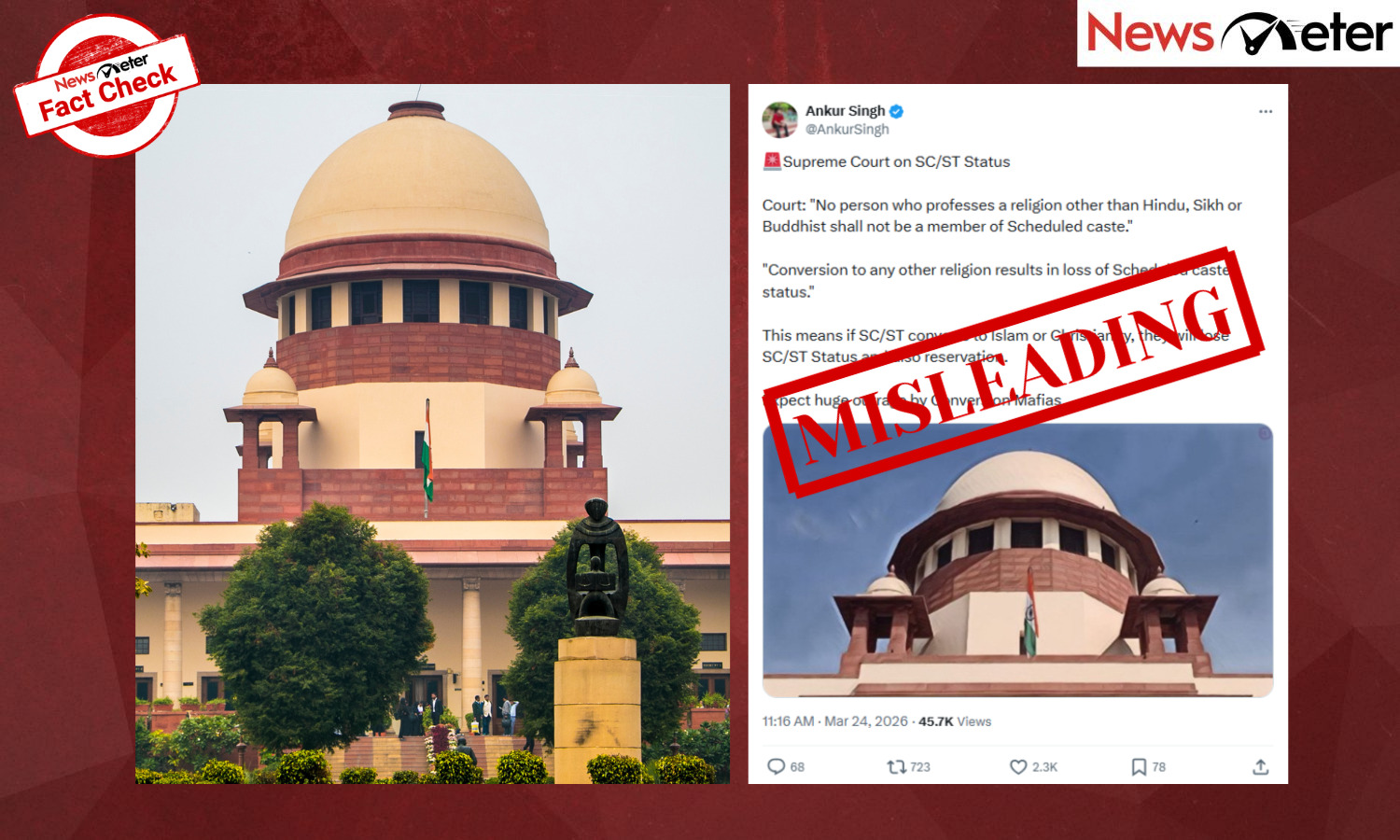
A social media claim suggesting that members of Scheduled Tribes (ST) would lose their reservation benefits upon converting to Islam or Christianity has been debunked as misleading by fact-checkers. The viral posts, which circulated following a Supreme Court judgment on March 24, misrepresented the court’s actual ruling.
The Supreme Court’s decision specifically addressed Scheduled Caste (SC) status, confirming that individuals who convert to Christianity cannot claim SC benefits. The two-judge bench of Justices Prashant Kumar Mishra and Manmohan upheld an Andhra Pradesh High Court order that stated a person cannot simultaneously profess a religion other than Hinduism, Sikhism, or Buddhism while claiming SC status.
“No person who professes a religion different from Hinduism shall be deemed to be a member of a Scheduled Caste,” reads Paragraph 3 of the Constitution (Scheduled Castes) Order, 1950, which formed the legal basis for the court’s decision.
The judgment reflects the constitutional framework established under Article 341, which ties SC status to specific religious identities. This framework recognizes the historical relationship between the caste system and certain religions, particularly Hinduism, while acknowledging that similar social structures exist in Sikhism and Buddhism.
However, the ruling has no bearing on members of Scheduled Tribes. ST status is determined by entirely different criteria based on tribal identity and regional factors, as outlined in Article 342 of the Constitution and the Constitution (Scheduled Tribes) Order, 1950.
Supreme Court advocate Abhilash MR explained to fact-checkers that the distinction lies in the constitutional provisions governing these communities. “The Constitution (Scheduled Castes) Order, 1950, imposes religious restrictions, while the Constitution (Scheduled Tribes) Order, 1950, does not have such restrictions,” he noted.
For tribal communities, their protected status hinges on maintaining their tribal identity rather than religious affiliation. This means that ST members can convert to any religion, including Islam or Christianity, without jeopardizing their reservation benefits or constitutional protections.
The misinterpretation of the Supreme Court ruling spread rapidly across social media platforms, with users on X (formerly Twitter) and Facebook sharing the incorrect claim. One viral post incorrectly stated that the Supreme Court had ruled “if SC/ST converts to Islam or Christianity, they will lose SC/ST Status and also reservation,” predicting “huge outrage by Conversion Mafias.”
This misinformation highlights the complex intersection of religion, caste, and tribal identities in India’s reservation system. It also points to the persistent confusion about the distinct constitutional frameworks governing SC and ST communities.
The spread of such claims occurs against a backdrop of ongoing debates about conversion and reservation policies in India. Some advocates have long argued for extending SC status to Dalits who convert to Christianity or Islam, pointing to studies showing that caste-based discrimination often persists even after religious conversion.
The Supreme Court’s recent judgment reaffirms the existing constitutional position while leaving open broader questions about the relationship between religion, caste identity, and access to affirmative action programs in contemporary India.
As social media continues to serve as a platform for both information and misinformation on legal matters, this case underscores the importance of fact-checking and understanding the nuanced distinctions in India’s constitutional provisions regarding historically marginalized communities.
Fact Checker
Verify the accuracy of this article using The Disinformation Commission analysis and real-time sources.

13 Comments
The Supreme Court’s ruling seems to strike a careful balance between protecting constitutional provisions and acknowledging the nuances of religious conversion and tribal identity. Thoughtful deliberation on such sensitive issues is crucial.
Agreed. Navigating the intersection of constitutional law, religious freedom, and tribal rights requires a nuanced approach that considers diverse perspectives.
This case serves as a reminder of the importance of preserving the distinct identities and rights of marginalized communities, even as social and religious dynamics evolve. Careful consideration of these issues is crucial.
This is an interesting clarification on the legal status of tribal identity. It’s important to uphold constitutional principles while respecting the complex histories and identities of minority communities in India.
The court’s clarification on the impact of religious conversion on tribal status is an important legal development. It will be interesting to see how this ruling is interpreted and applied in practice.
This case highlights the need for clear, consistent policies that address the unique circumstances of different marginalized communities. Upholding the legal framework while respecting self-determination is a delicate balance.
The Supreme Court’s clarification on the impact of religious conversion on tribal status is an important legal development. It will be interesting to see how this ruling is interpreted and applied going forward.
The Supreme Court’s decision highlights the complex interplay between individual religious freedom and collective tribal identity. Navigating this balance will be an ongoing challenge for policymakers and communities.
This ruling provides much-needed clarity on the legal status of tribal identity in India. It’s a positive step, but continued efforts to protect the rights and autonomy of indigenous communities will be essential.
While the court’s decision may seem straightforward from a legal standpoint, the social and cultural implications are likely more complex. Ongoing dialogue between lawmakers, tribal representatives, and religious groups will be crucial.
Absolutely. Addressing issues at the intersection of identity, faith, and constitutional rights requires a nuanced, inclusive approach that considers diverse perspectives.
The Supreme Court’s decision provides much-needed clarity on the legal status of tribal identity in India. It’s a positive step, but continued efforts to protect the rights and autonomy of indigenous communities will be essential.
This ruling highlights the complex interplay between individual religious freedom and collective tribal identity. Striking the right balance will require ongoing dialogue and collaboration between all stakeholders.