


Listen to the article
Camel Tears as Snakebite Antivenom: Scientists Clarify Misleading Viral Claim
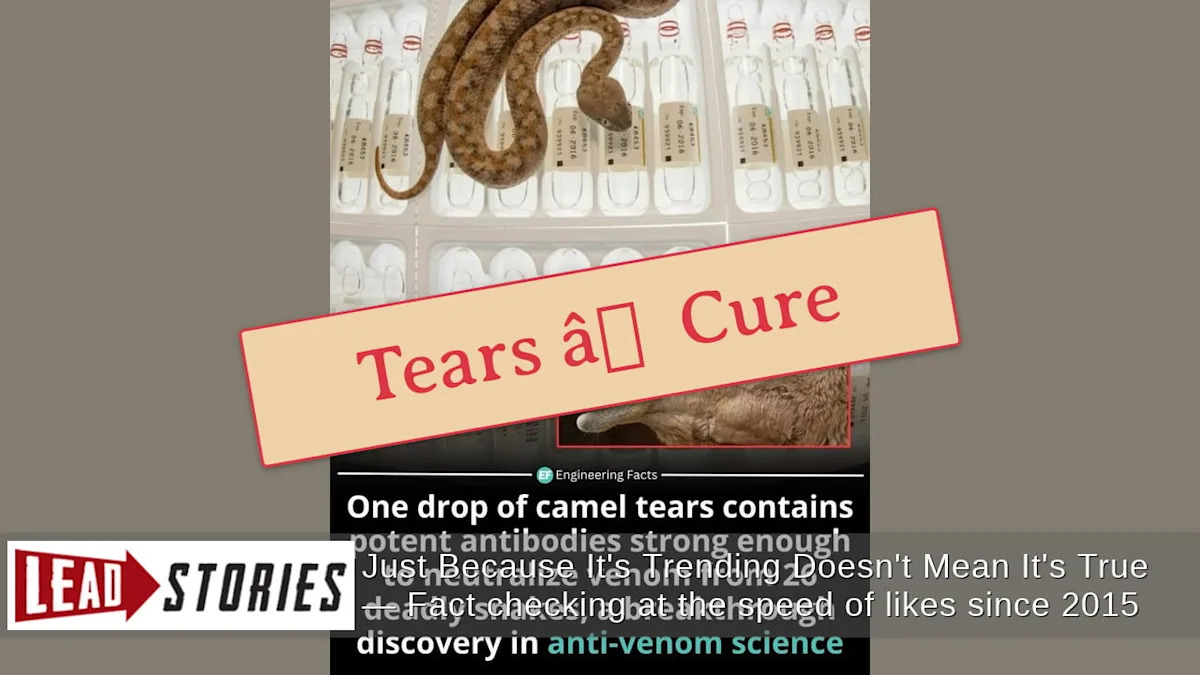
A viral claim suggesting that a single drop of camel tears contains antibodies capable of neutralizing venom from 26 different snake species has been debunked by medical experts. The assertion, which spread rapidly across social media platforms, significantly misrepresents current scientific research on animal-derived antivenoms.
The claim originated on Bluesky in late November when user @pleasebegneiss.bsky.social posted a humorous scenario about rushing a camel into an emergency room to watch “The Notebook” to collect its tears for treating a snakebite victim. While presented as a breakthrough in antivenom science, toxicology experts confirm this characterization is misleading and lacks scientific context.
Dr. Kim Aldy, an emergency room physician and toxicologist at Baylor Medical Center in Dallas, explained the fundamental scientific error in the claim. “A camel that has not been exposed to snake venom will not have antibodies against snake venom,” Aldy stated in correspondence with fact-checkers. “So the claim being circulated is out of context.”
The viral post fails to mention that any potential antivenom properties would only appear in the tears of camels previously immunized with snake venom—a crucial distinction that completely changes the scientific understanding of the process.
This immunization process is not unique to camels. As Dr. Aldy, who serves as Program Director at the American College of Medical Toxicology, clarified: “This is the same process used to create the current US snake antivenom in sheep, and what was previously done in horses. Once immunized, these camels will generate snake venom antibodies in their blood, and antibodies can also appear in other bodily secretions, like tears.”
The presence of antibodies in tears is actually common across species. “Humans also have antibodies in our tears, so this is not unique,” Aldy noted. “If I was immunized with small doses of snake venom over time—which I would not recommend—it’s possible that I would also have antibodies to snake venom in my tears!”
Research published in the National Library of Medicine in 2025 does show scientists investigating antibodies derived from camelid species such as alpacas and llamas for potential use in snakebite treatments. However, these studies represent early-stage research conducted on mice in laboratory settings, not proven human treatments.
The researchers themselves acknowledged that while their findings offer “hope for advancing such snakebite envenoming therapeutics to future clinical application,” they are far from declaring a functional human antivenom derived directly from camel tears.
What makes camelid antibodies of particular interest to researchers is their potential to create antivenoms that don’t require refrigeration—a significant advantage for use in tropical regions where snakebites are common and cold storage facilities limited. However, these would be laboratory-derived products from immunized animals, not raw tears collected directly from camels.
The viral claim exemplifies how scientific research can become distorted as it spreads through social media. By omitting critical details about immunization requirements and exaggerating the current state of research, what began as promising laboratory findings transformed into a misleading claim about miracle cures.
Snakebite treatments remain an important area of medical research, particularly for regions with limited healthcare infrastructure. While camelid-derived antibodies show promise, experts emphasize that effective treatments require rigorous scientific development and clinical trials before becoming viable options for human use.
Fact Checker
Verify the accuracy of this article using The Disinformation Commission analysis and real-time sources.

12 Comments
Fascinating to see the science behind the camel tears claim debunked. It’s a good reminder to be skeptical of viral health claims not backed by rigorous research.
Good to see this viral claim about camel tears debunked. Fact-checking is so important, especially when it comes to health and safety issues.
Interesting to see the science behind the camel tears claim examined. While it may have been presented as a joke, it’s still crucial to correct misinformation, even in a lighthearted context.
Glad to see experts clarifying the limitations of using camel tears as a snakebite antidote. While an intriguing idea, it seems the science just isn’t there to support it yet.
Absolutely. Relying on unproven remedies could be extremely risky when dealing with venomous snakebites. Better to stick to established medical treatments.
This is an important clarification. While camel tears may have other interesting properties, they don’t appear to be an effective snakebite antidote based on current research.
Appreciate the experts weighing in to set the record straight on this claim. It’s crucial we don’t spread potentially dangerous misinformation, even in jest.
Agreed. Even if the initial claim was presented humorously, it’s still important to correct the record and prevent the spread of inaccurate medical information.
This is an important fact-check. Spreading misinformation, even in jest, can be dangerous when it comes to medical claims. Good to see the science set straight.
As someone interested in natural remedies, I’m disappointed to hear the camel tears claim doesn’t hold up. But I appreciate the experts taking the time to clarify the science.
I’m glad to see this viral claim debunked. It’s a good reminder to be cautious about unverified health treatments, no matter how intriguing they may seem.
Absolutely. Spreading misinformation, even inadvertently, can have serious consequences. It’s crucial to rely on scientific evidence when it comes to medical claims.