


Listen to the article
President Trump to Deliver State of the Union Address Amid Economic Mixed Signals
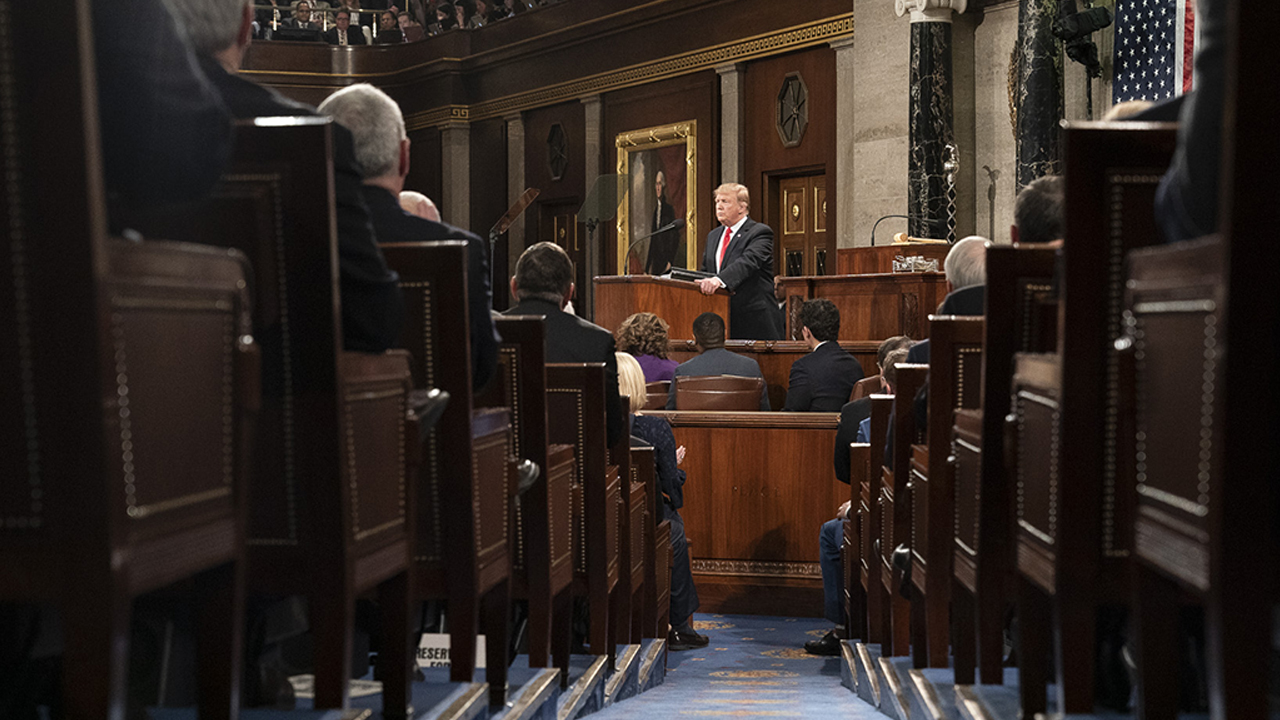
WASHINGTON – President Donald Trump will deliver the first State of the Union address of his second term on Tuesday evening, with his administration planning to spotlight the economy, immigration, crime, energy, and national security as key achievements and priorities.
The much-anticipated speech comes at a critical moment for the Trump administration as it navigates complex economic realities and implements significant policy shifts in its second term. White House officials have indicated the President will use the platform to highlight his administration’s accomplishments while setting the agenda for the coming year.
Economic performance will likely feature prominently in the address, with Trump expected to portray the United States as experiencing a dramatic turnaround under his leadership. The President has frequently characterized the U.S. as “the hottest country anywhere in the world” after years as what he terms a “dead country.” However, economic data reveals a more nuanced picture.
The U.S. economy was far from stagnant when Trump returned to office. Under President Biden’s administration, the country saw GDP growth of 2.8% in 2024, outpacing nearly all major economies globally except for Spain. The economy had also posted solid gains from 2021 through 2023.
Trump’s second term has seen some economic volatility. GDP contracted in early 2025 for the first time in three years, rebounded midyear, then slowed again in the fourth quarter. Overall growth for 2025 was 2.2% – respectable but lower than the previous year’s performance.
Inflation, a persistent economic concern, reached a near five-year low in January. Despite this improvement, the Federal Reserve’s preferred gauge indicates prices remain elevated for essential categories including furniture, clothing, and groceries – items that directly impact American households.
The labor market has shown signs of cooling. Employers added just 181,000 jobs in 2025, the lowest number outside a recession since 2002. Analysts attribute this slowdown to multiple factors: uncertainty surrounding tariff policies, disruptions from artificial intelligence implementation, and a natural cooldown following the post-pandemic hiring surge.
While the U.S. stock market posted strong gains last year with the S&P 500 rising 17%, several international markets outperformed American indices. South Korea’s market surged an impressive 71%, while Hong Kong (29%), Japan (26%), Germany (22%), and the United Kingdom (21%) all saw stronger percentage growth than U.S. markets.
The President is also expected to highlight what his administration claims are unprecedented investment commitments to the United States. Trump frequently references securing up to $18 trillion in investments, though this figure appears to lack substantiation. The White House website cites a more modest $9.6 trillion, a figure that seemingly includes commitments made during the previous administration.
A January study cast doubt on whether more than $5 trillion in investment pledges from major U.S. trading partners will materialize or how effectively they would be deployed in the American economy.
The State of the Union address represents a critical opportunity for the President to frame his administration’s narrative as he moves deeper into his second term. With Democrats controlling the House of Representatives and Republicans holding the Senate, Trump faces a divided Congress that will influence his ability to implement his agenda.
Security measures have been heightened around the Capitol for the event, with extensive road closures throughout Washington, D.C. The speech will be broadcast across all major networks and streaming platforms, with political analysts anticipating clues about the administration’s legislative priorities for the remainder of the year.
The address comes as the administration continues to implement significant policy shifts in areas ranging from immigration enforcement to international trade, with many of these initiatives likely to feature prominently in Tuesday’s speech. Regardless of political perspective, the State of the Union represents a crucial moment for assessing the administration’s vision and priorities for the nation.
Fact Checker
Verify the accuracy of this article using The Disinformation Commission analysis and real-time sources.

6 Comments
Interesting to see the economic data paint a more nuanced picture than the President’s rhetoric. I’ll be curious to see how he frames the economy during the State of the Union address.
With the President’s mixed signals on the economy, I’m curious to see how the fact-checkers respond to his claims during the address. Transparency and accountability are important, especially on high-profile issues like this.
The mining and energy sectors will likely feature prominently in the speech, given their importance to the economy and the President’s ‘America First’ agenda. I wonder how he’ll position the administration’s policies in these areas.
Agreed, the energy and mining sectors are crucial to the administration’s priorities. It will be telling to see how the President balances economic realities with his political messaging.
As someone invested in the mining and commodities space, I’ll be listening closely to how the President portrays the performance and outlook for these industries. Objective data will be key to separating rhetoric from reality.
The State of the Union is always a high-stakes political event. It will be interesting to see how the President’s messaging on the economy, energy, and mining aligns with the data and expert analysis.