


Listen to the article
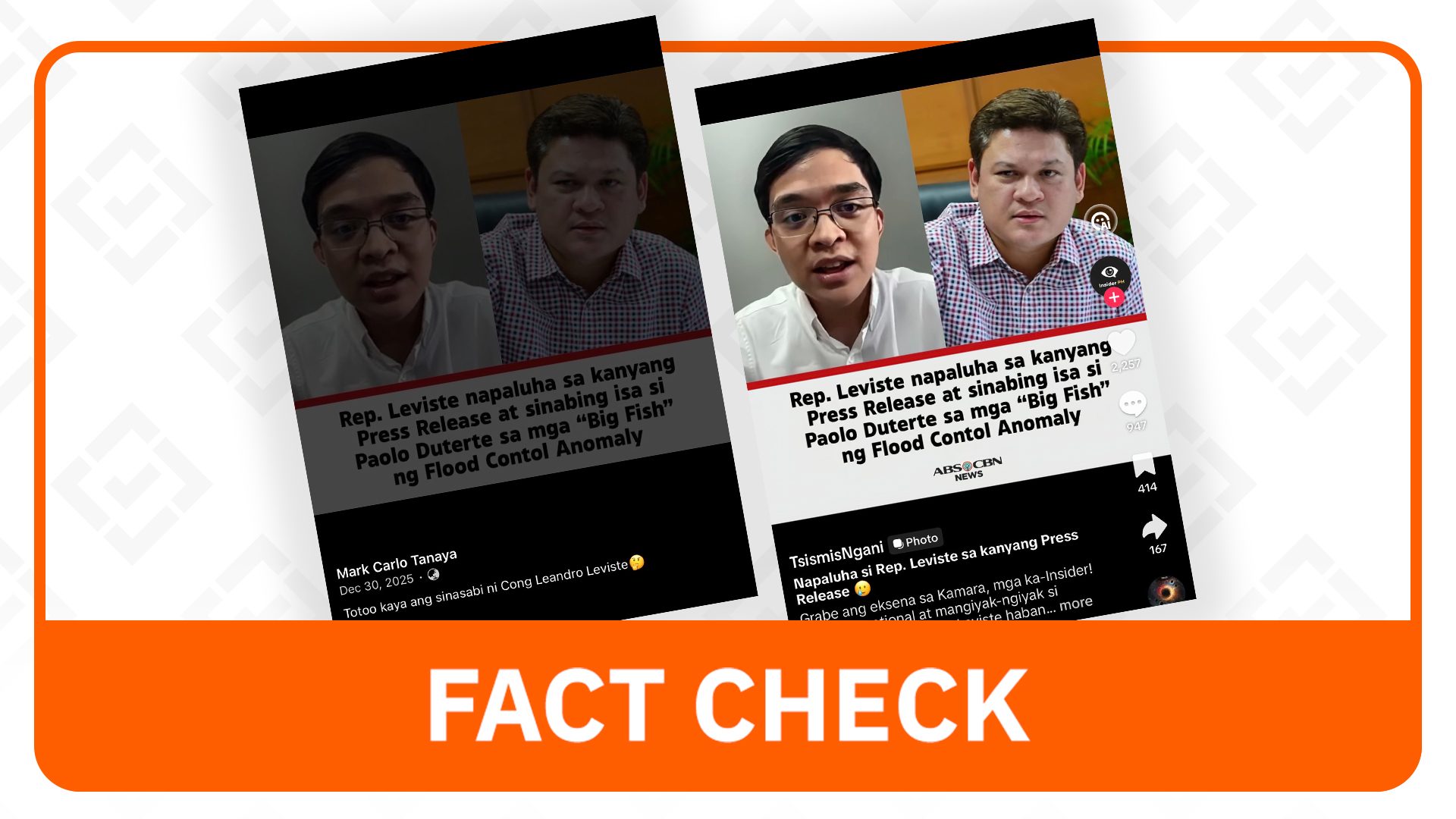
In a troubling example of misinformation, a fabricated social media graphic falsely claiming that Batangas Representative Leandro Leviste implicated Paolo Duterte in the flood control scandal has gone viral across multiple platforms.
The doctored image, which bears the ABS-CBN News logo and branding, shows photos of both lawmakers with text stating: “Rep. Leviste teared up in his press release and said that Paolo Duterte is one of the ‘big fish’ in the flood control anomaly.” This fabrication has reached hundreds of thousands of viewers through TikTok, Facebook, and Instagram.
Fact-checking reveals that no such statement was made by Leviste, nor did ABS-CBN publish any such graphic. The post appears to be part of a pattern of misinformation from a TikTok account called Insider PH, which has repeatedly published false claims using the ABS-CBN brand identity to lend credibility to fabricated content.
The image likely repurposed a photograph of Leviste from his December 29 interview with Ted Failon and DJ Chacha on True FM, where he discussed the “Cabral files” – documents allegedly from late Department of Public Works and Highways (DPWH) undersecretary Catalina Cabral revealing congressional district funding allocations from 2023 to 2025.
While Leviste has been vocal about alleged corruption in flood control projects, at no point did he publicly name Paolo Duterte, son of former president Rodrigo Duterte, as being involved in these irregularities.
The flood control scandal has become a major political issue in the Philippines, with allegations of ghost projects, kickbacks, and irregular fund allocations prompting increased scrutiny of the public works department. Leviste has called for greater transparency in DPWH budgeting after revealing what he claims are budget insertions and irregularities in government flood control initiatives.
Among those Leviste has actually implicated is Construction Workers Solidarity Party-list Representative Edwin Gardiola. Leviste released documents allegedly showing approximately P22 billion in DPWH projects that Gardiola had “pre-ordered” for contractors connected to him. Leviste has also made allegations against DPWH Secretary Vince Dizon regarding budget insertions, claims Dizon has dismissed as unfounded.
Though the viral graphic connecting Leviste and Duterte is fabricated, the younger Duterte has indeed been mentioned in the broader flood control investigation. During a House probe in September, Cabral confirmed that the Davao City representative’s district received P51 billion for infrastructure projects during his father’s presidency from 2020 to 2022. When questioned about this, Paolo Duterte expressed concern about the “sudden shift” in the investigation’s focus while maintaining there was “nothing to hide.”
This incident highlights the growing problem of misinformation in the Philippines, where fabricated news graphics featuring legitimate media branding can quickly spread across social platforms, potentially influencing public opinion on politically sensitive issues. It underscores the importance of media literacy and fact-checking in an environment where sophisticated misinformation tactics increasingly blur the line between legitimate news and fabrication.
As investigations into the flood control projects continue, distinguishing between actual allegations and manufactured controversies remains essential for understanding the true scope of the issue.
Fact Checker
Verify the accuracy of this article using The Disinformation Commission analysis and real-time sources.

10 Comments
This story serves as a reminder of the importance of critical thinking when consuming news and social media content. We must always question the source and verify claims before sharing or believing them.
I’m glad the Disinformation Commission is on top of this and exposing the fabricated nature of this post. It’s important to call out these tactics and hold the responsible parties accountable.
Absolutely. Using false images and quotes to smear political figures is a dangerous game. Fact-checking and media literacy are essential to combat this type of manipulation.
This is a clear case of misinformation being spread through doctored social media posts. Fact-checking is crucial to stop the spread of such false claims, especially those using established media branding to lend credibility.
This story highlights the ongoing challenge of combating misinformation in the digital age. It’s a complex issue that requires a multi-faceted approach involving media literacy, platform accountability, and strong fact-checking efforts.
Doctored images and false statements can have serious consequences, especially when they involve public figures and important issues like corruption. Responsible journalism and media literacy are crucial safeguards.
Absolutely. We need to be vigilant about verifying information from all sources, even those that claim to be authoritative. Fact-checking is the best defense against the spread of misinformation.
The use of established media branding to lend credibility to fabricated content is a deceptive tactic that undermines public trust. Fact-checkers play a vital role in exposing these kinds of manipulations.
It’s concerning to see a pattern of misinformation from this TikTok account. We need to be vigilant about verifying the source and accuracy of information, especially when it involves serious allegations.
Agreed. This highlights the need for stronger regulations and enforcement around social media platforms to curb the spread of deliberate disinformation campaigns.