


Listen to the article
The vast majority of America’s top universities have rejected the Trump administration’s new higher education initiative, according to documents obtained by The National Desk’s Fact Check Team. Seven out of nine elite institutions have formally declined to sign the “Compact for Academic Excellence,” a cornerstone policy of President Trump’s second term education agenda.
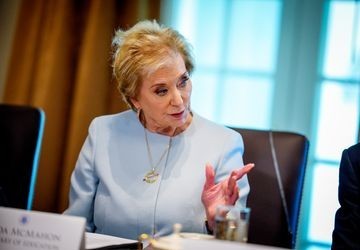
Education Secretary Linda McMahon unveiled the compact last month during a Cabinet meeting at the White House, framing it as a necessary reform to restore “traditional American values” and “intellectual diversity” to college campuses. The policy would require participating universities to implement specific curriculum changes and campus speech regulations in exchange for continued federal research funding and student aid eligibility.
Harvard University led the opposition with a strongly worded statement from its Board of Trustees. “While we share the administration’s stated goal of fostering robust intellectual debate, we cannot accept external mandates that would fundamentally compromise our institutional autonomy and academic freedom,” the statement read.
Columbia University followed suit, with its president citing “grave constitutional concerns” about the compact’s requirements. Princeton, Yale, Stanford, MIT, and the University of Chicago have also declined to sign, according to multiple sources familiar with the negotiations.
Only the University of Pennsylvania and Cornell University indicated potential willingness to work with the administration, though neither has formally signed the agreement. Penn’s interim president acknowledged “constructive elements” in the proposal while expressing “significant reservations” about specific provisions.
The compact would require universities to implement several controversial measures, including mandatory American history courses with prescribed content, new hiring practices designed to increase “viewpoint diversity” among faculty, and stricter disciplinary measures for student protesters. Institutions refusing to comply could face substantial financial consequences, with the Department of Education empowered to restrict access to federal research grants and student aid programs.
Legal experts have questioned the constitutionality of the administration’s approach. “There are serious First Amendment issues at play here,” said Erwin Chemerinsky, dean of UC Berkeley Law School. “The government cannot condition funding on universities adopting specific ideological positions or restricting protected speech.”
The standoff has significant financial implications for higher education. Federal funding accounts for approximately $40 billion annually in university research grants, while federal student aid programs provide over $120 billion in support to students. Many institutions rely heavily on these funding sources to maintain operations and research programs.
Secretary McMahon defended the initiative during a press conference yesterday, characterizing the universities’ resistance as “elitist obstruction” of necessary reforms. “These institutions have become echo chambers of liberal ideology while accepting billions in taxpayer dollars,” McMahon stated. “If they want continued public support, they need to demonstrate a commitment to true educational diversity.”
The rejection has sparked political reactions along partisan lines. Senate Majority Leader James Reynolds praised the universities for “standing firm against government overreach,” while House Speaker Thomas Greene accused them of “perpetuating left-wing indoctrination with taxpayer money.”
California Governor Gavin Newsom announced his state would establish an emergency fund to support public universities that might lose federal funding due to non-compliance. “We will not allow political threats to undermine our world-class higher education system,” Newsom stated.
Meanwhile, student groups have organized demonstrations both for and against the compact. Conservative student organizations like Turning Point USA have held rallies supporting the administration’s initiative, while progressive campus groups have staged protests against what they describe as “authoritarian interference” in higher education.
The confrontation represents the most significant federal challenge to university autonomy in decades and signals a potentially transformative shift in the relationship between the federal government and higher education institutions. As the academic year progresses, universities face difficult choices between financial stability and institutional independence, with the education of millions of students hanging in the balance.
Fact Checker
Verify the accuracy of this article using The Disinformation Commission analysis and real-time sources.

10 Comments
Silver leverage is strong here; beta cuts both ways though.
I like the balance sheet here—less leverage than peers.
The cost guidance is better than expected. If they deliver, the stock could rerate.
I like the balance sheet here—less leverage than peers.
Nice to see insider buying—usually a good signal in this space.
Silver leverage is strong here; beta cuts both ways though.
Good point. Watching costs and grades closely.
The cost guidance is better than expected. If they deliver, the stock could rerate.
Interesting update on Seven Major Universities Reject Trump’s New Campus Policy. Curious how the grades will trend next quarter.
Production mix shifting toward Fact Check might help margins if metals stay firm.