


Listen to the article
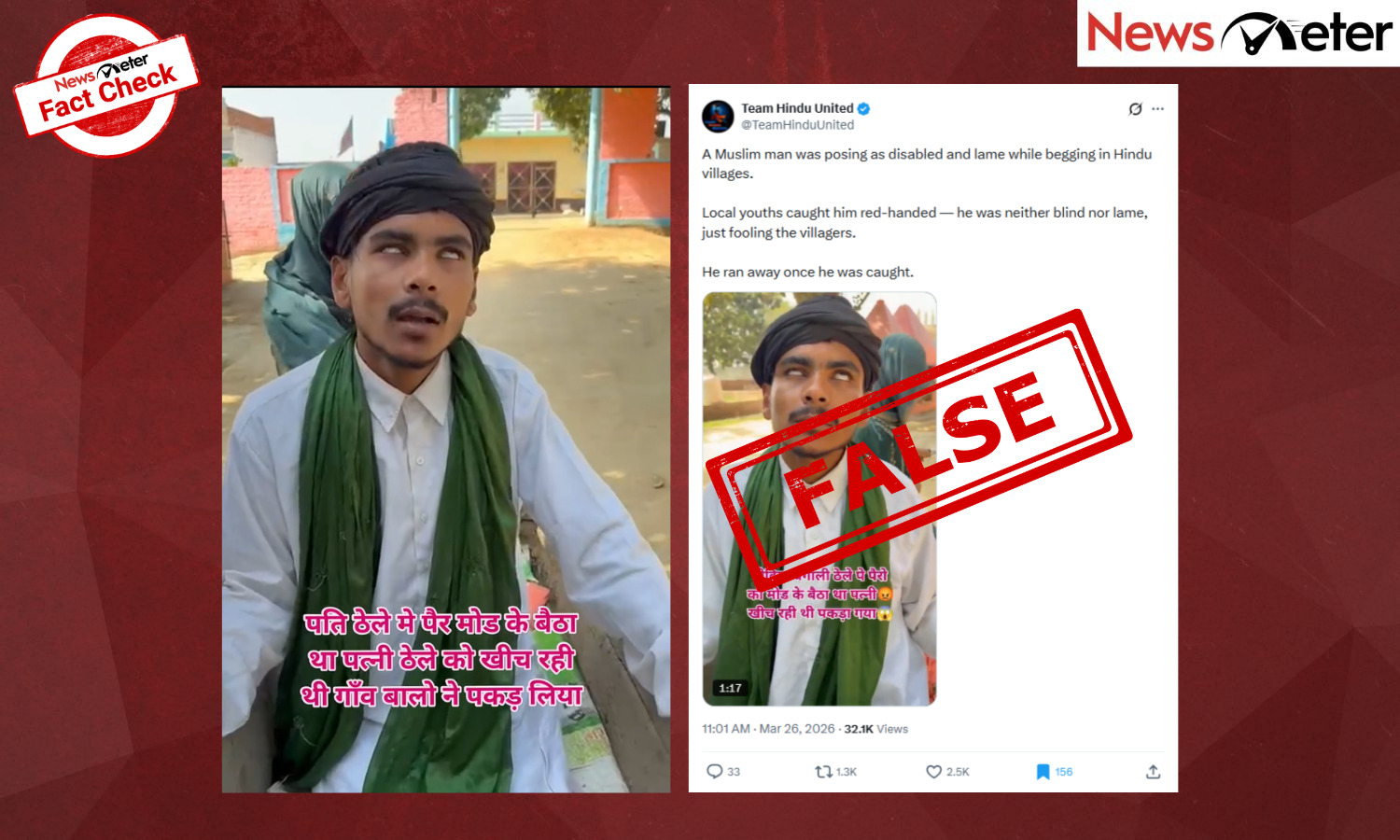
Social media platforms have become battlegrounds for misinformation, as demonstrated by a recent viral video falsely portraying a man as a Bengali Muslim faking disabilities to collect money from unsuspecting villagers.
The widely shared clip shows a man appearing to be both blind and missing limbs while seated on a cycle van. In the footage, a group of men confront him, revealing that he actually has legs and was pretending to be disabled. As the confrontation escalates, the man reportedly flees the scene.
Social media users rapidly circulated the video with inflammatory captions. One user on X (formerly Twitter) wrote, “A Muslim man was posing as disabled and lame while begging in Hindu villages. Local youths caught him red-handed — he was neither blind nor lame, just fooling the villagers. He ran away once he was caught.” Text overlaid on the video claimed, “Rohiya Bengali was sitting on a cycle van with his legs folded while his wife was pulling him and he was caught.”
However, an investigation by NewsMeter has determined the claim to be entirely false. Through reverse image searches of key frames from the video, fact-checkers discovered the footage was first shared on Facebook on March 2 by a page called “Shyam Marg.”
Crucially, this page explicitly states in its bio that “All the videos posted on this page are scripted and have been made to create awareness and prevent fraud, so if you receive such messages, you should be careful.” The page regularly produces staged videos about various forms of fraud, child abduction scenarios, and other scripted content meant to raise awareness.
Further investigation revealed that the man who appears disabled in the viral video has played different roles in other scripted videos from the same content creator. He is not blind or disabled in real life, and comparison images show him appearing completely normal in other videos.
This case highlights a troubling pattern of scripted content being weaponized to stoke communal tensions. What was intended as educational content about potential scams has been repurposed with divisive religious overtones, falsely identifying the actor as a “Bengali Muslim” to provoke anti-Muslim sentiment.
The incident underscores the growing challenge of content manipulation on social platforms, where original context can be stripped away and replaced with harmful narratives. Social media companies continue to struggle with effectively moderating such content, particularly when it crosses linguistic and cultural boundaries.
Digital literacy experts recommend that users verify information before sharing, especially content that appears to vilify specific religious or ethnic groups. Simple verification steps like checking the source, searching for original context, or using reverse image search tools can help prevent the spread of such harmful misinformation.
NewsMeter has reached out to the original content creator for additional clarification, though their investigation has already conclusively established that the viral claim is false.
Fact Checker
Verify the accuracy of this article using The Disinformation Commission analysis and real-time sources.

14 Comments
This case underscores the importance of verifying information and not jumping to conclusions, especially when it comes to sensitive issues involving identity and community. We should all strive to be more discerning consumers of online content.
Absolutely. Knee-jerk reactions and unsubstantiated claims can have real consequences for vulnerable groups. Fact-checking and nuanced, balanced reporting are essential to fostering a more informed and inclusive public discourse.
This case highlights the importance of critical thinking and media literacy. We should all be more skeptical of sensational claims and take the time to verify information before sharing it online.
Well said. Spreading unverified information, even unintentionally, can have real consequences for vulnerable communities. Fact-checking should be a habit, not an afterthought.
This is a concerning example of how social media can be weaponized to spread harmful stereotypes and biases. We must be vigilant in calling out and debunking such false narratives whenever they arise.
Absolutely. Letting these kinds of false claims go unchallenged only emboldens those who seek to sow division and mistrust. Fact-based reporting is crucial to maintaining a healthy public discourse.
It’s disappointing to see how social media platforms can be used to spread disinformation and stoke communal tensions. We need stronger measures to combat the rise of misinformation and ensure the integrity of online discourse.
Absolutely. Platforms need to do more to proactively identify and remove content that violates their policies against false or misleading information.
I appreciate the diligent fact-checking work done by NewsMeter to uncover the truth behind this viral video. It’s a good reminder that we can’t always trust what we see on social media at face value.
Agreed. Thorough investigations like this are essential to counter the rising tide of misinformation. We need more journalists and fact-checkers dedicated to this important work.
This seems like another case of misinformation being spread on social media. It’s concerning how quickly these false narratives can gain traction, especially when they involve vulnerable communities. We should be more careful about verifying the facts before jumping to conclusions.
Agreed. Fact-checking is crucial to prevent the spread of harmful rumors and biases. I’m glad the investigation was able to debunk this claim.
It’s disheartening to see how quickly misinformation can spread, especially when it targets marginalized communities. This incident serves as a reminder of the urgent need for digital literacy education and better content moderation on social platforms.
Well said. Equipping people with the skills to critically evaluate online information is key to combating the rise of misinformation. Platforms must also take more responsibility for the content they amplify.