


Listen to the article
Satirical Story About Trump’s “Pro Kings” Rally Confusion Spreads on Social Media
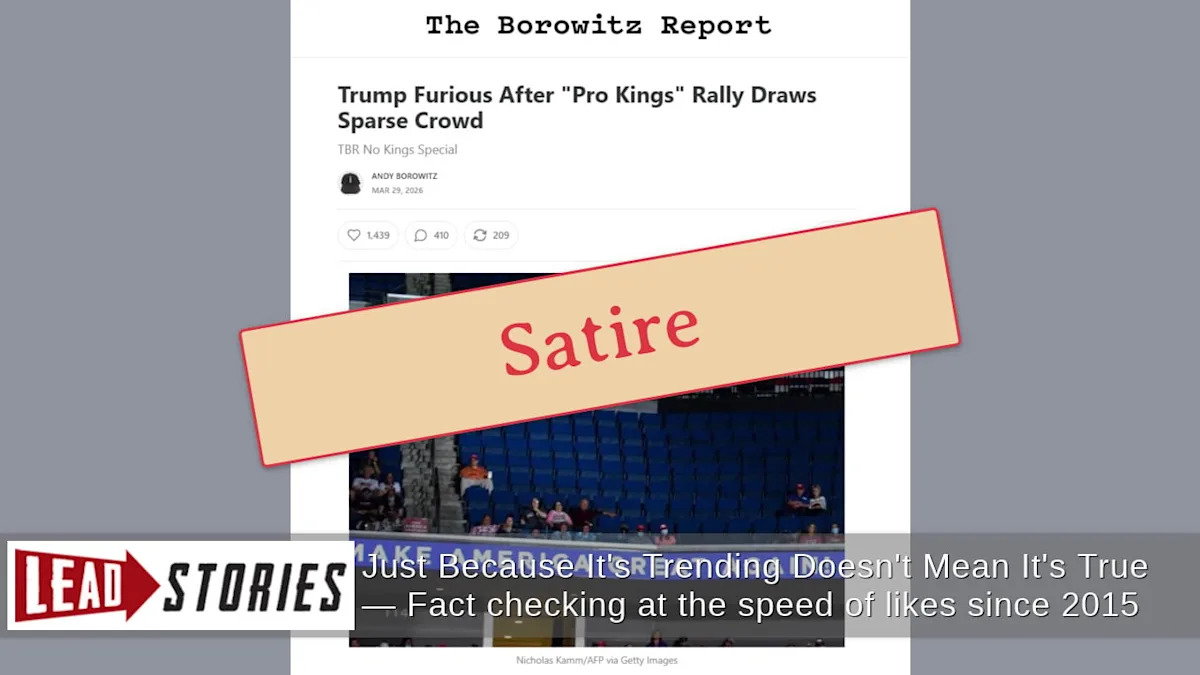
A satirical article claiming former President Donald Trump was “apoplectic with rage” over poor attendance at a fictional “Pro Kings” rally in Kentucky has been mistaken for genuine news by some social media users, fact-checkers report.
The fictional story, published on March 29 by comedy writer Andy Borowitz on his satirical newsletter “The Borowitz Report,” described Trump as furious after only 17 people allegedly showed up at Kroger Field in Lexington for a rally. The stadium has a capacity of 61,000 seats, according to the satirical piece.
“An advance team led by Eric Trump had scheduled the event at Lexington, Kentucky’s Kroger Field,” the satirical article claimed, adding that the team later engaged in “an orgy of finger-pointing” over the dismal turnout.
Despite clear indications that the article was intended as humor, the story gained traction on social media platforms where it was shared as if it were factual reporting. The piece even fabricated a quote purportedly from Trump’s Truth Social account saying, “Especially this year, when we’re celebrating the 250th anniversary of the last time we had a King!”
A search of Trump’s Truth Social account shows no such post exists, confirming the satirical nature of the claims. The former president made no mention of any “Pro Kings” rally on his official social media channels.
Borowitz, a well-established humorist who previously wrote for The New Yorker, clearly identifies his work as satire on his Substack newsletter. His about page states: “I’m Andy Borowitz, a writer and comedian… I’ve been writing satirical news since I was eighteen. This represents either commitment to a genre or arrested development.”
This incident highlights the ongoing challenge of distinguishing between genuine news and satirical content in today’s fast-paced social media environment. Political satire has a long tradition in American discourse, but the speed at which information spreads online can sometimes blur the line between humor and reality.
Media literacy experts have noted that satire can sometimes spread beyond its intended audience, particularly when it aligns with existing beliefs or biases about political figures. When content is shared without its original context, the satirical intent may be lost.
Political rallies and their attendance figures have been a sensitive subject for Trump since his presidency began. During his 2017 inauguration, disputes arose over crowd size estimates, and rally attendance became a recurring theme throughout his administration and subsequent campaign events.
This isn’t the first time satirical content about political figures has been misinterpreted as factual. Similar instances have occurred with publications like The Onion and Babylon Bee, whose humorous takes on current events are sometimes mistaken for genuine news reports.
Social media platforms have implemented various fact-checking measures to help users identify misinformation, but satirical content presents unique challenges. Unlike deliberate disinformation, satire isn’t intended to deceive but rather to entertain and sometimes provide social commentary.
For readers encountering politically charged content online, media literacy advocates recommend checking the source, looking for “about” pages that might indicate satirical intent, and verifying claims through multiple trusted news organizations before sharing or accepting information at face value.
Fact Checker
Verify the accuracy of this article using The Disinformation Commission analysis and real-time sources.

10 Comments
While I appreciate the intent behind political satire, I do worry about its potential to contribute to the spread of misinformation, even unintentionally. It’s a delicate balance that requires careful consideration from both creators and consumers of news.
This story serves as a good reminder that we should always approach online content with a critical eye, regardless of whether it appears to be factual or satirical. Fact-checking and media literacy are essential skills in the digital age.
While I enjoy a good political satire, I worry that the proliferation of such content can contribute to the spread of misinformation, even unintentionally. It’s important for readers to approach any news, whether serious or satirical, with a critical eye.
The idea of Trump being ‘apoplectic with rage’ over a poorly attended rally is quite comical. While satire can sometimes blur the line with reality, this article seems pretty straightforward in its humorous intent.
Haha, this is clearly a satirical piece poking fun at Trump’s tendency to exaggerate crowd sizes. It’s amusing that some people actually believed it was real news. Gotta love a good political parody!
I find it fascinating how quickly misinformation can spread on social media, even when the source is clearly marked as satirical. It speaks to the importance of critical thinking and fact-checking, especially when it comes to political news.
I’m curious to know how widespread the belief in this satirical story was. It would be interesting to see data on how many people actually thought it was real news versus those who recognized it as parody. Social media can be a tricky landscape to navigate.
Satirical news articles can be a useful tool for social commentary and political critique, but they also come with the risk of being misinterpreted. This seems like a classic case of the line between fact and fiction getting blurred on the internet.
The fact that this satirical article was mistaken for real news highlights the importance of media literacy education. Helping people distinguish between factual reporting and parody is an ongoing challenge in the digital age.
This story is a prime example of the need for media literacy education. Helping people distinguish between factual reporting and satirical commentary is crucial in an age where information (and misinformation) spreads rapidly online.