


Listen to the article
AI-Generated Police Outburst Video Debunked by Philippine Authorities
A fabricated video depicting a police officer losing his temper at fast food workers has been exposed as an AI-generated fake after circulating widely on social media platforms. The Philippine National Police (PNP) has issued an official warning about the deceptive content that falsely portrays their organization.
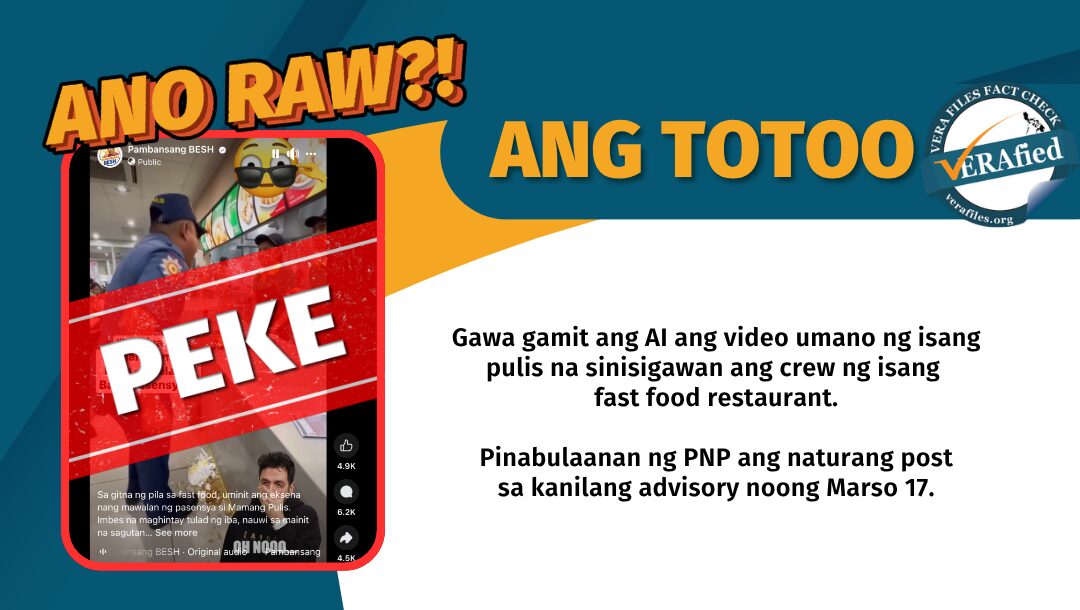
The 26-second clip, uploaded to Facebook on March 7, shows a man in police uniform shouting in Filipino and aggressively slamming food trays while restaurant staff attempt to calm the situation. Text overlaid on the video reads: “Shame on you, Police Officer — Don’t you have any patience? OH NOOO….”
The post’s caption described the incident: “In the middle of a queue at a fast food restaurant, the scene got messy when a policeman lost his patience. Instead of waiting like everyone else, a heated exchange happened at the counter.”
On March 17, the PNP Anti-Cybercrime Group responded with an official statement on their Facebook page, labeling the video as artificially generated content that “falsely impersonates police officers to spread misinformation and damage the reputation of the PNP organization.”
Several telltale signs expose the video as synthetic. Close analysis reveals people in the background abruptly disappearing, with superimposed text strategically placed to hide these inconsistencies. The uniform worn by the supposed officer features incorrect details that don’t match authentic PNP general office attire, including improperly designed shoulder patches.
Additional visual anomalies include the officer’s right hand changing shape between frames and menu board text appearing blurred or illegible – a common artifact in AI-generated imagery known as “hallucinations.”
VERA Files Fact Check enlisted help from the Deepfakes Analysis Unit (DAU) of the India-based Trusted Information Alliance to conduct a technical assessment of the content. The DAU used multiple AI-detection tools to analyze both video and audio components.
Video analysis through WasitAI, AIorNot, and Hive AI classifiers consistently indicated the footage was likely AI-generated. Sightengine specifically flagged the clip as not created using Google AI. However, when individual keyframes were examined through IsitAI, results were mixed, with some frames classified as “likely created using AI” while others as “likely human.”
Interestingly, audio analysis tools including Hive AI audio classifier, Hiya, Aurigin AI, and ElevenLabs speech classifier suggested the audio wasn’t AI-generated. The DAU noted this discrepancy might be due to the video’s visual clutter, including text boxes and animated elements that potentially interfered with accurate analysis.
The DAU highlighted additional suspicious elements, including a drink in a sipper cup that mysteriously “vanishes the moment he lifts the tray and slams it down” with “no visual evidence of the drink inside it to have spilled.”
The timing of this fake video is notable, appearing just one day after the PNP launched its coaching and mentoring program at Camp Crame. This program represents a preventive strategy within the organization’s internal disciplinary framework, designed to strengthen “professional guidance, ethical leadership, and accountability among personnel.”
The original post, published by a Facebook page called “Pambansang BESH” (created November 24, 2025), generated substantial engagement with 4,800 reactions, 6,200 comments, 4,500 shares, and 1.9 million views. The video was subsequently reposted by another Facebook page, accumulating an additional 69,318 engagements.
This incident highlights the growing challenge of identifying and countering increasingly sophisticated AI-generated misinformation that targets public institutions and threatens to undermine public trust.
Fact Checker
Verify the accuracy of this article using The Disinformation Commission analysis and real-time sources.

12 Comments
This seems like a concerning incident, if it was indeed real. However, it’s good to see the authorities stepping in to clarify that the video was fabricated. Spreading misinformation can be harmful, so I’m glad they addressed this promptly.
You’re right, it’s important to verify the authenticity of online content, especially when it involves sensitive topics like law enforcement. I appreciate the Philippine National Police taking action to address this misleading video.
Interesting to see the Philippine National Police taking a proactive stance in addressing this fabricated video. It’s a good reminder that not everything we see online is necessarily true, and we should be cautious about spreading unverified information.
I agree. The PNP’s response shows they’re committed to maintaining transparency and public trust, which is crucial for effective law enforcement. Kudos to them for swiftly debunking this misleading content.
Ah, another case of AI-generated ‘fake news’. It’s disheartening to see how easily misinformation can spread these days. I’m glad the authorities were able to debunk this video and clarify the facts.
Absolutely, it’s crucial that we remain vigilant and fact-check information, especially when it comes to sensitive issues like this. The PNP’s response helps maintain trust and transparency.
It’s concerning to see how easily misinformation can spread online, even in the form of AI-generated content. I’m glad the Philippine National Police took the time to investigate and officially debunk this fabricated video.
You make a valid point. The PNP’s response shows their dedication to maintaining public trust and ensuring accurate information is circulated, which is essential for effective law enforcement and community relations.
This highlights the importance of verifying the source and authenticity of online content, especially when it involves sensitive topics like law enforcement. I’m glad the Philippine authorities were able to identify and address this AI-generated misinformation.
Absolutely. In today’s digital age, it’s crucial that we all exercise caution and critical thinking when consuming and sharing online information. The PNP’s actions demonstrate their commitment to upholding the truth.
This is a good example of why we need to be cautious about content we see online, especially when it seems designed to provoke a certain reaction. I’m glad the authorities were able to identify this as an AI-generated fake.
You make a fair point. In today’s digital landscape, it’s important to approach questionable content with a critical eye and verify the facts before sharing or reacting to it. The PNP’s actions are commendable.