


Listen to the article
A Facebook page posing as a legitimate New Zealand news outlet has been caught publishing AI-generated images and videos of real news events, raising concerns about misinformation and eroding trust in journalism.
The page, called NZ News Hub—a name strikingly similar to the recently closed legitimate media organization Newshub—has been repackaging news stories from established outlets while adding fabricated visual content generated by artificial intelligence.
AAP FactCheck, which previously debunked the page’s false AI images of January’s deadly Mt Maunganui landslide, has identified numerous additional instances of misleading content. The page did not respond to requests for comment.
Dr. Andrew Lensen, senior lecturer in AI at Victoria University of Wellington, confirmed the images are clearly AI-generated. He explained the motivation behind such deceptive practices: “These pages want to get as much engagement as possible, in order to build their following and potential ad revenue.”
The fake news page may also be using AI to circumvent copyright issues that would arise from using legitimate media images without permission, according to Dr. Lensen. More concerning is the potential damage to public trust. “Trust in journalism is already a huge concern, and any source that presents itself as a fake source of news will just increase distrust further,” he said.
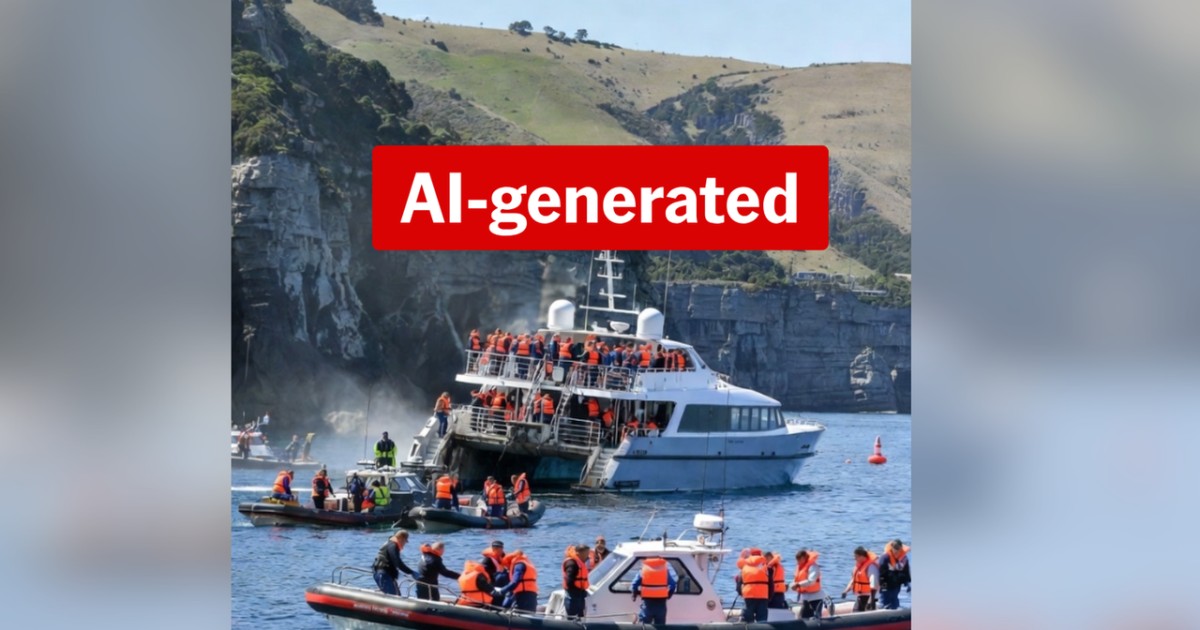
Recent examples of NZ News Hub’s deceptive content include fabricated images of a January 31 tourist boat capsizing near Akaroa Head. The AI-generated image shows a catamaran that bears no resemblance to the actual Black Cat vessel involved in the incident, while the background landscape differs significantly from Akaroa Harbour. Some people in the image have distorted facial features—a telltale sign of AI generation.
Another post purportedly depicting anti-immigration protests in Auckland shows police officers with distorted faces wearing uniforms that don’t match those of New Zealand police, as documented in legitimate coverage by the New Zealand Herald and RNZ.
The page’s deception extends to wildlife content, with a post about New Zealand’s native wood pigeon (kereru) featuring an AI-generated bird that looks nothing like the actual species. Similarly, an image claimed to show dirt bike riders in South Auckland contains distorted figures and incorrect police vehicles.
Perhaps most disturbingly, the page has used AI to animate still photographs, including images of disaster victims. One post artificially animates a photo of Mt Maunganui landslide victim Sharon Maccanico, 15, showing her performing unrealistic dance moves that were not part of the original still image released by her family.
Other examples include animated versions of news photos from the Otago Daily Times and RNZ, with one particularly concerning case involving a grieving family interviewed about a teenager’s suicide. The reporter who conducted the original interview confirmed to AAP FactCheck that no such video was recorded during their conversation.
The page has even manipulated images of political figures, using AI to animate a still photo of Finance Minister Nicola Willis and Prime Minister Christopher Luxon, with fabricated speech that doesn’t match actual footage of the January 19 press conference.
As AI-generated content becomes increasingly sophisticated, the proliferation of such deceptive practices poses significant challenges for media literacy and threatens to undermine public confidence in legitimate news sources at a time when trust in journalism is already fragile.
Fact Checker
Verify the accuracy of this article using The Disinformation Commission analysis and real-time sources.

10 Comments
This is a concerning trend that erodes trust in media and enables the spread of misinformation. Generating fake visual content to misrepresent news events is a serious breach of journalistic ethics. The motivations behind such deceptive practices are troubling and need to be addressed.
I agree, the use of AI to create misleading visuals is very problematic. Robust fact-checking and accountability measures are crucial to maintain the integrity of news reporting.
The use of AI to create false visual content and misrepresent news events is extremely concerning. It’s crucial that media organizations uphold the highest standards of integrity and transparency. Fact-checking and accountability measures must be strengthened to prevent the spread of misinformation.
This is a concerning development that highlights the need for greater transparency and accountability in the media industry. The use of AI to generate misleading visuals is a clear violation of journalistic principles and erodes public trust. Robust fact-checking and ethical reporting practices should be the norm, not the exception.
I agree, the spread of misinformation through AI-generated content is a serious threat to the integrity of news reporting. Stronger regulations and oversight are necessary to prevent these kinds of unethical practices.
The use of AI to create false visuals and misrepresent news events is a clear breach of journalistic ethics. This practice not only undermines the credibility of the media but can also have real-world implications for public understanding and decision-making. Stronger oversight and fact-checking measures are needed to address this issue.
It’s disappointing to see a media organization engage in such unethical practices. Misrepresenting news through AI-generated content not only undermines trust in journalism but can also have real-world consequences. Fact-checking and transparency should be top priorities for all news outlets.
Absolutely. Generating fake visuals to sensationalize or distort news stories is a clear violation of journalistic principles. The public deserves accurate, reliable information from credible sources.
This is a troubling development that highlights the need for stronger regulations and oversight in the media industry. The use of AI to generate misleading visuals undermines the public’s trust in journalism and can have serious consequences. Fact-checking and ethical reporting practices should be non-negotiable.
I agree, the potential for abuse and the erosion of public trust are major concerns. Robust safeguards and accountability measures are essential to ensure the integrity of news reporting.