


Listen to the article
Trump’s State of the Union Address Highlights Divisive America Amid Contested Claims
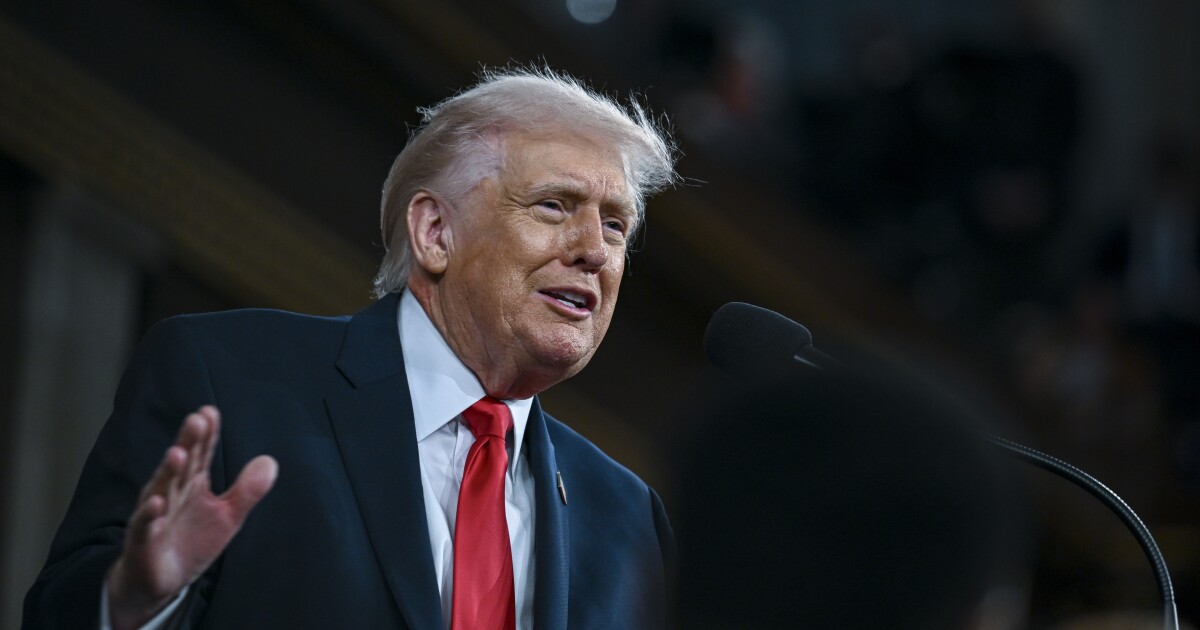
President Donald Trump delivered his first State of the Union address of his second term Tuesday night, presenting his administration’s accomplishments and outlining future plans amid a deeply divided nation. Recent polling from NPR/PBS News/Marist indicates that 60% of Americans believe the country is worse off than last year, with a majority questioning the strength of the union.
The speech touched on numerous policy areas including immigration, foreign policy, the economy, and healthcare, though many of Trump’s claims required context or correction according to fact-checkers.
On immigration, Trump claimed the U.S. now has “the strongest and most secure border in American history,” which is partially accurate. While border crossings have fallen to their lowest levels in 50 years according to Pew Research, more than 237,000 crossings still occurred in 2025. His assertion that millions of immigrants from “prisons and mental institutions” entered during the Biden administration lacks evidence, with research consistently showing immigrants commit fewer crimes than citizens.
Trump’s economic claims portrayed dramatic improvements under his leadership. He characterized the economy he inherited as “stagnant” with “inflation at record levels,” though economists note the U.S. economy was already robust before his return to office. While inflation has cooled to 2.4% in January from 3% when Biden left office, Trump’s statement that his administration achieved “the lowest level in more than five years” overreaches.
The stock market has indeed performed strongly, with the Dow Jones Industrial Average surpassing 50,000 for the first time. However, job growth slowed significantly in 2025, with employers adding just 181,000 jobs compared to 1.4 million in 2024.
On foreign policy, Trump claimed to have “ended eight wars” in his first ten months, an exaggeration according to analysts. While he helped broker a ceasefire between Israel and Hamas in Gaza, Israel has continued limited operations. His claim of “obliterating” Iran’s nuclear program through Operation Midnight Hammer cannot be fully verified as Iran has restricted international inspectors.
The president highlighted his tariff policy, suggesting it would eventually “substantially replace the modern day system of income tax.” Economists note that most tariff costs are passed to U.S. businesses and consumers, not foreign countries. The Supreme Court recently struck down about half of Trump’s tariffs, ruling he exceeded his authority.
Energy policy featured prominently in the speech, with Trump highlighting lower gasoline prices. While the national average is indeed down about 22 cents from a year ago to $2.92 per gallon, his specific claims of widespread $1.99 gas prices appear exaggerated, with only 8 out of 150,000 stations nationwide selling below $2 per gallon.
On healthcare, Trump’s statement that Americans “will now pay the lowest price anywhere in the world for drugs” is not accurate. Despite initiatives like the TrumpRx website, Americans still pay several times more for prescription drugs than residents of peer countries, and the site currently offers just 40 medications.
The speech revealed deep partisan divides on issues like voting rights, where Trump repeated claims about “rampant” voting by noncitizens despite evidence showing such cases remain exceedingly rare. His proposal for a “SAVE AMERICA Act” is not expected to gain the necessary Senate support.
As Trump seeks to build momentum in his second term, the address reflected a president navigating significant economic, social, and international challenges while presenting a vision that remains contentious across a polarized electorate.
Fact Checker
Verify the accuracy of this article using The Disinformation Commission analysis and real-time sources.

7 Comments
The immigration statistics cited seem to paint a more complex picture than Trump’s rhetoric. It’s important to look at the full data when evaluating border security and immigration trends.
Agreed, a balanced assessment requires digging into the underlying data rather than relying on simplified soundbites.
Given the contested nature of many of Trump’s claims, I’m glad to see detailed fact-checking from a reputable source like NPR. Maintaining an informed and objective public discourse is critical.
The divisions in the country highlighted by the polling data are concerning. Hopefully this speech can help bridge some of those divides, though the partisan nature of politics makes that a tall order.
You’re right, the deep polarization in the US makes it challenging for any single speech or event to heal those divisions. It will take sustained, good-faith efforts on all sides.
Interesting fact check from NPR on Trump’s State of the Union claims. I appreciate the nuanced analysis and effort to provide proper context around the statements made.
Trump’s economic claims will likely be heavily scrutinized. I’m curious to see how independent analysts assess the state of the economy and whether his statements hold up to factual scrutiny.