


Listen to the article
Trump Delivers First State of the Union Address of Second Term Amid Divided Public Sentiment
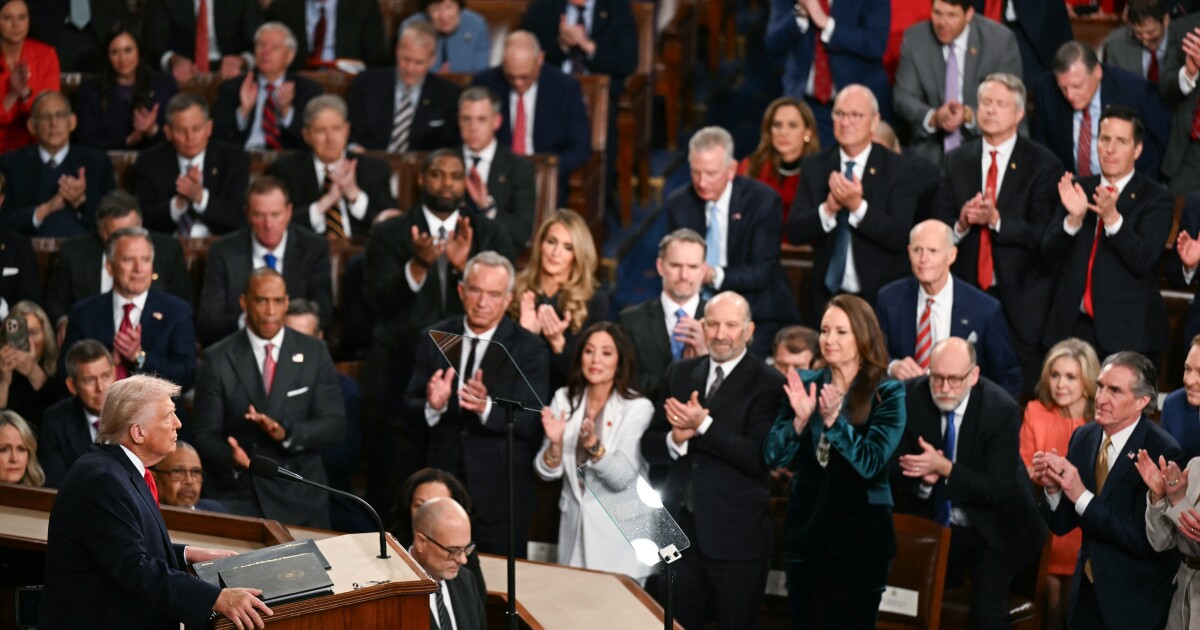
President Trump delivered the first State of the Union address of his second term on Tuesday night, using the platform to highlight what he views as his administration’s accomplishments during its first year back in office.
The speech comes at a politically challenging moment for the President. According to a new NPR/PBS News/Marist poll, approximately 60% of Americans believe the country is worse off than it was a year ago, with a majority expressing the view that the state of the union is not strong.
In his address, Trump portrayed his return to office as a dramatic economic turnaround, claiming he inherited “a nation in crisis with a stagnant economy” and “inflation at record levels.” These characterizations, however, stand in contrast to economic assessments from late 2024, when publications like The Economist had described the U.S. economy as “the envy of the world” for its strong recovery from the pandemic recession compared to global peers.
The President devoted significant attention to inflation, claiming his administration has “driven core inflation down to the lowest level in more than five years.” While inflation has indeed cooled in recent months, with the annual rate dipping to 2.4% in January, the cost of living continues to rise in key sectors. Housing, groceries, and utilities have all become more expensive, though some items like gasoline and eggs have seen price decreases.
Trump highlighted the stock market’s performance, noting it has “set 53 all-time record highs since the election,” with the Dow Jones Industrial Average recently crossing 50,000 for the first time. The S&P 500 gained 18% in 2025, following a 24% increase in 2024. However, economic experts note that stock ownership remains highly concentrated, with the wealthiest 10% of Americans owning 87% of all stock market wealth.
On immigration, Trump declared, “We now have the strongest and most secure border in American history.” While Border Patrol encounters with migrants have fallen to their lowest level in more than 50 years according to Pew Research Center analysis, there were still 237,538 border crossings recorded in 2025 by U.S. Customs and Border Protection.
The President’s claims about job creation presented a selective view of the labor market. While it’s true that more Americans are employed than ever before, job growth has slowed dramatically. U.S. employers added just 181,000 jobs in all of 2025, compared to more than 1.4 million in 2024. Unemployment currently stands at 4.3%, slightly higher than the 4% rate when Trump returned to office.
Trump also highlighted falling gasoline prices, citing examples as low as $1.85 per gallon in Iowa and under $2 in some locations. While these specific price points represent exceptional cases rather than the norm—with GasBuddy reporting only 8 out of approximately 150,000 gas stations nationwide selling fuel below $2 per gallon—the national average price of $2.92 is about 22 cents lower than a year ago.
Energy analysts attribute these lower prices primarily to global market conditions, specifically a worldwide oversupply of oil, rather than any specific presidential policy. Presidents have limited direct control over gasoline prices, though Trump’s pressure on OPEC may have contributed to keeping oil prices in check.
The State of the Union address, which the President had predicted would be lengthy, allowed Trump to frame his administration’s first year in office and outline priorities for the coming months, even as Americans remain sharply divided over the actual state of the nation.
Fact Checker
Verify the accuracy of this article using The Disinformation Commission analysis and real-time sources.

10 Comments
Interesting how the President and media have such different takes on the state of the economy. I’ll have to look into the data more closely to form my own view. What are your thoughts on the inflation and growth numbers cited?
I agree, it’s important to look at the underlying data rather than just the political rhetoric. Curious to see how independent analysts evaluate the economic performance.
As someone invested in mining and energy equities, I’m curious to see how this fact check addresses the administration’s policies and their real-world impacts on those industries. Objective analysis would be very valuable.
Definitely, those sectors are critical for the broader economy. It will be interesting to see if the fact check delves into the nuances of how different policies have affected production, prices, and investment in those areas.
This fact check seems like a good starting point, but I’d want to dig deeper into the underlying data and expert analysis to form my own view on the state of the economy and key industries like mining and energy. Relying solely on political rhetoric is rarely insightful.
Well said. Going beyond the headlines to scrutinize the facts and figures is the only way to get a clear, unbiased picture. I’ll be checking out the full NPR report to see if it provides that level of detail.
As an investor, I’m closely watching the commodity and energy markets. Curious to hear if this fact check covers any analysis of the mining, metals, or uranium/lithium sectors under the new administration.
Good point. Those industries are crucial for the clean energy transition, so understanding the policy impacts will be key. I’ll have to check the full fact check report.
The economic data seems to tell a complex story. I’d like to see a more balanced and nuanced assessment beyond the political spin from both sides. An objective analysis of the recovery and inflation trends would be helpful.
Agreed, cutting through the partisan narratives to get the full picture is important. Fact-based economic reporting is essential, especially on issues like commodity markets that impact so many sectors.