


Listen to the article
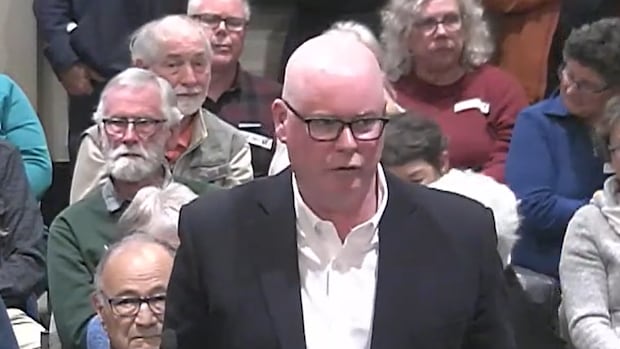
In the face of growing local opposition, ProEnergy Canada’s executive John MacIsaac redirected Tantramar council members to N.B. Power for answers about a controversial natural gas plant proposed for southeastern New Brunswick during a tense council meeting Tuesday evening.
The proposed 400-megawatt facility in Centre Village, which would feature eight turbines, has sparked significant community concern, with the council chambers packed to capacity as MacIsaac fielded questions for nearly an hour.
“Unfortunately, you’re the wrong person to be here tonight, because we should be asking N.B. Power questions, not you,” said Councillor Josh Goguen, drawing applause from attendees. MacIsaac agreed, suggesting councillors request an executive summary on the site selection process from N.B. Power.
Tantramar Mayor Andrew Black called for N.B. Power representatives to attend a future council meeting, expressing frustration over the utility’s long-term energy strategy. “I think if N.B. Power had actually invested in renewable energy, like people have been telling them [since] 20 to 25 years ago, we wouldn’t be even having this conversation right now,” Black remarked.
If approved, preliminary construction on the plant could begin in early 2023, with operations targeted to start by mid-2028. The project represents a significant long-term commitment, with a planned 25-year operational lifespan.
When questioned by Councillor Debbie Wiggins-Colwell about committing to such a large facility for a quarter-century, MacIsaac framed the plant primarily as a grid stabilization measure rather than just a power generation facility. He claimed the turbines would operate 85 percent of the time without burning gas, functioning instead as synchronous condensers providing voltage support to accommodate renewable energy integration.
However, this explanation appears at odds with statements from N.B. Power itself. The utility’s 2023 Integrated Resource Plan makes no mention of synchronous condensing or voltage support needs. Instead, N.B. Power vice-president Brad Coady recently told a legislative committee that the gas plant proposal originated from predictions of baseload power shortages by 2028, which “triggered a bunch of activities” leading to the current proposal.
Several councillors expressed skepticism about MacIsaac’s claims, particularly regarding previous statements about Indigenous partnerships. Councillor Allison Butcher directly challenged the company’s credibility: “There are no Indigenous groups that are backing this right now. So when I hear these great news things about how it will work, I can’t, in good faith, believe it.”
The company had previously claimed a partnership with the North Shore Mi’kmaq Tribal Council. When pressed on this discrepancy, MacIsaac offered a terse explanation: “Our public messaging was based on our understanding at the time.”
Local MLA Megan Mitton, a vocal opponent of the project who attended the meeting, expressed frustration afterward, revealing she had recently learned the plant would cost N.B. Power at least $1 billion over the 25-year agreement. “Who knows actually how much?” Mitton said. “They won’t tell us how much.”
The council concluded the meeting by unanimously approving a motion to send formal letters to Premier Susan Holt, Beausejour MP Dominic LeBlanc, New Brunswick Environment Minister Gilles LePage, N.B. Power CEO Lori Clark, and MacIsaac, calling for increased engagement and a comprehensive environmental impact assessment.
The Tantramar dispute highlights growing tensions across Canada as utilities balance energy security needs with climate commitments and local environmental concerns. While natural gas plants produce fewer emissions than coal, environmental advocates argue they represent continued investment in fossil fuel infrastructure at a time when renewable energy should be prioritized.
For residents of this rural community, questions about site selection, long-term environmental impacts, and the true purpose of the facility remain unanswered despite the developer’s appearance at council.
Fact Checker
Verify the accuracy of this article using The Disinformation Commission analysis and real-time sources.

13 Comments
The developer’s redirection of questions to NB Power raises some red flags. The council should continue to press for direct answers and accountability, especially around the utility’s long-term energy strategy and investment in renewables.
Absolutely. NB Power needs to step up and provide the community with a clear, evidence-based rationale for their energy plans and decision-making process.
It’s encouraging to see the local council taking a proactive stance in scrutinizing this proposed natural gas plant. Transparency and open dialogue are essential to addressing community concerns and finding the best solution.
It’s good to see the local council taking a proactive role in scrutinizing this proposed natural gas plant. They’re right to demand more transparency and accountability from the utility on their long-term energy planning.
Agreed. The council is representing the community’s interests, and NB Power needs to provide clear, factual information to address the valid concerns that have been raised.
Interesting development with this natural gas plant proposal. It’s good to see the local council pushing for more transparency and accountability from NB Power on their long-term energy strategy. Renewable energy should be a bigger part of the mix going forward.
Agreed. The council’s frustration with NB Power’s lack of investment in renewables over the years is understandable. They need to step up and provide clear answers to the community.
This is a complex issue with valid concerns on both sides. The community deserves a thorough, fact-based assessment of the proposed plant’s impacts and alternatives. Hopefully NB Power will engage transparently and address the council’s questions.
Absolutely. Open and honest dialogue between the developer, utility, and local government is key to finding the best solution for the community.
This seems like a complex issue with reasonable arguments on both sides. The council is right to push for a thorough, fact-based assessment before making any decisions. Transparent dialogue between all stakeholders is crucial.
The developer’s request for the council to direct questions to NB Power seems like an attempt to avoid scrutiny. The council is right to demand more accountability and information, especially around the long-term energy plan.
I agree, the council needs to keep pressing NB Power for a clear explanation of their decision-making process and future energy strategy.
This is an important debate about balancing energy needs, environmental impacts, and community concerns. I hope the dialogue continues in a constructive manner focused on facts and finding the best path forward.