


Listen to the article
In his State of the Union address, President Donald Trump presented a view of the U.S. economy that significantly diverged from economic reality, continuing his pattern of making claims that don’t withstand factual scrutiny.
The president’s record-long speech was marked by numerous mischaracterizations of economic data. Among his most striking assertions was a claim that $18 trillion in new investments were secured during his first year in office—a figure that doubles even the White House’s own published estimate of $9.7 trillion, which economists already consider implausible.
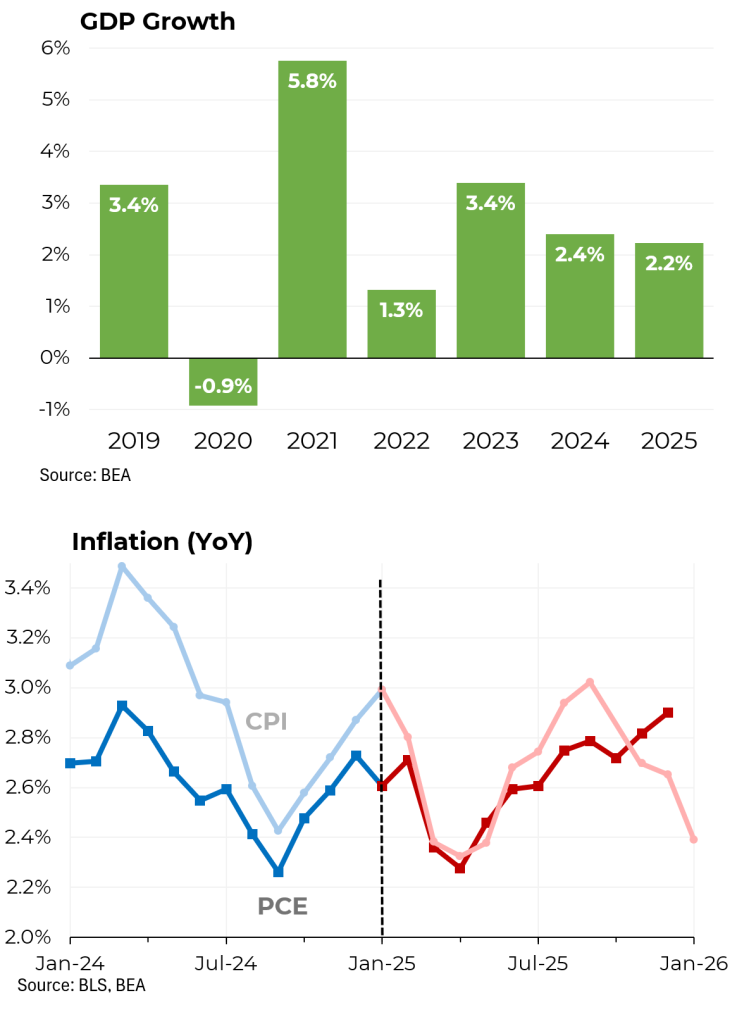
Trump portrayed himself as having inherited “a nation in crisis, with a stagnant economy, inflation at record levels” that he has since transformed into an economy “roaring like never before.” However, economic data tells a different story.
Far from inheriting a stagnant economy, Trump took office following years of steady growth. The U.S. economy grew by 3.4% in 2023 and 2.4% in 2024—both stronger performances than the growth rate in 2025, Trump’s first year back in office. Multiple factors contributed to this slowdown, including reduced immigration, Trump’s tariff policies, sluggish hiring, and disruption from a government shutdown in the fourth quarter.
The president’s inflation claims similarly distort economic reality. When Trump returned to office, inflation had already declined substantially from post-pandemic highs and was hovering around 3%. While the Consumer Price Index dropped to 2.4% by year-end, the Federal Reserve’s preferred inflation gauge—the Personal Consumption Expenditures index—actually increased from 2.6% to 2.9% during Trump’s first year. Federal Reserve Chairman Jerome Powell has attributed much of this persistent inflation to the impact of Trump’s tariff policies.
Employment statistics cited by the president also painted an incomplete picture. While Trump correctly stated that more Americans are working than ever before, this is primarily a function of population growth rather than economic vitality. Job growth during his first year averaged just 15,000 positions monthly, a dramatic decline from the previous year’s 122,000 monthly average. Manufacturing jobs actually decreased, while healthcare employment accounted for more than all net job creation.
The unemployment rate rose from 4% to 4.3% during Trump’s first year back in office, with long-term unemployment increasing significantly. Approximately 25% of unemployed Americans have now been without work for more than 26 weeks.
Trump’s claims about manufacturing resurgence also conflict with economic data. Spending on manufacturing construction steadily declined throughout 2025 as his administration imposed tariffs and halted Biden-era investment initiatives like the Inflation Reduction Act. The tariffs created uncertainty around input costs, a factor that typically delays corporate investment decisions.
Perhaps most dubious was the president’s suggestion that tariff revenues could “substantially replace the modern-day system of income tax.” This claim ignores basic math: the federal government collects approximately $2.7 trillion annually in personal income taxes, while last year’s tariffs generated only $264 billion in revenue. Even if every import to the United States were heavily taxed, the revenue would fall far short of replacing income tax receipts.
Economic research also contradicts Trump’s assertion that tariffs are “paid for by foreign countries.” A Federal Reserve Bank of New York study found that nearly all tariff costs are paid by U.S. importers, who then typically pass these expenses to American consumers through higher prices.
As the president’s economic agenda continues to unfold, the widening gap between his economic assertions and measurable data presents challenges for businesses, investors, and policymakers attempting to navigate the actual economic landscape.
Fact Checker
Verify the accuracy of this article using The Disinformation Commission analysis and real-time sources.

8 Comments
It’s always important to fact-check claims, especially when they come from political figures. This article does a good job of digging into the data and providing a more nuanced perspective on the economic performance during Trump’s presidency.
Hmm, the figures on new investments seem quite inflated compared to the White House’s own estimates. It would be good to dig deeper into the specifics and get a clearer picture of the actual economic performance during Trump’s tenure.
Agreed, the discrepancy in the investment figures is quite striking. Careful analysis of the data is needed to separate political rhetoric from economic reality.
The article highlights some interesting contrasts between Trump’s narrative and the underlying economic data. It’s important to look beyond the political spin and focus on the objective economic indicators to get a clear understanding of the situation.
Hmm, the article raises some valid questions about the accuracy of Trump’s economic claims. I’m curious to see how this debate plays out and whether the data can provide a clearer picture of the actual economic trends during that period.
The economic data seems to paint a different picture than Trump’s rhetoric. It would be helpful to see a more detailed analysis of the various factors that contributed to the economic performance during his tenure.
Agreed, a deeper dive into the data and the underlying drivers of economic growth (or lack thereof) would provide valuable insights beyond the political spin.
It’s interesting to see the fact-checking on Trump’s economic claims. The economic data seems to tell a different story from his portrayal of inheriting a stagnant economy. I wonder how much of this is political spin versus actual facts on the ground.