


Listen to the article
Misinformation Clouds Sudan’s Civil War as Death Toll Mounts
The brutal civil war raging in Sudan since April 2023 has claimed tens of thousands of lives, with estimates ranging from 20,000 to as many as 200,000 casualties. Amid this devastating conflict, social media has become a battleground for competing narratives, with accurate reporting often drowned out by misleading or fabricated content.
“This war is also very much taking place on social media, where disinformation is being spread in the wildest forms,” explains Volker Perthes, former Special Representative of the Secretary-General of the United Nations for Sudan from 2021-2023. “Depending on which side different activists are on, they blame the war and various massacres on the opposing side — or on the US or the UN. It’s all very hate-filled.”
The Rapid Support Forces (RSF), a paramilitary group fighting against the Sudanese Armed Forces (SAF), has been accused by international organizations including the United Nations and the United States government of genocide, ethnic cleansing, and crimes against humanity. Yet determining the truth behind specific incidents has become increasingly difficult.
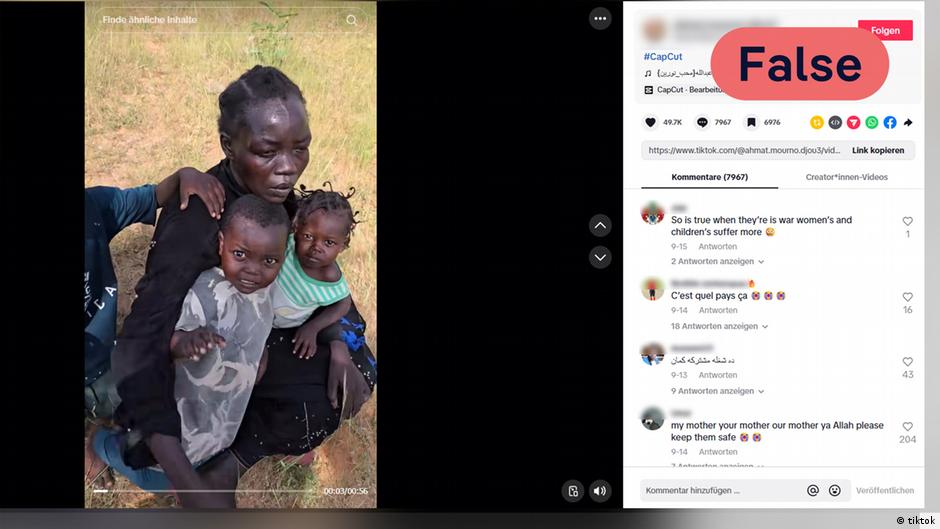
A striking example emerged in late October when a viral video claimed to show RSF troops terrorizing a Sudanese mother and her three children. The video, which accumulated millions of views across multiple platforms, was presented as evidence of RSF brutality in El-Fasher, a city that had recently fallen to the paramilitary group.
On October 29, a self-described “independent analyst” of geopolitics posted the video on X (formerly Twitter), claiming it showed “the UAE-backed RSF terrorizing a mother and her children in Sudan.” The post garnered nearly 13 million views and was shared more than 41,000 times.
The following day, the same footage appeared in posts describing the fall of El-Fasher to RSF forces. By October 31, Syrian internet personality Jamil Al-Hasaan, who has millions of followers across Instagram and X, had incorporated the video into his emotional five-minute plea for help, claiming without evidence that the woman in the footage was ultimately killed.
Investigation revealed these narratives to be false. A reverse image search showed the original video was posted on TikTok on September 12—more than a month before El-Fasher fell to RSF forces. Arabic language experts who analyzed the dialogue determined the men in the video were likely SAF soldiers, not RSF members. Rather than threatening the woman, they appeared to be questioning her about her tribal affiliation and asking whether she had connections to the RSF. The woman identified herself as part of the Zaghawa tribe and stated that the RSF had arrested her husband.
The gunfire heard in the footage, which initially caused the woman to flinch, appeared to be distant and not directed at her. At one point, an adult hand briefly reached from behind the camera to comfort one of the children.
Even more troubling, Al-Hasaan’s plea included a second clip purportedly showing another woman and child cowering before armed soldiers in a desert trench. This footage, which also went viral with hundreds of thousands of views, was entirely artificial—created and watermarked by self-described “Creative AI specialist” Khoubaib Ben Ziou. Despite Ben Ziou explicitly labeling the clip as “AI generated” when he posted it on October 28, it continued to spread as authentic footage.
“Disinformation is a huge problem in Sudan,” says Gerrit Kurtz, a Horn of Africa specialist at the German Institute for International and Security Affairs in Berlin. “Media literacy isn’t particularly high. Then again, the availability of social media and the internet in rural areas is limited.”
The disinformation appears primarily targeted at international audiences, reflecting the complex geopolitical interests at stake in the strategically located, mineral-rich country.
“There are close personal ties between the leadership of the RSF and political leaders in the United Arab Emirates,” Kurtz explains. “The warring parties are constantly posting their narratives on their own channels. Telegram is popular, Hemedti [RSF General Mohamed Hamdan Dagalo] is on Truth Social, the SAF and their allies are on Facebook and X.”
While numerous foreign powers maintain stakes in the outcome of Sudan’s conflict, it is the Sudanese civilians who continue to bear the brutal consequences. International organizations have documented widespread atrocities including mass rape and ethnic cleansing, particularly by RSF forces.
As the information war intensifies online, distinguishing fact from fiction becomes increasingly critical—not just for understanding the conflict, but for holding perpetrators accountable and delivering meaningful humanitarian assistance to those caught in the crossfire of Sudan’s devastating civil war.
Fact Checker
Verify the accuracy of this article using The Disinformation Commission analysis and real-time sources.

6 Comments
This is a complex and fast-moving situation, and it’s critical that the international community has access to accurate, impartial information. Disinformation campaigns that obscure the truth are only making the crisis in Sudan worse.
The use of social media to spread hate and propaganda during conflicts is a disturbing trend. I hope the Sudanese people can find a path to peace and reconciliation, guided by the facts rather than the distortions of warring factions.
You’re right, objective journalism and fact-checking are crucial in these situations. Social media should not be allowed to become a tool for fueling further violence and division.
It’s deeply concerning to see how social media is being weaponized to spread disinformation and inflame tensions in Sudan. Fact-based reporting and accountability for atrocities will be key to resolving this crisis.
The scale of the violence and loss of life in Sudan is truly horrific. I’m glad this study is highlighting the problem of misinformation, which can make it even harder to understand and address the underlying causes of the conflict.
This is a very troubling situation in Sudan. It’s critical that accurate, impartial reporting cuts through the misinformation and disinformation being spread on social media. Determining the truth is challenging, but holding those responsible for atrocities accountable is essential.