


Listen to the article
#
The internet was abuzz this week after a supposed exchange between Minneapolis Mayor Jacob Frey and Vice President J.D. Vance went viral, featuring a crude suggestion involving furniture. However, fact-checking reveals this interaction was fabricated, highlighting once again how easily misinformation spreads on social media platforms.
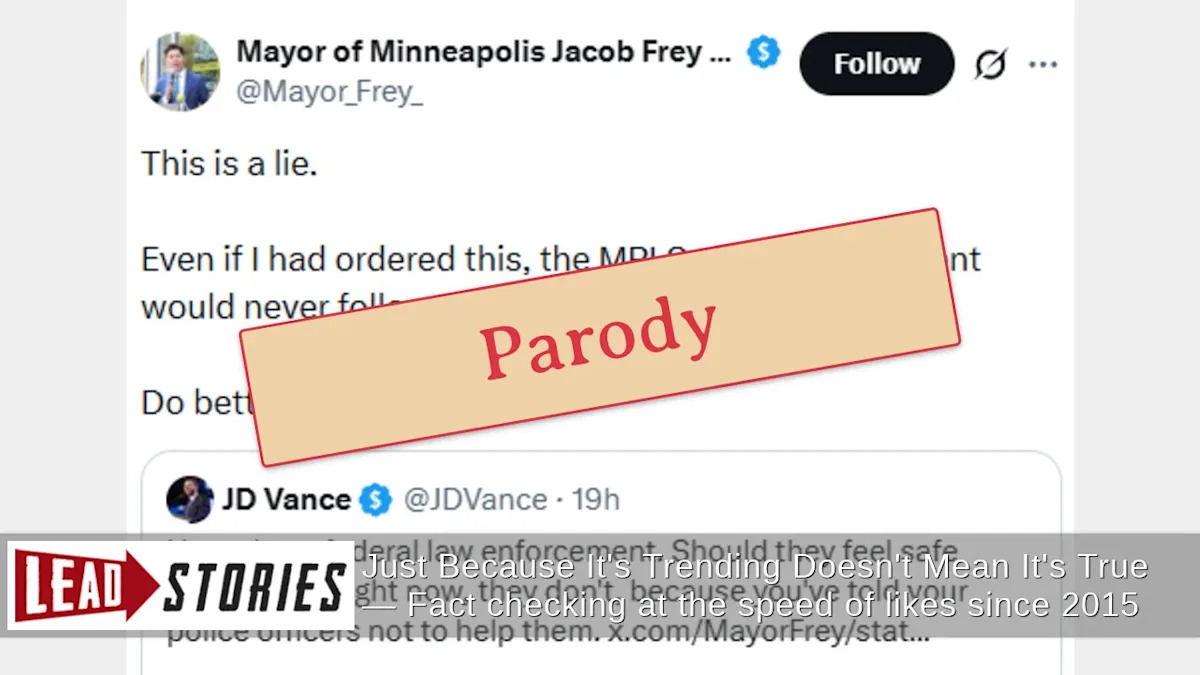
The alleged exchange began when Vice President Vance shared and commented on a genuine post from Mayor Frey’s official account on X (formerly Twitter). The controversy erupted when what appeared to be Mayor Frey responded with a hostile message telling Vance to “go fuck a couch.”
Many users who saw the exchange believed it to be authentic communication from the Minneapolis mayor. The inflammatory post read: “This is a lie. Even if I had ordered this, the MPLS police department would never follow an order from me. Do better. Go fuck a couch.”
However, this vulgar response did not come from Mayor Frey’s official account but instead from a parody account using the handle @Mayor_Frey_ rather than Frey’s verified account @MayorFrey. The parody account includes “Parody” in its bio, but this designation is often missed by casual observers, especially on mobile devices where screen limitations can hide such qualifiers.
This incident underscores ongoing challenges faced by social media platforms in clearly distinguishing between authentic and satirical content. Despite X’s policies requiring parody accounts to clearly identify themselves, the visual similarity between official and unofficial accounts continues to cause confusion.
The real context behind the exchange involves a policy disagreement about law enforcement and emergency response protocols, with Vice President Vance critiquing a position he attributed to Mayor Frey. The actual Mayor Frey had indeed made a post that Vance was responding to, but the vulgar reply came from the impersonator.
This fabricated exchange gained additional traction due to existing internet memes about Vice President Vance and couches, which stem from false claims about his memoir “Hillbilly Elegy: A Memoir of a Family and Culture in Crisis.” These claims involve a completely fictional passage that was never actually in Vance’s book but has nonetheless become a persistent online joke.
Media literacy experts point to this incident as a perfect case study in how misinformation spreads. “When content aligns with what people already believe or want to believe about public figures, critical evaluation often takes a backseat,” explains Dr. Melissa Thompson, a digital media researcher at Northwestern University. “The combination of a parody account, a heated political climate, and pre-existing memes created perfect conditions for this falsehood to spread.”
The incident also highlights the evolution of political discourse on social media platforms, where the lines between official communications, parody, and deliberate misinformation continue to blur. Political figures increasingly find themselves responding to or denying statements they never made as these fabrications take on lives of their own in the digital ecosystem.
Platform design choices also contribute to the problem. On X, parody account labels can be difficult to spot, especially on mobile devices where space constraints may push such identifiers out of immediate view. Critics argue that platforms should do more to visually distinguish parody content from authentic posts by public officials.
As for Mayor Frey and Vice President Vance, neither has directly addressed this specific fabricated exchange, though both continue to engage on the platform regarding legitimate policy matters affecting Minneapolis and the nation at large.
Fact Checker
Verify the accuracy of this article using The Disinformation Commission analysis and real-time sources.

15 Comments
Kudos to the fact-checkers for quickly identifying and debunking this false information. Their work is essential in an era of rampant misinformation.
This incident serves as a reminder that we must all be vigilant and critical consumers of information, especially on social media. Fact-checking should be a routine practice.
This highlights the challenges of regulating and managing misinformation in the digital age. Platforms and officials need to be proactive in addressing these issues.
Interesting case of misinformation. It’s concerning how easily fabricated social media posts can spread and be perceived as authentic these days. Fact-checking is so important to verify the source and context.
While parody accounts can be amusing, they can also be used maliciously to spread disinformation. Proper labeling and context are important to avoid confusion.
Absolutely. Platforms should have clear policies to identify and label parody accounts, so users can make informed judgments about the content they encounter.
The ease with which misinformation can spread on social media is alarming. Robust fact-checking processes are essential to combat the proliferation of false narratives.
I agree. Platforms and authorities need to work together to find effective ways to identify and limit the reach of fabricated content.
It’s disappointing to see public officials targeted with this kind of crude and fabricated content. Maintaining civil discourse is crucial for a healthy democracy.
The distinction between a verified account and a parody account is crucial, but it can be easily missed by many online. Kudos to the fact-checkers for catching this and setting the record straight.
Absolutely. Vigilance is needed to identify legitimate information from misinformation, especially on fast-moving social media platforms.
This is a good reminder to always verify the source and context of information, especially when it seems sensational or controversial. Fact-checking is an important civic duty.
I wonder what the motivation was behind creating this parody post targeting the Minneapolis mayor and Vice President Vance. Spreading disinformation for political gain is troubling.
Yes, the intent behind such parody accounts is often concerning. Fact-checking and transparency are crucial to maintain trust in public discourse.
This situation underscores the need for greater digital literacy and critical thinking skills among the public. We must all be vigilant consumers of information.