


Listen to the article
India’s Foreign Ministry Refutes Claims of US Military Presence for Iran Operations
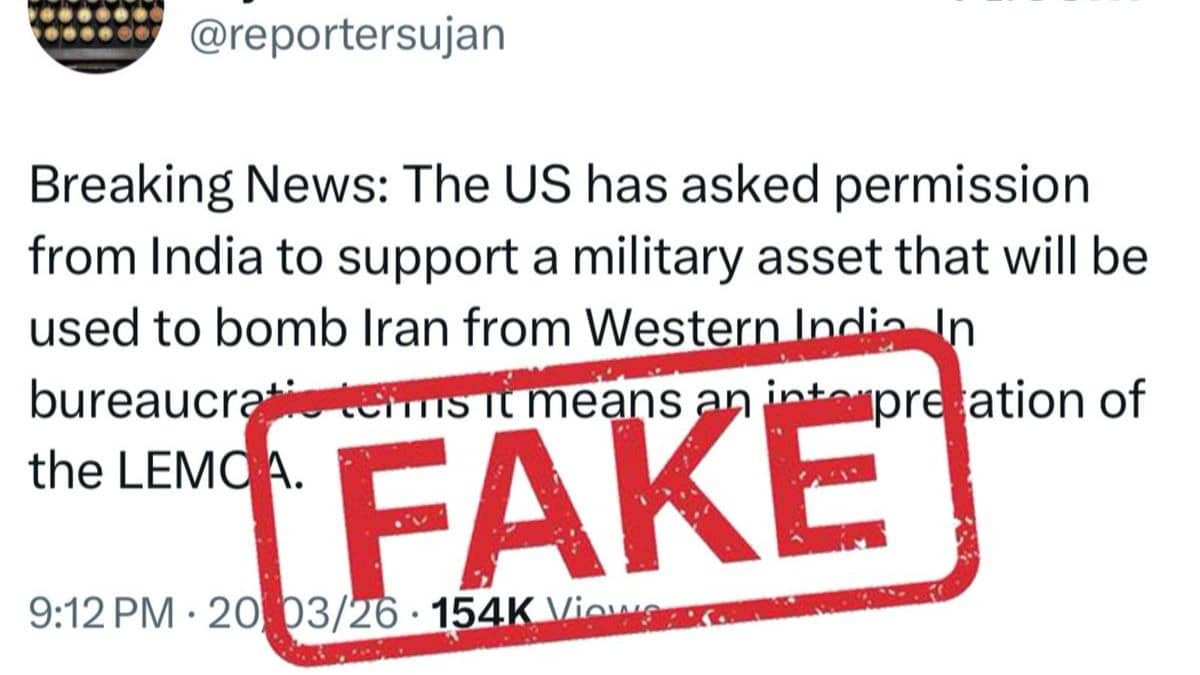
India’s Ministry of External Affairs (MEA) has forcefully denied viral social media claims suggesting that the United States has requested permission to use Indian territory or naval bases for potential military operations against Iran.
The ministry issued a “Fake News Alert” through its official fact-checking channel on X (formerly Twitter), warning the public against these “baseless and fabricated” reports that have been circulating widely online in recent days.
The false narrative gained traction following an interview on a US television network, where a former military official allegedly claimed that American forces were relocating to Indian ports after the destruction of regional installations in West Asia. This assertion was subsequently amplified across social media platforms, with some posts specifically claiming the US had formally asked to use India’s Konkan coast as a base for military strikes against Iran.
“There is absolutely no factual basis to these claims,” a senior Indian government official stated emphatically. “India maintains a long-standing policy of strategic autonomy and does not permit its territory to be used for offensive military operations by foreign powers.”
The controversy centers around misrepresentations of the Logistics Exchange Memorandum of Agreement (LEMOA), a pact signed between India and the United States in 2016. While this agreement does facilitate mutual access to military facilities for specific logistical support—such as refueling, repairs, and supply replenishment—it expressly prohibits the establishment of foreign military bases on Indian soil or the launching of combat operations from Indian territory.
Defense analysts note that the LEMOA has been carefully structured to enhance military cooperation without compromising India’s sovereignty or its traditionally non-aligned foreign policy stance. The agreement represents a pragmatic approach to defense collaboration without entangling India in external conflicts or power projections.
The timing of these rumors is particularly sensitive as tensions in West Asia continue to escalate. Following coordinated US-Israeli strikes on targets in Tehran in late February, the entire region has entered a phase of heightened volatility, with potential implications for global energy security and maritime commerce.
India has consistently advocated for dialogue and diplomatic solutions to the crisis. Prime Minister Narendra Modi has described the situation as “deeply concerning,” while Indian diplomats have been engaged in discussions with counterparts across the region to promote de-escalation.
The MEA’s swift response to these false claims underscores India’s determination to maintain its diplomatic neutrality amid growing regional tensions. Foreign policy experts suggest that India is walking a delicate balance—preserving its strategic partnership with the United States while simultaneously maintaining constructive relations with Iran, a significant energy supplier and regional power.
“This kind of misinformation can potentially damage India’s carefully calibrated diplomatic position in West Asia,” explained an international relations expert from a New Delhi-based think tank. “By immediately clarifying that no such military arrangements exist, the government is protecting both its bilateral relationships and regional credibility.”
The incident highlights the increasing challenge of combating geopolitical misinformation in the digital age. With tensions between Iran and Western powers continuing to simmer, Indian officials remain vigilant against false narratives that could misrepresent the country’s foreign policy stance or potentially draw it into unwanted conflicts.
By debunking these rumors, New Delhi has reaffirmed its commitment to an independent foreign policy that prioritizes regional stability and national interests, even as maritime security and energy markets face pressure from the ongoing crisis in the vital Strait of Hormuz shipping corridor.
Fact Checker
Verify the accuracy of this article using The Disinformation Commission analysis and real-time sources.

10 Comments
India’s dismissal of the alleged US military request is a reassertion of its independent foreign policy. This stance aligns with the country’s historical reluctance to align too closely with any major power bloc.
Interesting development, though not entirely unexpected given India’s historically cautious stance on foreign military involvement. India’s strategic autonomy and non-alignment policy are likely to take precedence in this situation.
Agreed. India will likely tread carefully to maintain its neutrality and avoid getting entangled in any potential Iran-US conflict.
It’s good to see the Indian government swiftly refuting these unsubstantiated claims. Maintaining neutrality and avoiding entanglement in foreign conflicts is crucial for India’s strategic interests.
This denial by the Indian government is not surprising. India has traditionally avoided aligning too closely with any single global power, preferring to maintain its independent foreign policy.
India’s refusal to provide military support for US operations against Iran is a prudent move to preserve its regional influence and diplomatic leverage.
The Indian government’s swift denial of these claims is a clear indication that it has no intention of involving itself militarily in the ongoing tensions between the US and Iran. Preserving its strategic autonomy remains a top priority for New Delhi.
India’s position underscores the complexity of the geopolitical landscape in the region. Navigating these waters requires a nuanced and pragmatic approach.
The denial by India’s Foreign Ministry underscores the country’s long-standing policy of non-alignment. India will likely continue to walk a careful diplomatic tightrope to balance its relationships with both the US and Iran.
India’s position highlights the complexities of geopolitics in the region. Maintaining strategic autonomy is a delicate balancing act for New Delhi.