


Listen to the article
Viral Photos of “Masked” Chimpanzees in Congo Revealed as Elaborate Hoax
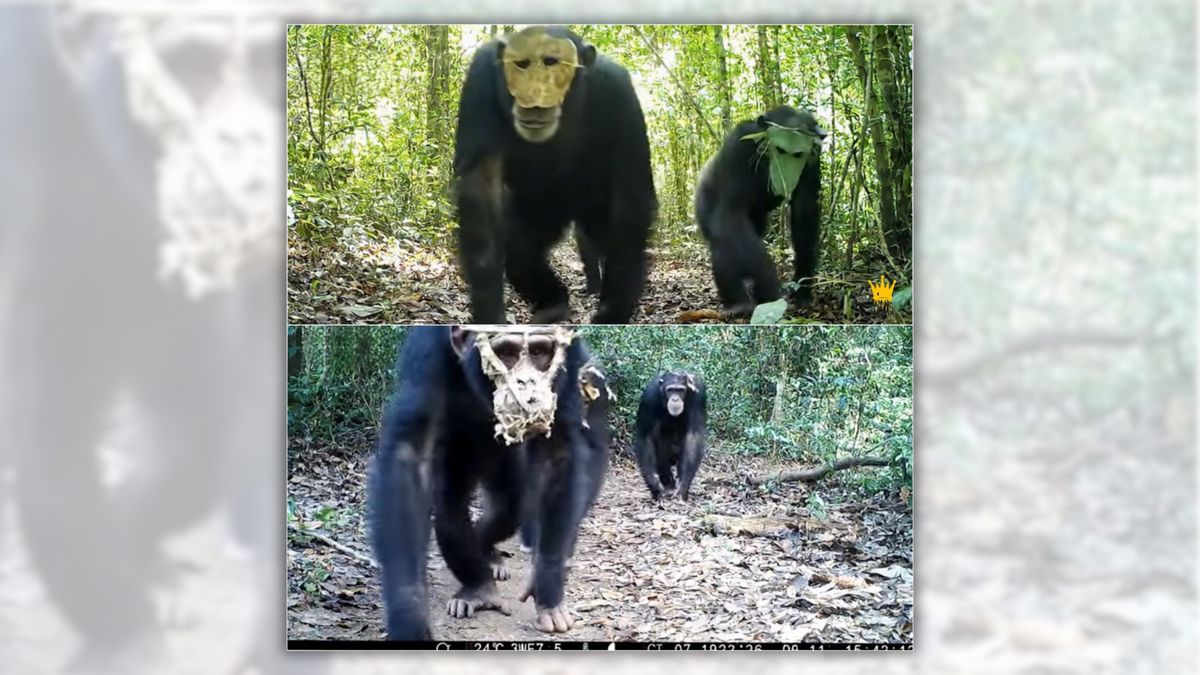
A composite image purportedly showing mask-wearing chimpanzees roaming through woodlands in Congo has been exposed as completely fabricated. The images, which went viral across multiple social media platforms in October, claimed to show primates that had learned to conceal their identities while conducting “raids” on local markets.
The viral posts, which garnered thousands of shares, contained elaborate backstories claiming that these chimps began “wearing makeshift masks” after authorities cracked down on them for stealing food. According to one widely-shared narrative, the animals had adapted to avoid capture after one chimpanzee was “taken away” for “repeatedly stealing food.” Another version claimed locals referred to the primates as “the masked raiders” and marveled at their apparent ability to craft masks from “leaves, bark, and old cloth.”
The images allegedly came from trail cameras stationed in an unspecified Congolese forest, though the posts failed to specify whether the alleged sightings occurred in the Democratic Republic of the Congo or the Republic of the Congo—a telling omission that raised immediate suspicions among wildlife experts.
Despite claims that these supposed behaviors had “left researchers stunned,” no credible scientific publications, conservation organizations, or reputable news outlets have reported on such extraordinary primate behavior. A comprehensive search through scientific literature and news archives reveals no documentation of chimpanzees using masks or similar disguises in the wild.
Close examination of the images reveals numerous inconsistencies that betray their fabricated nature. The chimpanzees appear to have anatomical abnormalities, including misplaced limbs and incorrect numbers of digits. The front-most primate in one image appears to have extra back legs, while another displays only three fingers and a thumb—errors consistent with AI-generated imagery.
The technical aspects of the images further confirm their fraudulent nature. They exhibit the telltale signs of artificially generated content: strategically blurry composition to obscure details, grainy quality to mask imperfections, and nonsensical image file information displayed in black bars across the bottom—a common error in AI-generated content.
Investigation traced the images to a Facebook page called “StoryTime,” which regularly publishes fabricated nature stories accompanied by edited or AI-generated images. Though presented as factual reporting, the page’s own description states it shares “an account of imaginary or real people and events told for entertainment,” and its administrators identify themselves as “digital creators”—subtle disclaimers that many casual viewers miss.
This isn’t StoryTime’s first venture into wildlife misinformation. The page has previously published other fabricated tales about Congo wildlife, including an equally implausible story claiming chimpanzees had domesticated penguins—a species not native to central Africa.
Wildlife experts express concern about such misinformation, noting that fabricated stories can detract from legitimate conservation issues facing great apes in the Congo Basin. The region’s chimpanzees face genuine threats from habitat loss, poaching, and disease, with several subspecies listed as endangered or critically endangered.
“While the idea of mask-wearing chimps might seem amusing, spreading misinformation about wildlife behavior can undermine public understanding of these animals’ actual intelligence and social complexity,” explained Dr. Jane Goodall Institute spokesperson in response to similar viral hoaxes.
The incident highlights the growing challenge of distinguishing authentic wildlife documentation from increasingly sophisticated digital fabrications in an era when AI-generated content continues to flood social media platforms. Conservation organizations encourage social media users to verify wildlife claims through established scientific sources before sharing content that seems extraordinary or unusual.
Fact Checker
Verify the accuracy of this article using The Disinformation Commission analysis and real-time sources.

15 Comments
Interesting update on Masked Chimps Allegedly Raiding Congo Markets: Reports Questionable. Curious how the grades will trend next quarter.
The cost guidance is better than expected. If they deliver, the stock could rerate.
Good point. Watching costs and grades closely.
Exploration results look promising, but permitting will be the key risk.
Silver leverage is strong here; beta cuts both ways though.
Good point. Watching costs and grades closely.
Good point. Watching costs and grades closely.
Uranium names keep pushing higher—supply still tight into 2026.
Interesting update on Masked Chimps Allegedly Raiding Congo Markets: Reports Questionable. Curious how the grades will trend next quarter.
If AISC keeps dropping, this becomes investable for me.
Exploration results look promising, but permitting will be the key risk.
I like the balance sheet here—less leverage than peers.
Uranium names keep pushing higher—supply still tight into 2026.
Nice to see insider buying—usually a good signal in this space.
Good point. Watching costs and grades closely.