


Listen to the article
Iran’s New Supreme Leader Faces Scrutiny Over Suspected AI-Manipulated Images
In today’s age where AI can even generate images, it has become increasingly difficult to distinguish between reality and digital fabrication, even in the most sensitive political contexts.
Serious questions have emerged about the authenticity of newly circulated images of Iran’s Supreme Leader, Mojtaba Khamenei, after a BBC Verify journalist indicated that photos released by Iranian media appear to have been manipulated using artificial intelligence.
Shayan Sardarizadeh, a senior journalist with BBC Verify who specializes in disinformation and online verification, raised concerns about the widely shared photograph of the new Iranian leader on social media platform X.
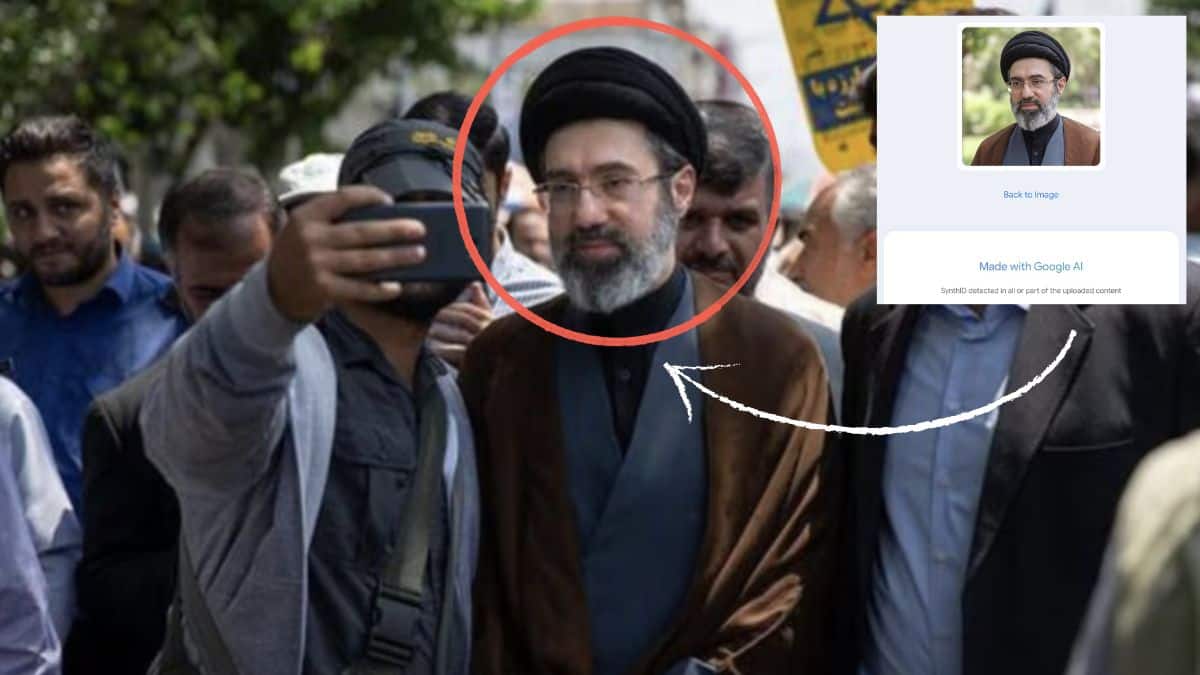
“This image of Iran’s new Supreme Leader, Mojtaba Khamenei, which has been widely published by Iranian media today and now appears on his new X account, appears to have been manipulated with AI,” Sardarizadeh wrote.
According to his analysis, Google’s SynthID tool identified watermarks in the image indicating it had been edited using Google AI. Sardarizadeh added that the image appears to be derived from an older photograph rather than a recent one of Khamenei.
“A cropped reverse image search appears to find the original version of the photo published several years ago,” he explained. “It shows Mojtaba at a pro-government rally. The background and surrounding figures seem to have been edited out using AI.”
The image has been widely circulated by Iranian state media and now features on Khamenei’s newly created X account. Metadata linked to the account reportedly indicates it is based in the Netherlands, adding another layer of intrigue to the situation.
The controversy surrounding the altered image has intensified speculation over the condition of Iran’s new leader, who has not appeared in public since being appointed earlier this week following the death of his father, Ayatollah Ali Khamenei.
Several reports suggest that Mojtaba Khamenei was wounded during the strike that killed his father on February 28. Since then, no verified recent photographs or public appearances have been released, fueling rumors about his health.
Some Western media outlets, including The Sun, have published claims alleging the new leader may be in critical condition. “One or two of his legs have been amputated. His liver or stomach has also ruptured. He is apparently in a coma as well,” the publication cited an unnamed source as saying.
Iranian officials have strongly dismissed these speculations. Yousef Pezeshkian, the son of President Masoud Pezeshkian and a government adviser, stated that Mojtaba Khamenei was “safe and sound” despite reports that he had been injured during the strikes that killed his father.
“I heard news that Mr. Mojtaba Khamenei had been injured. I asked some friends who had connections, and they told me that, thank God, he is safe and sound,” Pezeshkian wrote in a post on Telegram, according to AFP.
Other Iranian sources have offered a different version, acknowledging that Khamenei sustained injuries but describing them as relatively minor, including a fractured foot, bruising around the eye, and facial cuts during the initial wave of airstrikes.
The situation highlights the growing challenge of verifying information in an era of sophisticated digital manipulation technologies. Iran, currently navigating a sensitive leadership transition amid regional tensions, has strong incentives to project stability and continuity in its governance.
In his first message since taking power, Mojtaba Khamenei called for national unity and urged citizens to participate in Quds Day, according to Iranian state media on Thursday. He also instructed that all US military bases in the region should be immediately closed and declared that the Strait of Hormuz would remain closed as a measure to pressure Iran’s adversaries.
“I would like to thank the brave fighters who are performing admirably at a time when our country is under attack and facing significant pressure,” he added in the statement.
Notably, this message was read out on state television rather than delivered in person. The format—a written statement read by a presenter—and his continued absence from public view have only intensified speculation about his health and actual leadership role.
Political analysts suggest that the lack of public appearances may be deliberate, as Iran seeks to project stability during the ongoing conflict while managing a potentially precarious leadership situation. The use of potentially AI-manipulated imagery further complicates efforts to determine the true state of affairs within Iran’s highest levels of leadership.
Fact Checker
Verify the accuracy of this article using The Disinformation Commission analysis and real-time sources.

16 Comments
Interesting development. If the images are indeed manipulated, it raises serious questions about transparency and trust in Iran’s leadership. Accurate information is crucial, especially on sensitive political matters.
Agreed. In the digital age, verifying the authenticity of images has become increasingly challenging. Thorough investigation is needed to get to the bottom of this.
If the reports of AI-generated images of Iran’s leadership are accurate, it’s a significant issue that threatens the credibility of information. Verifying the authenticity of visual content is crucial, especially in sensitive political contexts.
The potential use of AI to manipulate images of political figures is concerning. It underscores the need for robust fact-checking and verification processes to ensure the public has access to reliable information.
Absolutely. Transparency and accountability should be top priorities, especially for those in positions of power. The implications of this issue extend beyond Iran.
The potential use of AI to manipulate images of Iran’s Supreme Leader is a worrying development. Maintaining public trust requires a commitment to transparency and the verification of information, especially on sensitive political matters.
I agree. The implications of this issue extend beyond Iran, as the proliferation of AI-generated content poses challenges to the integrity of information globally.
This report highlights the importance of scrutinizing the veracity of images, especially those related to high-profile political figures. The use of AI to potentially manipulate such visuals is a concerning development that warrants further investigation.
If the reports of AI-manipulated images are accurate, it’s a troubling development that erodes trust in Iran’s government. Maintaining the integrity of information is crucial for informed public discourse.
You raise a valid point. The proliferation of AI-generated content is a growing challenge that requires vigilance and rigorous verification processes to combat misinformation.
The potential use of AI to create altered images of Iran’s leadership is concerning and raises questions about transparency and accountability. Verifying the authenticity of information is critical, especially in sensitive political contexts.
I agree. In today’s digital landscape, the ability to manipulate images using AI is a serious issue that demands attention and robust fact-checking measures.
The allegations of AI-manipulated images of Iran’s new Supreme Leader are troubling. Maintaining public trust requires ensuring the accuracy and authenticity of information, particularly on sensitive political matters.
Precisely. In an era of increasing digital manipulation, robust fact-checking and transparency are essential to uphold the integrity of information and discourse.
This report highlights the need for vigilance in verifying the authenticity of visual content, particularly when it comes to high-profile political figures. The use of AI to potentially manipulate such images is a concerning trend that warrants further investigation.
The allegations of AI-manipulated images of Iran’s new Supreme Leader are troubling and raise important questions about transparency and accountability. Maintaining public trust requires a commitment to verifying the accuracy of information, especially on sensitive political matters.