


Listen to the article
Trump Touts Economic Success in Prime-Time Address, but Facts Tell More Complex Story
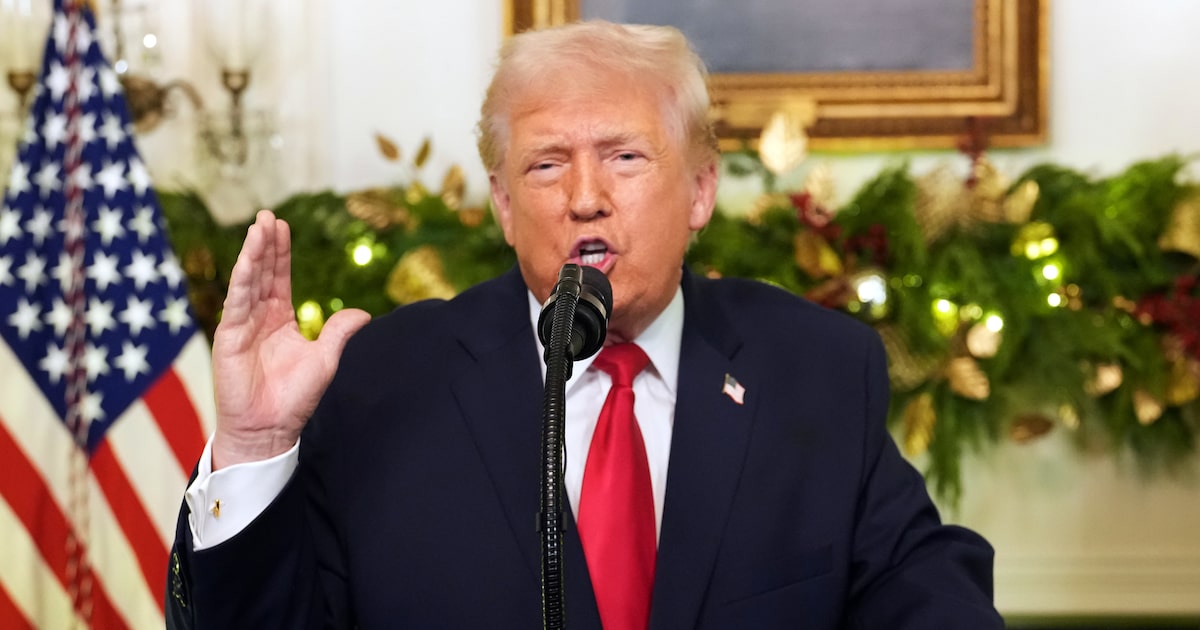
President Donald Trump delivered an 18-minute prime-time White House address on December 17, claiming his 11-month presidency has yielded historic improvements to American lives after years of what he characterized as immigration and economic chaos.
In his televised speech, Trump announced that 1.45 million U.S. military personnel would receive $1,776 checks as part of a new “warrior dividend.” “The checks are already on the way,” Trump stated. “Nobody understood that one until about 30 minutes ago.”
However, the rosy economic picture painted by the President stands in stark contrast to public sentiment. According to December polling by NPR/PBS News/Marist, just 36% of Americans approve of Trump’s handling of the economy, with more than one-third reporting their personal finances had deteriorated over the past year. Consumer confidence remains near the lows reached during mid-2022, when inflation peaked at around 9% during the Biden administration.
Fact-checkers have identified several inaccuracies in Trump’s claims. He significantly exaggerated the amount of foreign investment he claims to have attracted to the U.S. by trillions of dollars. The President also overstated the historic scale of tax cuts in his domestic spending law and their impact on older Americans, while repeating false talking points about unauthorized immigration.
On crime, Trump claimed rates were at record levels, though historical data shows violent crime rates were approximately twice as high in the early 1990s as they are today.
Regarding the economy, Trump declared that “inflation has stopped, wages are up, prices are down.” However, inflation had not stopped at the time of his speech. The most recent data available showed prices had increased by 3% year over year in September, identical to the inflation rate when Trump took office in January. Updated Bureau of Labor Statistics data released the day after his speech showed November inflation at 2.7% – a decline but still above the Federal Reserve’s 2% target.
Trump’s claim about wages is more accurate, as wage gains have outpaced inflation during his presidency.
The President also made mathematically impossible claims about drug price reductions, stating he had worked to “slash prices on drugs and pharmaceuticals by as much as 400, 500, and even 600%.” Such reductions are not logically possible – a 100% reduction would mean a consumer pays nothing, while anything beyond that would mean pharmaceutical companies would be paying consumers to take medications.
The newly announced military “warrior dividend” would cost approximately $2.58 billion for the 1.45 million service members. Trump indicated the funding would come from tariff revenue, saying, “We made a lot more money than anybody thought.” However, expenditures of this magnitude typically require congressional appropriation, and it remains unclear how the checks could already be “on the way” as Trump claimed without such approval. The White House did not immediately respond to inquiries seeking clarification.
Looking ahead, Trump predicted “the largest tax refund season of all time” next spring. Tax policy experts believe refunds will indeed be larger in early 2026, primarily benefiting higher-income households. Joseph Rosenberg, senior fellow with the Urban Institute-Brookings Institution Tax Policy Center, confirmed that “some of the tax changes included in the One Big Beautiful Bill Act were effective for tax year 2025.”
The Tax Policy Center estimates overall tax bills will decrease by approximately $125 billion, averaging $650 per taxpayer, though the distribution will be uneven. Among the bottom fifth of taxpayers by income, only about 16% will receive tax cuts, while 91% of the top fifth will see reductions averaging about $2,300.
Garrett Watson, Tax Foundation policy analysis director, noted that refund sizes will partly depend on whether taxpayers adjusted their withholding. If they maintained previous rates, “instead of gradually receiving the benefit of the tax cuts through higher take-home pay during the year, most taxpayers will receive it all at once when they file their returns.”
Fact Checker
Verify the accuracy of this article using The Disinformation Commission analysis and real-time sources.

10 Comments
As an investor in mining and commodities, I’m closely watching how these economic dynamics could impact the outlook for key materials like gold, copper, and lithium. Lots of moving parts to consider.
That’s a great point. The mining and energy sectors are so closely tied to macroeconomic conditions. Careful analysis of inflation, consumer demand, and geopolitics will be crucial for navigating the markets ahead.
This article dives into some important context around the President’s claims on the economy. It’s good to see the data and fact-checking scrutiny, as these issues can have wide-ranging implications.
Agreed, the need for rigorous analysis is critical, especially on high-profile economic and policy topics. Looking forward to seeing more reporting that examines the nuances and differing perspectives.
The contrast between the President’s positive rhetoric and the more mixed public sentiment is noteworthy. I’m curious to see how this tension plays out in terms of policy decisions, market reactions, and public trust in economic data.
Well said. Reconciling differing perceptions of the economy’s health is an ongoing challenge. Maintaining transparency and credibility around economic reporting will be crucial, regardless of political affiliation.
Interesting to see the economic connections between inflation, wages, and military spending. This is a complex topic with many factors at play. I’m curious to learn more about the potential impacts on different industries and regions.
You’re right, the economic interplay here is nuanced. I’ll be reading more to better understand how factors like geopolitics, productivity, and consumer sentiment all feed into the bigger picture.
Military spending is an interesting angle to explore here. I wonder how the proposed “warrior dividend” and other defense-related outlays could ripple through the broader economy, especially in sectors like aerospace and logistics.
That’s a perceptive observation. Defense budgets and procurement can have significant second-order effects, both positive and negative, on employment, manufacturing, and broader economic indicators. Worth digging deeper into those dynamics.