


Listen to the article
Fact-Checking Organization Exposes Indian Media Misrepresentation of Tarique Rahman’s Speech
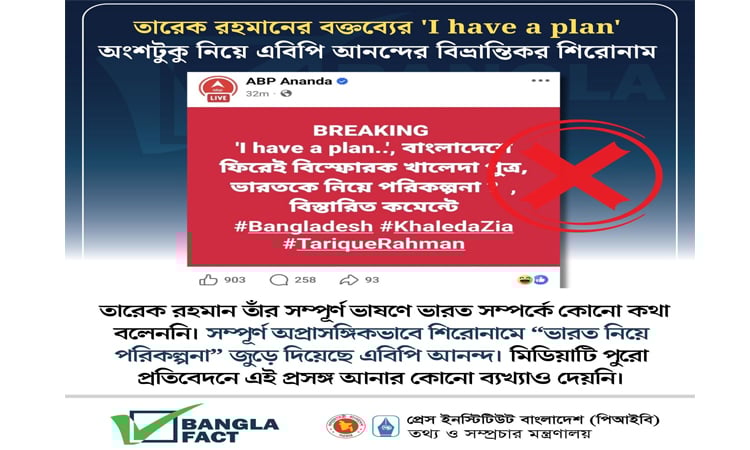
BanglaFact, the fact-checking and media research division of the Press Institute of Bangladesh (PIB), has called out Indian media outlet ABP Ananda for publishing misleading information about BNP Acting Chairman Tarique Rahman’s recent public address. The fact-checking body revealed that the Indian news organization had falsely suggested Rahman made comments about India in his speech when no such remarks were made.
Rahman, who returned to Bangladesh on December 25 after a 17-year absence, addressed a massive crowd at a reception ceremony held in Dhaka’s Purbachal 300-feet area. During his speech, the BNP leader spoke about his vision for Bangladesh’s future, telling supporters: “I have a plan, for the people of my country, for my country.”
Despite the clear domestic focus of Rahman’s remarks, ABP Ananda published a report with the headline: “‘I have a plan…’, Explosive statement by Khaleda’s son upon returning to Bangladesh-plan regarding India?” BanglaFact’s analysis confirmed that Rahman made no reference to India throughout his entire address, making the headline’s implication entirely unfounded.
“The reference to India in the headline was completely irrelevant, as Tarique Rahman did not mention India at any point in his speech,” BanglaFact stated in its report. The fact-checkers further noted that ABP Ananda provided no explanation or justification for introducing this angle in their coverage.
Rahman’s actual speech focused on domestic matters and called for peace in Bangladesh. He drew inspiration from American civil rights leader Martin Luther King Jr.’s famous “I Have a Dream” speech, adapting the iconic phrase to his own context by stating, “I have a plan.” Rahman emphasized that his vision was specifically “for the interests of the people of the country.”
The misleading report highlights ongoing tensions in Bangladesh-India media relations, where cross-border reporting sometimes introduces questionable narratives. Media analysts note that such misrepresentations can potentially influence public perception and diplomatic relations between the neighboring countries.
Rahman’s return to Bangladesh marks a significant political development in the country. As the son of former Prime Minister Khaleda Zia and the acting chairman of the Bangladesh Nationalist Party, his homecoming after nearly two decades abroad has generated considerable attention both domestically and internationally.
The incident also underscores the critical role of fact-checking organizations like BanglaFact in an era where misinformation can spread rapidly across borders. By identifying and correcting misleading reports, these institutions help maintain journalistic integrity and provide the public with accurate information.
Media ethics experts emphasize that responsible journalism requires strict adherence to factual reporting, particularly when covering politically sensitive issues or figures. Headlines that suggest unfounded narratives or introduce elements not present in the original content can damage media credibility and exacerbate regional tensions.
As Bangladesh navigates this new political chapter with Rahman’s return, the accuracy of media reporting will remain essential for informed public discourse. BanglaFact’s intervention in this case demonstrates the growing importance of media literacy and fact-checking in contemporary news consumption across South Asia.
Fact Checker
Verify the accuracy of this article using The Disinformation Commission analysis and real-time sources.

14 Comments
The Indian media’s misrepresentation of Tarique Rahman’s speech is troubling. It’s critical that news outlets report accurately and avoid pushing misleading agendas, especially on sensitive regional issues.
Well said. Responsible journalism is essential for maintaining public trust and informed discourse.
This highlights the need for rigorous, unbiased journalism. Jumping to conclusions and publishing misleading headlines is irresponsible, especially on matters involving regional geopolitics.
Well said. Fact-checking is an essential part of maintaining journalistic integrity.
This case highlights the need for greater media scrutiny and accountability. Fact-checking organizations play a vital role in holding news outlets to high standards of accuracy and objectivity.
Agreed. Fact-checking is a crucial check on the power of the media to shape public opinion.
It’s concerning to see Indian media outlets spreading disinformation about a political figure’s remarks. Fact-checking organizations play a vital role in keeping the public accurately informed.
Agreed. Transparency and accountability are key, especially when it comes to reporting on sensitive regional dynamics.
Interesting to see this fact-checking on the Indian media’s misrepresentation of Tarique Rahman’s speech. It’s important to get the facts straight, especially on sensitive political topics.
Absolutely, media accuracy is crucial. Glad to see BanglaFact stepping in to correct the record.
It’s concerning to see Indian media spreading disinformation about a political figure’s remarks. Fact-checking is essential to counter the proliferation of misleading narratives, especially on sensitive regional topics.
Absolutely. Maintaining journalistic integrity is crucial for informed public discourse.
This is a good reminder that we should be wary of sensationalized media narratives, particularly around political topics. Kudos to BanglaFact for taking the time to set the record straight.
Absolutely. Fact-checking is an important safeguard against the spread of misinformation.