


Listen to the article
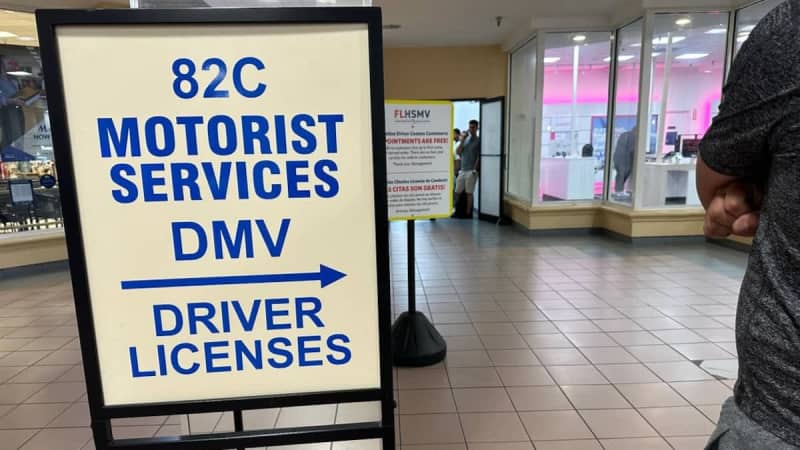
In a significant policy shift, Florida officials announced that all driver’s license exams will now be administered exclusively in English, eliminating options for interpreters or translators across all license classifications. The change comes in the wake of a fatal August 2025 crash on Florida’s Turnpike that killed three people.
The incident involved a tractor-trailer driver, Harjinder Singh, who attempted to make an illegal U-turn. Singh, reported to be in the country illegally with a commercial driver’s license obtained in California, failed an English proficiency test following the crash, according to state officials.
Governor Ron DeSantis expressed support for the new requirement on social media, writing: “Good reform by Florida Highway Safety and Motor Vehicles to require driver exams be conducted only in English. Need to be able to read the road signs!”
Critics, including Nikki Fried, chairperson of the state Democratic Party and former agriculture commissioner, have condemned the policy change as discriminatory. “In one of the most multilingual states in the country, Florida is going to implement driver’s license exams exclusively in English,” Fried wrote on X. “This is not about safety, this is about racism.”
The policy change carries particular significance in Florida, where approximately 30% of residents over age five speak a language other than English at home, according to U.S. Census data. The Migration Policy Institute reports that 35% of the state’s naturalized citizens have limited English proficiency.
Previously, Florida offered non-commercial driver’s license exams in multiple languages, while commercial permit and license exams were available in both English and Spanish. The Tampa Bay Times reports that only a handful of states—including Oklahoma, South Dakota, and Wyoming—offer exams exclusively in English.
Despite proponents’ claims that the policy will enhance road safety, transportation experts note there is no conclusive evidence linking foreign-language testing to increased accident rates. When contacted about safety evidence supporting the policy shift, the Florida Department of Highway Safety and Motor Vehicles did not respond to specific inquiries.
“The standard iconography and signage used across the country is meant to be easily recognizable and understandable for drivers, and so it’s unlikely that a language barrier would make a big difference in one’s understanding of this signage,” explained Joe Young, spokesperson for the Insurance Institute for Highway Safety, a nonprofit funded by auto insurers.
Young noted that traffic signs often use “dual coding”—combining words with symbols—to ensure quick comprehension regardless of language proficiency. In cases where text appears, signage typically uses short phrases with large lettering for easy recognition.
Safety experts caution that strict English-only policies could have unintended consequences. Preventing non-English speakers from obtaining licenses might increase the number of unlicensed and uninsured drivers on Florida’s roads, potentially creating other safety concerns.
The American Association of Motor Vehicle Administrators (AAMVA) explicitly states in its guidelines that inability to speak English “is not necessarily a barrier to proper motor vehicle operation” provided the driver meets knowledge requirements and can interpret road signs and signals. The organization further suggests that accommodating non-English speakers helps prevent unqualified drivers from operating vehicles without proper licensing.
Research on driver safety has consistently found that factors such as age, experience, and behavior—particularly distracted or impaired driving—are the strongest predictors of crash risk. A January 2023 study on international drivers adapting to U.S. traffic systems found that those translating in real-time experience increased mental demand and slower reaction times, suggesting that traffic education should become less text-dominant and more visually adaptive.
The policy comes amid heightened federal attention to language proficiency for commercial drivers. Florida’s new requirement will affect all driver’s license applicants, who must pass a multiple-choice test on traffic laws and road signs, a driving test, and a vision test to obtain licensure.
Fact Checker
Verify the accuracy of this article using The Disinformation Commission analysis and real-time sources.

10 Comments
This seems like a controversial move that could unfairly target immigrant communities. Requiring English proficiency for a driver’s license doesn’t necessarily improve road safety. A more nuanced approach focused on actual driving skills would be better.
I agree. Discriminating against non-English speakers could create more problems than it solves. A fairer, more practical solution is needed.
Interesting policy change in Florida. While road safety is important, I’m not sure an English-only exam requirement is the best approach. Shouldn’t we be finding ways to improve language comprehension and testing for all drivers, regardless of native tongue?
You raise a fair point. An inclusive, multilingual testing system could be more effective for ensuring all drivers understand road rules and signs.
While road safety is crucial, an English-only driver’s license exam feels like an overly simplistic solution that could unfairly disadvantage non-English speakers. Shouldn’t we be looking for ways to improve driver education and testing that work for all residents, regardless of their primary language?
Absolutely. A more inclusive, multilingual approach would likely be more effective at ensuring all drivers have the necessary skills and knowledge to operate vehicles safely.
While the intention may be to enhance safety, an English-only exam policy feels misguided. In a diverse state like Florida, we should be exploring ways to improve driver education and testing that are accessible to all residents, regardless of their primary language.
Exactly. Promoting inclusivity and language accessibility should be the priority, not excluding certain groups from obtaining driver’s licenses.
This new requirement raises some valid concerns about equity and accessibility. Instead of an English-only approach, Florida could explore multilingual testing options or provide more driver education resources in different languages. That seems like a more constructive solution.
Good point. A more balanced, equitable policy would better serve the diverse population of Florida drivers.