


Listen to the article
Trump’s Davos Address Riddled with Factual Inaccuracies
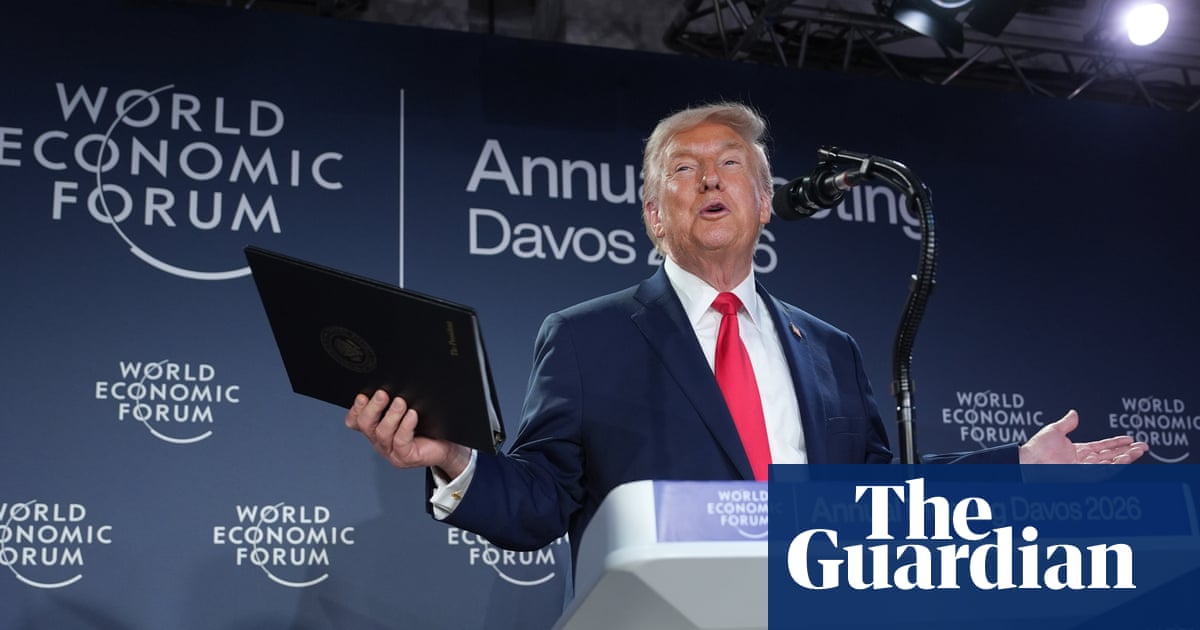
Former President Donald Trump delivered a wide-ranging address at the World Economic Forum in Davos that contained numerous dubious claims on topics spanning from international conflicts to renewable energy. An analysis of his statements reveals several assertions that range from exaggerated to demonstrably false.
During his speech, Trump claimed to have “settled eight other wars” during his time in office. While his administration did play a role in brokering several ceasefires, including between Israel and Iran, India and Pakistan, and Armenia and Azerbaijan, many of these were incremental agreements with disputed levels of U.S. involvement. The Israel-Hamas ceasefire and hostage deal he helped secure remains incomplete, with hundreds of casualties reported in Gaza since the first phase began in October.
Other peace deals Trump referenced have shown limited durability. The agreement between Rwanda and the Democratic Republic of Congo collapsed shortly after signing, resulting in hundreds of civilian deaths. Cambodia and Thailand continue to exchange accusations over broken ceasefires, while the Egypt-Ethiopia dispute centers on a Nile dam project—a diplomatic issue rather than an active conflict.
On technology, Trump asserted American dominance in artificial intelligence, claiming, “We’re leading the world in AI by a lot. We’re leading China by a lot.” Industry experts paint a different picture. Nvidia CEO Jensen Huang has described China as “nanoseconds” behind the United States, while White House AI czar David Sacks estimated Chinese models lag by only “three to six months.” Chinese companies like DeepSeek have released competitive, less expensive AI models despite U.S. restrictions on advanced chips—a development Trump himself previously described as a “wake-up call” for American tech firms.
Perhaps most blatantly incorrect was Trump’s claim about renewable energy in China: “China makes almost all of the windmills, and yet I haven’t been able to find any windfarms in China…They make them. They sell them for a fortune…but they don’t use them themselves.” In reality, China leads the world in wind capacity, generating approximately 40% of global wind energy in 2024, according to Ember Energy. The country is currently constructing 159 gigawatts of wind projects—part of nearly two-thirds of all renewable capacity being developed worldwide, as reported by Global Energy Monitor.
Trump also questioned NATO allies’ commitment to the United States, saying, “We’re there for NATO 100%. I’m not sure if they’d be there for us.” This statement overlooks significant allied sacrifices in U.S.-led military operations. In Afghanistan, NATO partners suffered 1,144 fatalities out of 3,609 total coalition deaths between 2001 and 2021. The United Kingdom alone lost 455 service members, with Canada (158), France (86), Germany (54), and Denmark (43) also sustaining substantial casualties. In Iraq, coalition partners recorded 324 deaths, with the UK suffering 182 casualties.
The former president’s claim about Greenland was particularly noteworthy for its historical inaccuracy. Trump stated, “After the war, we gave Greenland back to Denmark. How stupid were we to do that?” The United States never owned Greenland. While the U.S. established military bases there through agreements in 1941 and 1951, these explicitly acknowledged Denmark’s sovereignty. International court rulings and treaties dating back to 1814 confirm Denmark’s continuous control of the territory.
Finally, Trump’s assertion that eliminating “50% of the fraud” would balance the federal budget ignores basic mathematics. According to the Government Accountability Office, the highest estimate of U.S. fraud losses is $521 billion. Even if all fraud were eliminated—an unprecedented achievement—it would cover less than a third of the projected $1.7 trillion deficit for 2025. Cutting fraud by half, as Trump suggested, would recover roughly $260 billion, leaving the government more than $1.5 trillion short of a balanced budget.
As world leaders gathered in Davos to discuss global economic challenges, Trump’s address demonstrated a concerning pattern of misrepresenting facts across multiple policy domains, raising questions about the reliability of his statements on the international stage.
Fact Checker
Verify the accuracy of this article using The Disinformation Commission analysis and real-time sources.

10 Comments
This fact-check highlights the importance of verifying claims, even from prominent figures. While diplomatic progress is often incremental, exaggerating or misrepresenting achievements is concerning. Transparent, evidence-based analysis is essential for understanding the realities behind political rhetoric on global conflicts and other issues.
This fact-check underscores the need to approach political rhetoric with a critical eye. While diplomatic breakthroughs are noteworthy, the details and long-term outcomes matter. It’s concerning to see exaggerated or misleading claims, even from former presidents. Thorough analysis is essential for understanding the realities behind such assertions.
The article provides a valuable assessment of the factual accuracy of Trump’s Davos speech. Fact-checking is crucial for holding leaders accountable and ensuring the public has access to reliable information, especially on complex foreign policy issues. I appreciate the nuanced analysis presented here.
Agreed, rigorous fact-checking is vital for maintaining the integrity of public discourse, particularly around matters of international significance. Careful scrutiny of leaders’ claims helps citizens make informed decisions.
This fact-check provides a helpful reality check on Trump’s assertions about his foreign policy accomplishments. While diplomacy can involve incremental progress, it’s concerning to see exaggerations or inaccuracies in high-profile speeches. Careful scrutiny of leaders’ claims is vital for informed public discourse.
The analysis in this article highlights the importance of verifying claims, even from prominent figures. Trump’s statements on global conflicts appear to overstate the durability and extent of the ceasefires he referenced. Rigorous fact-checking is crucial for maintaining accountability and trust in public discourse.
The article raises good points about the need to fact-check political rhetoric, especially on sensitive international issues. Trump’s record on conflict resolution appears more mixed than his speech suggested. Transparent and rigorous analysis is important for understanding the realities behind claims.
Yes, maintaining a clear-eyed, evidence-based perspective is key when assessing the foreign policy achievements of any administration. Nuance and context are essential for accurately evaluating such complex matters.
Interesting fact-checking on Trump’s claims about resolving global conflicts. While diplomacy can be complex, it’s important to scrutinize leaders’ statements to ensure accuracy. I’m curious to learn more about the nuances and durability of the ceasefires he referenced.
Agreed, evaluating the true impact and longevity of negotiated agreements is critical. It will be informative to see how these situations evolve over time.