


Listen to the article
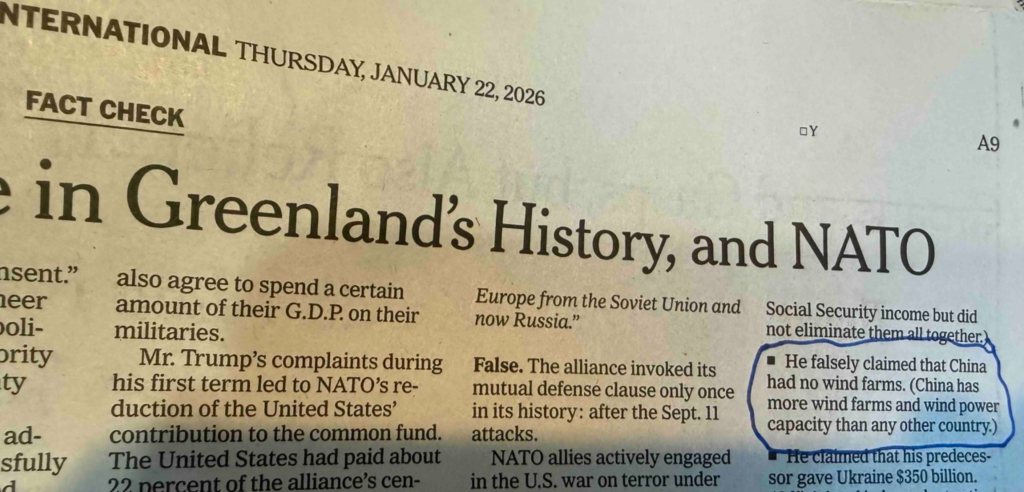
In a speech that has sparked controversy, former President Donald Trump made bold claims about Chinese renewable energy practices and U.S. food prices at the World Economic Forum in Davos, triggering a fact-checking response from The New York Times that itself contains inaccuracies.
During his Davos address, Trump asserted that China manufactures wind turbines but barely uses them domestically. “China makes almost all of the windmills, and yet, I haven’t been able to find any wind farms in China,” he said, before acknowledging in the same speech that China has “put up a couple of big wind farms” primarily for show while relying heavily on coal.
The New York Times fact-checker Linda Qiu claimed Trump “falsely claimed that China had no wind farms,” despite Trump’s explicit mention of Chinese wind farms in his speech. This mischaracterization fails to address Trump’s central argument that China’s energy production remains overwhelmingly dependent on fossil fuels while profiting from selling renewable technology to other nations.
Data from the International Energy Agency supports Trump’s core assertion, showing that coal and coal products account for 71 percent of China’s energy production, while solar, wind, and other renewables combined represent just 5.4 percent. This stark disparity validates Trump’s broader point about China’s continued reliance on traditional energy sources despite its position in the renewable manufacturing market.
The Times’ citation of Chinese wind capacity, rather than actual energy production and usage, mirrors talking points from Chinese foreign ministry spokesman Guo Jiakun. The newspaper referenced the World Wind Energy Association as a source, without noting the organization’s significant Chinese leadership connections, including its former director He Dexin and current vice president Qin Haiyan, who also serves as secretary general of the Chinese Wind Energy Association.
Even China appears to be reconsidering its wind investment strategy. The Global Wind Energy Council’s latest report acknowledges that Chinese developers are becoming “more cautious about future investments due to growing uncertainty about rates of return.” Additionally, China’s National Energy Administration has issued notices regarding the decommissioning of wind farms that have reached the end of their designed service life.
On the domestic front, Trump’s comments about grocery prices were similarly contested by The Times, which claimed prices are “still increasing” despite Trump’s assertion that they are “coming down.” However, recent data from the Commerce Department’s Bureau of Economic Analysis shows food inflation at 0.0 percent in both October and November 2025, with year-over-year PCE inflation for food declining to 1.9 percent in November from 2.4 percent in September.
Private data provider Truflation reports even more significant declines in food and overall inflation for January 2026, lending credence to Trump’s statements on price trends.
Trump’s economic optimism extends to predictions of substantial GDP growth and stock market performance. Since a July 2024 New York Times opinion piece warned of “enormous risks” from a second Trump term, the S&P 500 has gained over 23 percent, casting doubt on those dire forecasts.
The discrepancies between Trump’s statements and The Times’ fact-checking raise questions about media objectivity in political reporting. While Trump’s characteristically hyperbolic style may invite scrutiny, The Times’ apparent eagerness to label his claims false, even when partially accurate, suggests potential bias in its coverage of the former president.
As economic indicators continue to evolve and global energy dynamics shift, the accuracy of both Trump’s claims and media fact-checking will remain subject to ongoing evaluation by the American public.
Fact Checker
Verify the accuracy of this article using The Disinformation Commission analysis and real-time sources.

10 Comments
This is a good example of how fact-checking can sometimes oversimplify nuanced political statements. While Trump’s remarks may have been imprecise, the NYT’s rebuttal also seems to have overlooked important context. I’m curious to see if this leads to a more thorough examination of the underlying energy data.
Absolutely, fact-checkers must be willing to re-evaluate their work and acknowledge limitations, especially when dealing with such complex and contentious policy issues. Transparency and intellectual honesty are key.
This highlights the challenges of accurately fact-checking complex policy claims, especially around international energy production. The key seems to be looking at the full context and data, not just isolated statements. Curious to see how this plays out.
Yes, nuance and full context are crucial. It will be interesting to see if the NYT revisits this fact-check and provides more comprehensive analysis of Trump’s remarks and the underlying energy data.
It’s concerning to see potential inaccuracies in a high-profile fact-check, especially one from a reputable source like the NYT. This underscores the importance of rigorous, impartial analysis when evaluating claims about energy and climate policy. I hope this leads to a more thorough examination of the facts on both sides.
Well said. Fact-checking should never be a rubber stamp – it requires a continuous process of scrutiny and re-evaluation, especially for complex topics like energy and the environment. I’m glad to see this issue is getting attention.
The mining and energy sectors are rife with political rhetoric, so it’s important to carefully scrutinize claims from all sides. This case shows how even reputable fact-checkers can miss important details. I hope further investigation sheds more light on the China wind energy issue.
Agreed, fact-checking in these complex policy domains requires rigor and impartiality. It will be telling to see if the NYT acknowledges any shortcomings in their initial assessment.
This is an interesting case of fact-checking the fact-checker. It seems the NYT article may have missed some nuance in Trump’s speech about China’s renewable energy policies. I’d like to see the full context and data to better understand the accuracy claims on both sides.
Agreed, it’s important to examine the details closely when high-profile figures make claims about energy and climate policy. Fact-checking requires rigor and objectivity on all sides.