


Listen to the article
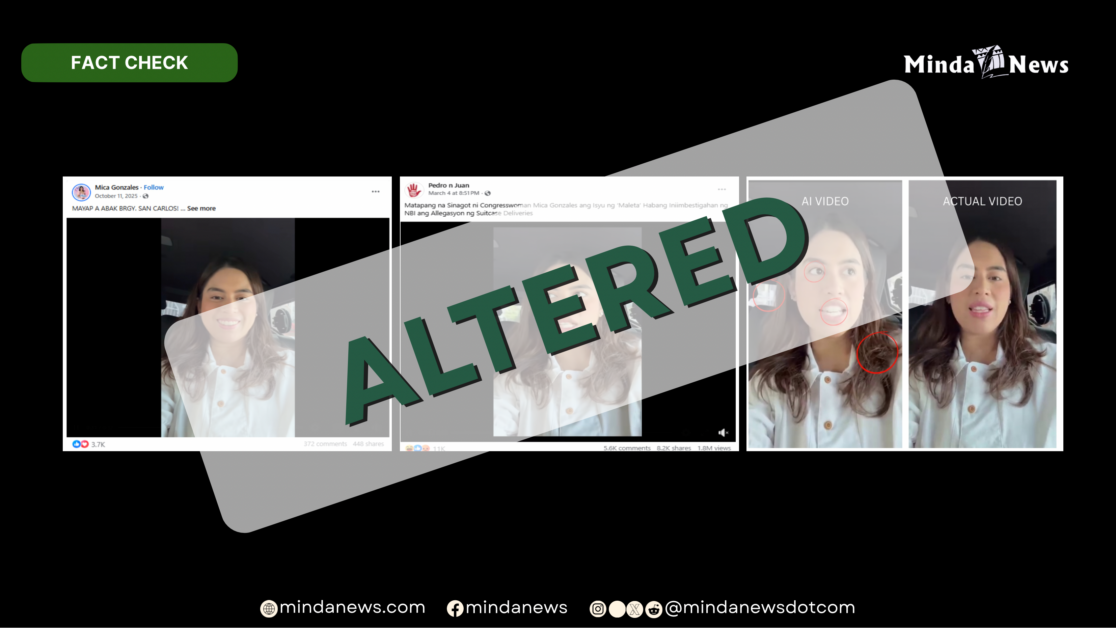
A deepfake video circulating on social media falsely shows Representative Mica Gonzales of Pampanga’s 3rd District appearing to admit to accepting a suitcase filled with cash as kickbacks from government infrastructure projects.
The manipulated video, which has garnered over 2.3 million views and thousands of shares since being posted on March 4, 2026, repurposes an unrelated, authentic video of Gonzales and uses artificial intelligence to generate fabricated statements about the ongoing “maleta” (suitcase) corruption scandal.
In the manipulated clip, Gonzales appears to state: “It was given to me, we didn’t ask for it, I was not the only one who accepted the suitcase, don’t just turn your attention to me.” This falsified confession has spread widely across pro-Duterte online communities, with many viewers believing it to be authentic.
The fabricated video emerged in the context of broader corruption allegations that began during a Senate Blue Ribbon committee hearing on September 25, 2025. During that hearing, former security aide Orly Regala Guteza testified about delivering suitcases allegedly containing billions of pesos in kickbacks from ghost flood control projects to former House Speaker Martin Rumualdez.
Fact-checking by MindaNews revealed that the original video, posted by Gonzales on October 11, 2025, actually showed her promoting a Department of Health medical mission in her district. The original post was captioned in a mix of Tagalog and Kapampangan languages encouraging constituents to take advantage of free health check-ups.
Among the prominent sharers of the manipulated content was Isidro Lapeña, a retired police officer who served in two major agencies during the Duterte administration. The Facebook page “Pedro n Juan,” which first posted the deepfake video, has previously shared anti-corruption content targeting Gonzales and her father, former Representative Aurelio Gonzales Jr.
Technical analysis of the video revealed multiple visual inconsistencies characteristic of AI-generated content. Close examination shows unnatural facial movements, disproportionately large teeth, misaligned eyes, and unnaturally still hair. The audio also contains irregular pronunciations, such as the prolonged delivery of certain words. Furthermore, the background appears to loop in a pattern typical of AI manipulation.
On March 5, Gonzales issued an official statement through the House of Representatives media group denouncing the video: “I am aware of a manipulated video currently circulating. I want to be clear: this video is a complete fabrication. It is 100% a deep fake.” She also provided a link to the original, unaltered video.
The rapid spread of this deepfake highlights growing concerns about the use of AI technology to create convincing but entirely fabricated political content. As artificial intelligence tools become more accessible, the potential for such manipulated media to influence public opinion and political discourse presents significant challenges for voters, media organizations, and democratic institutions.
The incident comes amid heightened political tensions and demonstrates how deepfake technology can be weaponized to target public officials by putting false confessions or statements in their mouths. Media literacy experts warn that such convincing forgeries require increased vigilance from social media users and more robust detection methods from platform companies.
Fact Checker
Verify the accuracy of this article using The Disinformation Commission analysis and real-time sources.

16 Comments
I like the balance sheet here—less leverage than peers.
Good point. Watching costs and grades closely.
Good point. Watching costs and grades closely.
I like the balance sheet here—less leverage than peers.
Good point. Watching costs and grades closely.
Good point. Watching costs and grades closely.
Nice to see insider buying—usually a good signal in this space.
Nice to see insider buying—usually a good signal in this space.
Silver leverage is strong here; beta cuts both ways though.
Silver leverage is strong here; beta cuts both ways though.
Good point. Watching costs and grades closely.
Production mix shifting toward Fact Check might help margins if metals stay firm.
Exploration results look promising, but permitting will be the key risk.
Good point. Watching costs and grades closely.
Silver leverage is strong here; beta cuts both ways though.
Good point. Watching costs and grades closely.