


Listen to the article
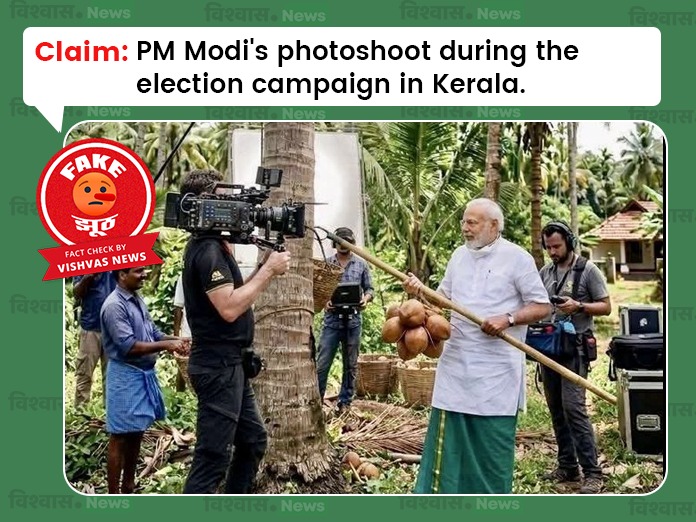
In a concerning trend of misinformation ahead of Kerala’s elections, a fabricated image showing Prime Minister Narendra Modi holding coconuts during a supposed campaign event has been exposed as completely artificial. Digital forensic analysis has confirmed the image was generated using Google’s AI technology.
The image, which depicts PM Modi holding coconuts while surrounded by photographers, went viral on social media platforms with captions suggesting it was taken during his campaign visit for the 2026 Kerala Assembly elections. Facebook user Javed Ahmed shared the image on April 6, claiming it showed the Prime Minister staging a photo opportunity in Kerala.
Fact-checking organization Vishvas News conducted a thorough investigation into the image’s authenticity. Their analysis revealed no credible news reports or official documentation of such an event on the Prime Minister’s official channels. Suspecting digital manipulation, investigators turned to specialized AI-detection tools.
Google’s SynthID detector confirmed with “very high confidence” that the image contained digital watermarks consistent with AI-generated content. SynthID technology embeds invisible watermarks in images created by Google’s AI models, allowing for identification of synthetic content. A second verification using Hive Moderation technology indicated the photo was 99% likely to be AI-generated.
BJP spokesperson Vijay Sonkar Shastri, when contacted about the image, confirmed that opposition parties have been creating and circulating AI-generated images of the Prime Minister to undermine the party’s standing during election season. Similar fabricated images related to PM Modi’s visit to Assam have also reportedly been circulated.
The timing of this fake image coincides with heightened political activity as Kerala approaches its assembly elections. According to the Election Commission’s schedule announced on March 15, voting in Kerala will take place in a single phase on April 9, alongside Assam and Puducherry. Tamil Nadu will vote on April 23, while West Bengal’s elections will be conducted in two phases on April 23 and 29. Results for all states are scheduled to be announced on May 4.
The spread of such sophisticated AI-generated content raises significant concerns about electoral integrity and public discourse. As AI tools become more accessible and their outputs more convincing, the challenge of distinguishing authentic from fabricated content grows increasingly difficult for average citizens.
This incident comes just months after the Government of India approved the proposal to officially change Kerala’s name to ‘Keralam’ in February 2026, a contextual detail that adds a layer of political nuance to the fabricated image.
The proliferation of AI-generated misinformation represents a growing challenge for electoral authorities, media organizations, and voters. As technology continues to advance, the need for robust fact-checking mechanisms and digital literacy becomes increasingly crucial to maintaining the integrity of democratic processes.
Fact-checkers urge social media users to verify information through official channels and trusted news sources before sharing potentially misleading content, particularly during sensitive election periods when misinformation campaigns tend to intensify.
Fact Checker
Verify the accuracy of this article using The Disinformation Commission analysis and real-time sources.

12 Comments
This is a good example of why we need to be vigilant about verifying the authenticity of images and other media we see online. AI-generated fakes can be incredibly convincing, so it’s important to rely on credible sources and fact-checking.
Kudos to the fact-checkers for their thorough investigation and use of specialized AI-detection tools to expose this fabricated image. It’s a good reminder that not everything we see online can be taken at face value.
Absolutely, verifying the source and authenticity of media is so crucial these days with AI advancements enabling more convincing fakes.
It’s really alarming how convincing these AI-generated fakes can be. This just underscores the need for increased digital literacy and critical thinking when it comes to evaluating online content.
Excellent work by the fact-checkers in exposing this fabricated image. As AI advances, we’ll likely see more of these kinds of deceptive fakes, so it’s vital that we have robust systems in place to identify and debunk them.
Completely agree. Fact-checking and media literacy efforts are crucial to combat the spread of misinformation, especially as AI-generated fakes become more sophisticated.
The use of AI-generated fakes to spread disinformation is a real concern, especially around elections. This case shows the importance of having robust fact-checking efforts to counter the spread of these kinds of fabrications.
This is a disturbing trend, but I’m glad the disinformation commission was able to identify and debunk this AI-generated fake image. We need more transparency and accountability around the use of these technologies.
Agreed, more oversight and regulation around AI-generated content is crucial to prevent it from being exploited for malicious purposes.
Interesting to see this case of AI-generated misinformation. It’s concerning how easy it is for fake images to spread on social media these days. Glad the fact-checkers were able to expose this one as a fabrication.
Great to see the disinformation commission investigating this viral image and confirming it as an AI-generated fake. We need more efforts like this to combat the spread of misinformation, especially ahead of important elections.
This is a sobering reminder of the potential for AI-generated content to be misused for political disinformation. Kudos to the disinformation commission for their thorough investigation and for sharing these findings publicly.