


Listen to the article
Viral Claims About Swedish Crime Rates Lack Context and Accuracy
Recent social media posts claiming dramatic increases in crime across Sweden contain misleading statistics and lack important context, according to fact-checkers and Swedish officials.
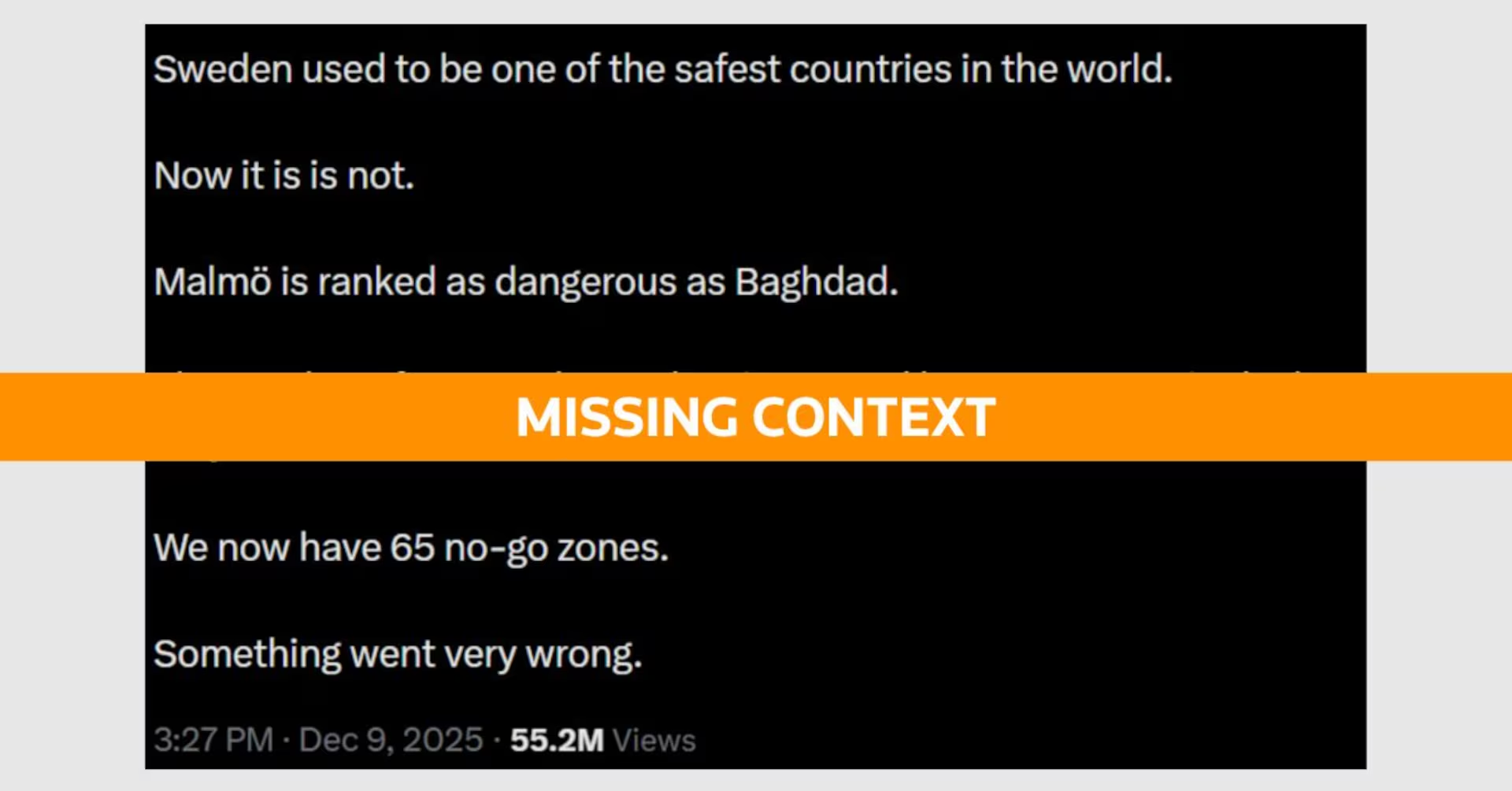
A widely circulated post on X, which garnered over 55 million views, asserted that “Sweden used to be one of the safest countries in the world” but is no longer, claiming that “Malmö is ranked as dangerous as Baghdad” and that “reported rapes have increased by over 2300% in the last 50 years.” The post also stated that Sweden now has “65 no-go zones.”
Swedish officials acknowledge the country faces serious challenges with violent crime, particularly related to criminal gang activity. According to the Swedish National Council for Crime Prevention (BRA), gun homicides have more than doubled over the past decade, with 53 firearm-related murders recorded in 2023. A 2021 BRA report indicated Sweden’s gun murder rate of 4 deaths per million inhabitants was more than twice the European average.
However, the viral posts contain several inaccuracies and exaggerations when compared with official data.
The reference to “65 no-go zones” appears to mischaracterize a police report that identified 65 areas as “vulnerable to criminal influence.” Of these, 19 are classified as “particularly vulnerable,” where police find it “difficult or almost impossible to complete their mission at the scene.” In the remaining 46 areas, criminal influence is expressed through social context rather than deliberate attempts to control the area.
A spokesperson for Swedish police explicitly rejected the “no-go zone” label, stating: “The police can act and work everywhere in Sweden. Of course there are individuals, as there are in every country, that don’t like the police being in their neighborhoods and can act with hostility towards our officers, but this has no effect on our ability to work in certain areas.”
The comparison between Malmö and Baghdad appears to originate from numbeo.com, a website that compiles user perceptions rather than official crime statistics. The site ranked Malmö with a safety score of 56 out of 100, similar to Baghdad’s 55.7. However, numbeo.com’s own disclaimer acknowledges that its information “has not necessarily been reviewed by people with the expertise required to provide you with complete, accurate or reliable information.”
A spokesperson for the City of Malmö authorities dismissed the numbeo.com information as inaccurate. More credible assessments, such as the Global Organized Crime Index 2023, rank Iraq as the 12th worst country for crime globally, while Sweden ranks 118th out of 193 countries.
Regarding rape statistics, while Sweden has experienced a significant increase in reported rapes over five decades, the figure is closer to 1,194% (from 769 cases in 1975 to 9,957 in 2024) rather than the claimed 2,300%.
Crime experts caution against simple interpretations of these statistics without considering important context. Sweden has progressively broadened its legal definition of rape over the decades. Rape within marriage became illegal in 1965, legislation became gender-neutral in 1984, and in 2018, Sweden removed requirements to prove force or threats, which led to sharp increases in both convictions and reports.
The Swedish National Council on Crime Prevention emphasizes that increased reporting doesn’t necessarily indicate higher crime rates. Countries with stronger protections for women and broader definitions of sexual assault often show higher reporting rates.
While Sweden continues to address serious issues with gang violence and organized crime, the viral social media claims significantly distort the reality of crime in the country through exaggeration and removal of essential context.
Fact Checker
Verify the accuracy of this article using The Disinformation Commission analysis and real-time sources.

14 Comments
The article does a good job of highlighting the nuances and complexities involved in understanding crime trends in Sweden. Simplistic narratives often fail to capture the full picture.
While Sweden faces real challenges, the viral posts seem designed to provoke fear and outrage rather than promote constructive dialogue. Fact-checking is an important antidote to the spread of misinformation.
This fact check provides important context around the misleading claims about crime rates in Sweden. While the country does face challenges with violent crime, the viral posts significantly exaggerate the scale of the problem.
It’s good to see the official data and statistics being presented to counter the sensationalized narratives. Fact-checking is crucial to prevent the spread of misinformation.
While Sweden faces real challenges, the viral posts seem more interested in generating outrage than offering constructive solutions. Fact-based analysis is essential to address complex social issues.
Agreed. Responsible journalism should strive for objectivity and balance, even on sensitive topics. Sensationalism and misinformation only serve to inflame tensions rather than inform the public.
The article rightly points out that the viral posts lack nuance and accuracy when discussing crime in Sweden. Interpreting complex social issues requires careful analysis of the facts, not inflammatory rhetoric.
Agreed. Simplistic claims and exaggerated statistics often do more to mislead than inform. Responsible journalism should strive for a balanced, evidence-based perspective.
While Sweden faces real challenges, the viral posts seem more interested in fueling outrage than promoting constructive dialogue. Fact-checking is essential to cut through the noise and get to the heart of the matter.
It’s concerning to see how quickly unsubstantiated claims can go viral online, even on serious issues like crime. Careful analysis of official data is crucial to separate fact from fiction.
Absolutely. Fact-checking is a vital service to the public, cutting through the noise and ensuring important debates are grounded in truth rather than rumor and speculation.
This fact check is a timely reminder of the importance of critical thinking and fact-checking, especially when it comes to claims about sensitive social issues. Inflammatory rhetoric often overshadows the nuances.
Absolutely. In an age of widespread misinformation, it’s crucial that we approach such claims with a healthy dose of skepticism and seek out authoritative, evidence-based sources.
The article provides a useful counterpoint to the misleading viral posts, highlighting the need to rely on official data and expert analysis rather than unsubstantiated online claims.