


Listen to the article
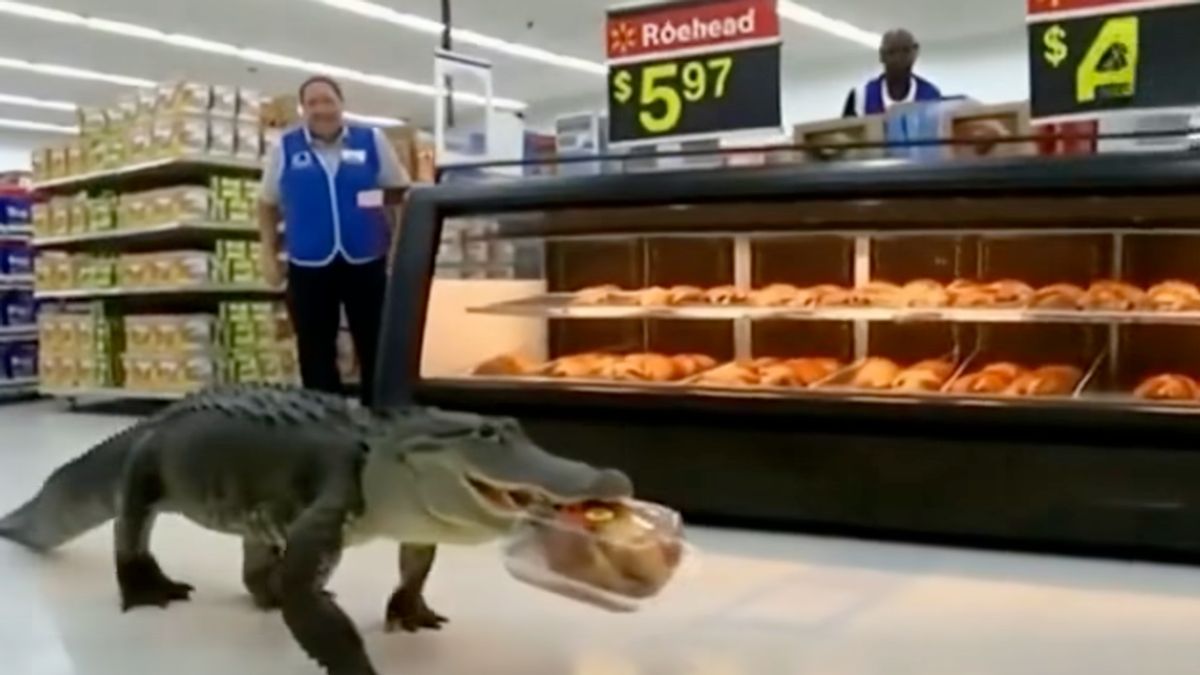
In January 2026, social media buzzed with what appeared to be bizarre footage of alligators stealing rotisserie chickens from Walmart stores across Florida. The videos, which resembled local news reports, showed reptiles casually wandering into stores, snatching hot chickens, and making off with their savory prizes.
“Only in Florida tonight—an alligator casually walked into a Walmart, grabbed a rotisserie chicken, and ate it right in the store,” claimed one widely-shared caption accompanying the footage on a Facebook page called “Extreme Living.”
The clips quickly spread across multiple platforms including Instagram and Bluesky, prompting bewildered viewers to question whether Florida had reached new heights of peculiarity. After all, the state is notorious for unusual wildlife encounters and eccentric news headlines.
However, a closer examination revealed all three videos to be elaborate fakes created using artificial intelligence technology. The videos claimed to document alligator incidents at Walmart locations in Ocala, St. Petersburg, and Wesley Chapel, Florida—yet searches through legitimate news sources yielded no corroborating reports of such events.
The “Extreme Living” Facebook page responsible for sharing the content openly acknowledges its artificial nature. Its “About” section clearly states: “Hey yall! Welcome to Extreme Living where we ai content that everyone can enjoy.” The page’s header image even proclaims itself “America’s Favorite AI videos.”
Telltale signs of artificial generation are evident throughout the footage. One video displays OpenAI’s Sora watermark—a digital signature the company embeds in content created using its text-to-video AI model. This watermark appears at two distinct points in the clip, confirming its artificial origin.
Other videos in the series contain visual anomalies common in AI-generated content. In one clip, a supposed television reporter holds a microphone labeled “7 Lews” instead of a recognizable news station. Another features a microphone with illegible characters followed by “cast.” The reporter’s fingers appear distorted—a classic limitation of current AI image generation technology.
The store environments also contain revealing errors. What’s meant to be a price reduction sign in the alleged Walmart reads “Róehead” instead of “Reduced,” and price displays show the letter “A” rather than actual numbers. Such garbled text and nonsensical characters are characteristic fingerprints of artificial intelligence struggling to reproduce realistic text in generated images.
These Florida alligator tales join a growing category of AI-generated content circulating on social media platforms. As text-to-video AI models like Sora become more accessible, distinguishing between authentic footage and sophisticated fakes grows increasingly challenging for average users.
Despite Florida’s reputation for unusual wildlife encounters—including genuine instances of alligators wandering into residential areas and businesses—these particular chicken-thieving reptile stories belong firmly in the realm of digital fiction.
The spread of these fabricated videos highlights ongoing concerns about AI-generated misinformation and the importance of digital literacy. As AI tools become more sophisticated, identifying their artifacts requires closer scrutiny and awareness of common signs like distorted body parts, garbled text, and inconsistent details.
While Florida will undoubtedly continue providing legitimately unusual news stories, viewers should approach viral content with healthy skepticism—particularly when alligators demonstrate suspiciously specific culinary preferences for rotisserie chicken.
Fact Checker
Verify the accuracy of this article using The Disinformation Commission analysis and real-time sources.

17 Comments
Nice to see insider buying—usually a good signal in this space.
Production mix shifting toward Fact Check might help margins if metals stay firm.
Good point. Watching costs and grades closely.
Good point. Watching costs and grades closely.
Exploration results look promising, but permitting will be the key risk.
Uranium names keep pushing higher—supply still tight into 2026.
Good point. Watching costs and grades closely.
Good point. Watching costs and grades closely.
Uranium names keep pushing higher—supply still tight into 2026.
Production mix shifting toward Fact Check might help margins if metals stay firm.
The cost guidance is better than expected. If they deliver, the stock could rerate.
Good point. Watching costs and grades closely.
Good point. Watching costs and grades closely.
I like the balance sheet here—less leverage than peers.
The cost guidance is better than expected. If they deliver, the stock could rerate.
Good point. Watching costs and grades closely.
Good point. Watching costs and grades closely.